Watch It First
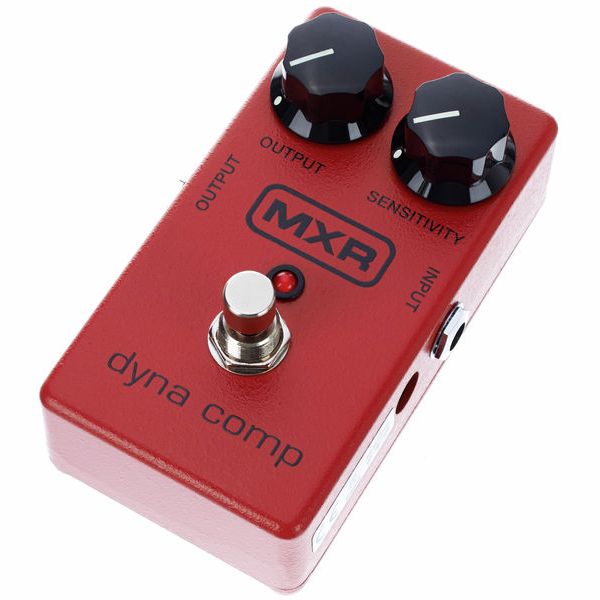
The MXR Dyna Comp is one of those pedals that gets recommended constantly and explained badly. Two knobs. That is the entire user interface, and people still argue about it forty-odd years later.
I have had one on and off my board since I was a teenager who thought compression was something that happened to audio files. It has never once made my guitar sound transparent, and that is precisely why I keep dragging it back out of the drawer.
So if you came here looking for a polite, invisible, studio-grade compressor that tidies your dynamics and vanishes, I can save you the trouble right now. This is not that pedal. This is the squashy one.
The Old-School Squash, Explained
The Dyna Comp first showed up in 1976 and the recipe barely changed. An OTA-based circuit, a fast and fairly aggressive attack, and a character so specific that entire genres were built on top of it.
Thomann lists the current one as the Dyna Comp 1976 and it has been in their catalogue since November 1999, which tells you something about staying power. Article number 129745, if you want to look it up yourself.
The important thing to understand is that this pedal has an opinion. It grabs your pick attack, flattens the front of the note, and then pushes the tail up until the sustain hangs there far longer than your guitar actually wants it to.
Two Knobs, No Menu Diving
Output and Sensitivity. No attack, no release, no ratio, no blend, no mix. You get a squash amount and a volume, and you sort the rest out with your hands.
Compare that to the Keeley Compressor Plus, which gives you blend, attack and a full tone-shaping suite. Or the Boss CS-3, which at least hands you attack and tone controls.
The Dyna Comp gives you neither, and somehow that is the point. You cannot dial in a bad sound because there are barely any sounds to dial in. IMO that is a feature when you are standing on a dark stage.
How It Actually Sounds
Switch it on with the Sensitivity around halfway and the first thing you notice is that everything got a bit louder, a bit thicker and a bit more even. Single notes suddenly have the same weight as chords.
Crank the Sensitivity and you get the famous effect: a soft, rounded front end followed by a long, slightly squeezed bloom. Chicken pickin. Nashville twang. That percussive pop before the note settles.
- A noticeable midrange push that helps single-coils cut through a band
- Attack softening that turns a hard pick stroke into a rounded thump
- Sustain that hangs on long past where the guitar would normally give up
- A slight treble roll-off, so bright amps stop sounding brittle
It is not subtle and it is not clean in the hi-fi sense. It is a colour. If you already love the sound of records made between 1978 and 1992, you already love this pedal, you just did not know what was causing it.
Where It Earns Its Space
Clean Funk And Country
This is the obvious one. Bridge pickup, spanky amp, Sensitivity past noon, and every note lands with the same authority. Your right hand suddenly sounds tighter than it actually is.
It plays beautifully with modulation too. Stack it into an MXR Phase 90 and you have basically bottled a whole decade of session guitar.
In Front Of Dirt
Feeding a compressed, level signal into an overdrive is one of the oldest tricks going. Put the Dyna Comp before an Ibanez TS9 and the drive stops fluctuating with your picking and just sits there, thick and stable.
Some people prefer it after the drive as a sustain booster. Both work. Neither is wrong. Try both and stop reading forum arguments about it.
Solo Sustain
Kicking it on for a lead is arguably the least glamorous use and the one I do most often. It is close to what a clean boost does, except the notes also stop dying halfway through the bend.
The Honest Niggles
It hisses. Not catastrophically, but push the Sensitivity up and the noise floor comes up with it, because that is what compressors do to the gap between notes. On a high-gain board you will want a noise suppressor after it.
There is no blend control, so you cannot dial back the effect while keeping the peaks tamed. If parallel compression is your thing, look elsewhere. The Fender The Bends exists for exactly this reason.
It also colours your tone whether you asked it to or not. Bypass it and back on again and you will hear the midrange change. Some players hate that. I file it under character, but I understand the complaint.
And the power supply is not included, which in 2026 still feels like a small joke. You can run a 9V battery, or add it to whatever brick is already living under your board.
Specs At A Glance
- Analogue optical-style compressor, always-on true character
- Controls: Output and Sensitivity
- Standard 6.3 mm jack input and output
- Powered by a 9V battery or a 9V DC adapter (adapter not included)
- Full-size MXR die-cast enclosure, built like a brick
- Thomann article number 129745, in the catalogue since November 1999
Who Should Actually Buy One?
If you play clean or lightly driven music and you want your notes to sound bigger and more consistent without thinking about it, this is a very easy yes.
If you are a modern player who wants surgical, invisible dynamics control, buy something with a blend knob and move on. You will only end up annoyed at this one.
And if you are building a first proper pedalboard, the Dyna Comp sits nicely next to a decent tuner and a Carbon Copy as one of those pedals you buy once and stop thinking about.
Final Verdict
The Dyna Comp is not the best compressor you can buy. It is not even trying to be. It is the old-school squashy one, and nothing else does that exact thing as convincingly for the money.
Forty years of records cannot all be wrong. Two knobs, one sound, and that sound happens to be one of the most recognisable in electric guitar. Punches well above its money and refuses to age.
Would I recommend it as your only compressor? For a lot of players, honestly, yes. Just keep a noise gate handy and stop staring at the Sensitivity knob 😉