Watch It First
Nobody buys a noise gate for fun. You buy it because your high-gain rig hisses like a angry cat the second you stop playing.
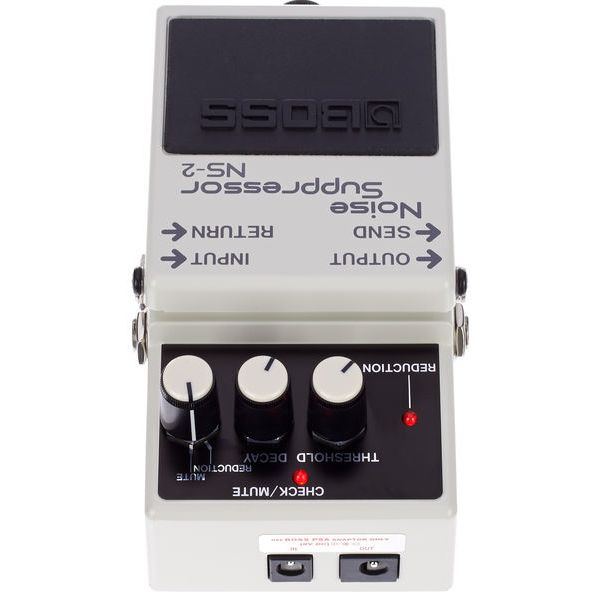
The Boss NS-2 has been the industry-standard answer to that problem since 1999, and it’s still on pedalboards everywhere for good reason.
It’s not exciting. It’s just really, really good at its one job.
Build Quality
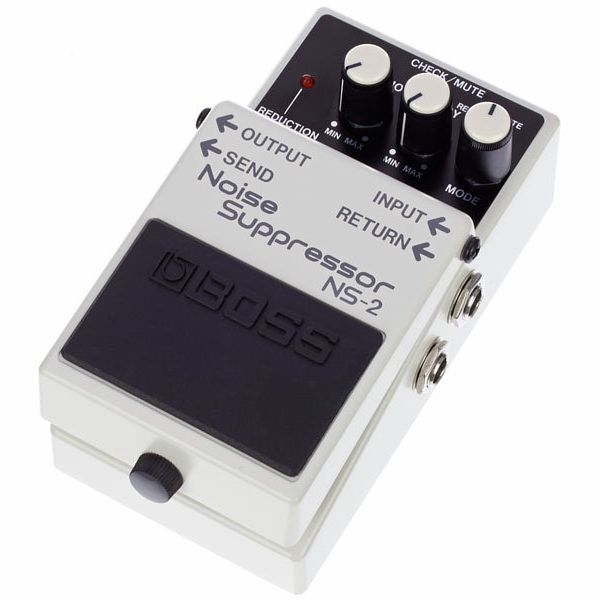
This is a standard Boss compact pedal enclosure, meaning it’s basically indestructible – the same chassis Boss has used for decades of stompboxes that survive touring abuse.
At 400 g it’s light, and the footswitch action is the usual Boss quality: firm, reliable, no wobble after years of use.
It runs on a 9V battery or standard adapter, drawing a modest 20 mA, so battery life is genuinely solid if you go that route.
Nothing fancy here, and that’s exactly the point – it’s a tool, not a showpiece.
How It Actually Works
Unlike a simple noise gate that just cuts everything below a volume threshold, the NS-2 uses a detection circuit that tracks your guitar’s signal specifically, so it can suppress hiss and hum without chopping off your note decay unnaturally.
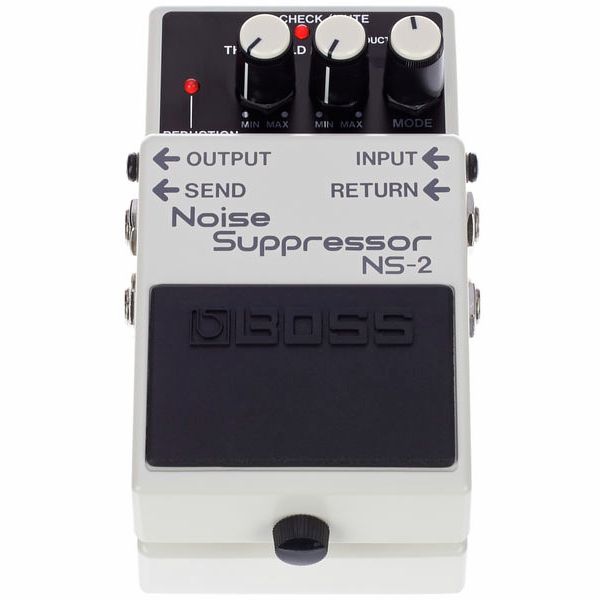
Two controls do the heavy lifting: Threshold sets how much noise gets let through before suppression kicks in, and Decay sets how gradually the suppression fades in.
There’s also a Mode switch for Reduction (a gentler noise reduction) versus Mute (a harder cutoff), depending on how aggressive you need to be.
Crucially, it has two sets of jacks – a standard in/out pair, plus a Send/Return loop – so you can place it either straight in your signal chain or, better, in your amp’s effects loop.
Where to Actually Put It
This is the detail most players get wrong, and it’s the whole reason some reviews complain the NS-2 „kills tone.”
Put in front of your amp, before a high-gain drive pedal like the Op-Amp Big Muff, it can genuinely dull dynamics and choke your sustain because it’s gating before the gain stage even happens.
Used correctly in the amp’s effects loop, after the preamp gain stage, it suppresses only the hiss that’s already been amplified, leaving your actual tone and dynamics untouched.
If your amp doesn’t have an effects loop, the Send/Return jacks let you build a mini-loop around just your dirt pedals instead, which solves the same problem.
Playability and Usability
Once it’s dialed in correctly, you genuinely forget it’s there – which is exactly what a good noise gate should do.
Setting Threshold too aggressively can cut off legato notes or quiet passages, so it takes a few minutes of tweaking per guitar and per amp setting to get it transparent.
It’s not a „set once and never touch again” pedal if you switch between clean and high-gain tones a lot – you may want slightly different settings for each.
For anyone running a complex board with delay and modulation, like a setup built around the Boss MD-200 or the Boss PS-6 Harmonist, this belongs after those effects in the loop too, so trailing delay and reverb tails don’t get abruptly cut off.
Who Is This Pedal For
Anyone running high-gain amps or heavily overdriven pedals who’s tired of hearing 60-cycle hum and fizz between phrases.
It’s also genuinely useful for home recording, where mic’d amps and hot pickups make noise far more noticeable than it is live.
If your rig is already quiet – low gain, single coils, no noisy pedals – you probably don’t need this at all, and that’s fine.
Honest Niggles
- Placement matters a lot – wrong position in the chain and it genuinely does hurt your tone
- Aggressive Threshold settings can clip quiet passages or pick harmonics
- It’s a 1999-era analog design, so don’t expect the polish of newer digital gates like the tc electronic Sentry
None of these are dealbreakers once you understand the pedal, but the learning curve on placement trips up a lot of first-time buyers.
How It Compares to Alternatives
Newer options like the tc electronic Sentry use a different detection algorithm and are arguably more „invisible,” but the NS-2 has decades of proven reliability and is genuinely cheaper.
If you’re running an all-in-one modeler like the Boss GT-1000CORE, you likely already have a built-in noise suppression algorithm and don’t need a separate pedal at all.
For a traditional pedalboard with a real amp, though, the NS-2’s Send/Return loop trick is still one of the most useful, low-cost fixes for noisy high-gain setups.
Placed after a time-based effect like the Boss DD-200, it’s worth setting Decay generously so delay trails don’t get chopped short.
A Quick Setup Tip
Start with Threshold and Decay both at zero, play normally, and slowly raise Threshold until the hiss disappears during silence but your quietest intended notes still ring through.
Then add a touch of Decay so the cutoff isn’t abrupt – a hard mute sounds unnatural, especially on sustained chords.
Do this test with your amp at gig volume, not bedroom volume, since noise floor changes a lot with output level.
Live Versus Studio Use
On stage, a hissy amp is often masked by the mix and room noise, so some gigging players run the NS-2 fairly conservatively, just enough to kill obvious hum between songs.
In the studio, though, close-mic’d amps expose every bit of noise, so a properly dialed-in NS-2 in the loop can save a lot of cleanup work in post.
Either way, always A/B it in and out of the chain before committing to a setting – your ears adjust to noise faster than you’d think, and it’s easy to over-gate without realizing it.
Key Specs
- Type: Noise suppressor / noise gate pedal
- Controls: Threshold, Decay, Mode (Reduction/Mute)
- I/O: Standard in/out plus Send/Return loop jacks
- Power: 9V battery or 9V DC adapter (adapter not included)
- Current draw: 20 mA
- Dimensions: 73 x 129 x 59 mm
- Weight: 400 g
Final Verdict
The Boss NS-2 isn’t glamorous, but it solves a real problem better than almost anything else at this price, provided you place it correctly.
Get the effects-loop placement right and it becomes invisible – exactly what you want from a noise gate.
For high-gain players, home recorders, or anyone running a noisy pedal chain, this is one of the cheapest, most effective upgrades you can make to your rig.
Recommended without hesitation, as long as you actually read the manual on where to put it.