Watch It First
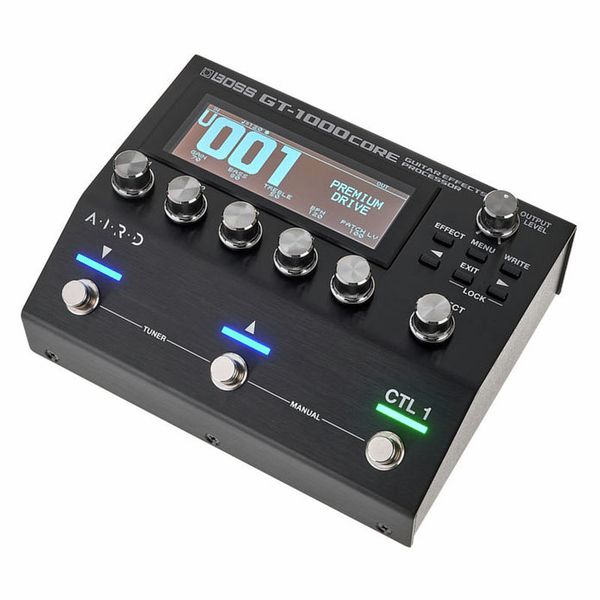
Boss has spent decades building pedals that just work, no drama, no fuss. The GT-1000CORE takes that reputation and squeezes it into a box roughly the size of a paperback novel — and somehow doesn’t lose a single ounce of the flagship GT-1000’s processing muscle.
If you’ve been eyeing a modeler but can’t stomach a full-size floorboard eating your entire pedal chain (or your entire budget), this is Boss basically saying „we heard you.” Same DSP, same AIRD amp modeling engine, same 140+ effect types — just without the built-in expression pedal and extra footswitches of the full-size unit.
I ran this through both a live rig and a quiet bedroom setup to see if the „core” cutdown actually costs you anything meaningful. Short version: barely, and what it does cost is stuff most players won’t miss.
What’s Actually Going On Under the Hood
The GT-1000CORE runs the exact same AIRD (Augmented Impulse Response Dynamics) modeling technology as its bigger sibling. That’s Boss’s current flagship amp-sim engine, and it’s genuinely a different tier from the amp sims Boss was shipping a decade ago on units like the GT-100.
You get 24 simultaneous effects blocks, which honestly is more routing flexibility than most players will ever use. Stack a drive into a modeled amp into a cab sim into a stereo delay into a reverb, and there’s still headroom to spare for a pitch block or a looper on top.
The Sound
Plug in and the first thing you notice is how three-dimensional the amp models feel. None of that flat, „plugin-through-a-DI” thinness that plagued a lot of early digital modelers back in the day.
Cleans shimmer nicely, crunch tones have real amp sag, and the high-gain models hold together under palm mutes instead of collapsing into fizz. It won’t fool a tube-amp purist in a blind test every single time, but for gigging, recording, or silent late-night practice, it’s more than convincing.
If you already lean on outboard EQ pedals to shape your live tone, it’s worth knowing the onboard EQ block does a lot of what something like the MXR Six Band EQ handles — except you can stack several of them wherever you want in the signal chain, pre or post modeling.
Feature Rundown
Connectivity is where the GT-1000CORE quietly flexes. You get two full send/return loops for running real analog pedals alongside the modeling, stereo ins and outs, MIDI in/out, and a USB port that doubles as an audio interface for recording direct into your DAW.
There’s a built-in tuner too, which sounds like a throwaway feature right up until you’re on a dark stage between songs and genuinely grateful for it.
One thing to flag: no battery operation here. It ships with (and needs) its power supply. Not a dealbreaker for a pedalboard mainstay, but worth knowing if you’d pictured this as a fully portable busking rig.
Who This Is For
Gigging players who want amp-in-a-box reliability without hauling a tube head are the obvious audience here. So are home recordists chasing reamp-quality tones without mic’ing a cab at 1am and annoying the neighbours.
If your board is already stacked with drive and modulation pedals — something like a MXR Analog Chorus handling your modulation duties, say — the GT-1000CORE can either replace the whole board or sit at the end purely for amp, cab, and time-based duties.
It’s also worth putting head-to-head against budget multi-effects like the Valeton GP-200 or the NUX MG-30. Those units are excellent for the money, no argument, but the GT-1000CORE plays in a different league on modeling depth and build quality — you’re paying for genuine flagship DSP, not a budget approximation of one.
And yes, it works for bass too. Boss built dedicated bass amp models and cab sims into the same engine, so it’s not just a guitar-only box if your gig calls for both.
Playability & Usability
The three onboard footswitches (Down, Up, Ctl 1) cover the basics, but if you want a proper „stomp through patches live” rig, you’ll likely want to add an external footswitch. Boss sells compatible ones and they’re not expensive.
Editing patches on the small LCD is fine for quick tweaks on the fly. For deep editing though, I’d strongly recommend Boss Tone Studio on a laptop or tablet — menu-diving on a tiny screen gets old fast once you’re nesting three effects blocks deep at soundcheck.
Honest Niggles
The screen is small and monochrome. It does the job, but it’s not going to wow anyone in 2026 — Boss clearly prioritized DSP power and I/O over display real estate here, which is a fair trade but worth knowing going in.
There’s no built-in expression pedal, so wah and volume-swell fans need to budget for an external EXP pedal separately. And while it’s genuinely compact for a flagship-tier modeler, it’s still a real footprint — this isn’t some tiny thing you squeeze onto a crowded board next to a couple of drive pedals like the EHX Nano Metal Muff.
The learning curve is real, too. There’s a LOT of routing power packed in here, and it takes a few sessions before patch-building stops feeling like homework. Worth it, but don’t expect to master it in an afternoon.
Specs at a Glance
- Effects processor: 24 simultaneous blocks, 140+ amp/effect types
- Amp modeling: Boss AIRD technology (same engine as the full-size GT-1000)
- Display: 256 x 80 pixel LCD
- Footswitches: Down, Up, Ctl 1 (external footswitch support via CTL jacks)
- I/O: stereo in/out, 2x send & return loops, MIDI in/out, USB audio interface
- Built-in chromatic tuner
- Power: DC power supply included, no battery operation
- Dimensions: 173 x 135 x 65 mm
- Weight: 920 g
Final Verdict
The Boss GT-1000CORE is proof that „compact” doesn’t have to mean „compromised.” You’re getting genuinely flagship-tier amp modeling and effects processing in a box that’ll fit on boards where a full-size GT-1000 simply won’t.
Is it the cheapest way into quality modeling? No — that title still belongs to the budget units. But if you want the real AIRD engine, real DSP horsepower, and the flexibility to run it as your entire rig or bolt it onto pedals you already love (whether that’s a Fender Hammertone Breakup Driver for extra grit or a stereo modulation pedal you’re not ready to part with), this is one of the smartest „one box” purchases in Boss’s current lineup.
If I were rebuilding my board from scratch tomorrow, this would be near the top of the list. Recommended, IMO, without much hesitation.