Watch It First
Most pedalboards have a compressor, a drive or two, maybe a delay. Almost nobody has an EQ. That’s kind of a mistake.
The MXR Six Band EQ has been quietly doing its job since the late 70s, letting players reshape their tone on the fly instead of walking back to the amp mid-set.
I looked into whether it’s still worth a spot on your board in 2026, or if it’s been made redundant by modeling amps and multi-effects units.
In Use — Deceptively Simple
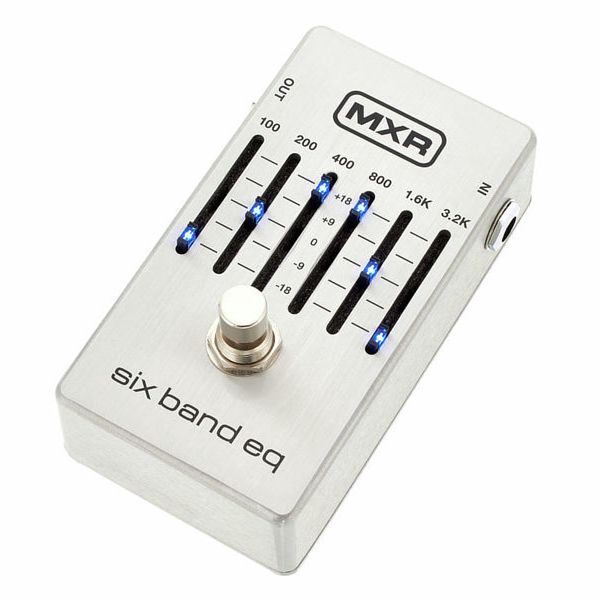
Six sliders, six frequencies: 100 Hz, 200 Hz, 400 Hz, 800 Hz, 1.6 kHz, and 3.2 kHz. Each one gives you ±18 dB of boost or cut. That’s it — no menus, no presets, no screen to squint at.
The sliders are lit from underneath, which sounds like a gimmick until you’re on a dark stage trying to see your settings. Then it’s genuinely handy.
The one real usability gripe: there’s no master output level control. Boost several bands at once and you’ll get a volume jump along with the tone shift, so you have to compensate by pulling other bands down rather than just gain-staging cleanly. It’s a known quirk, not a hidden flaw — MXR’s own 10-band model added that master control for exactly this reason.
Where It Sits On Your Board
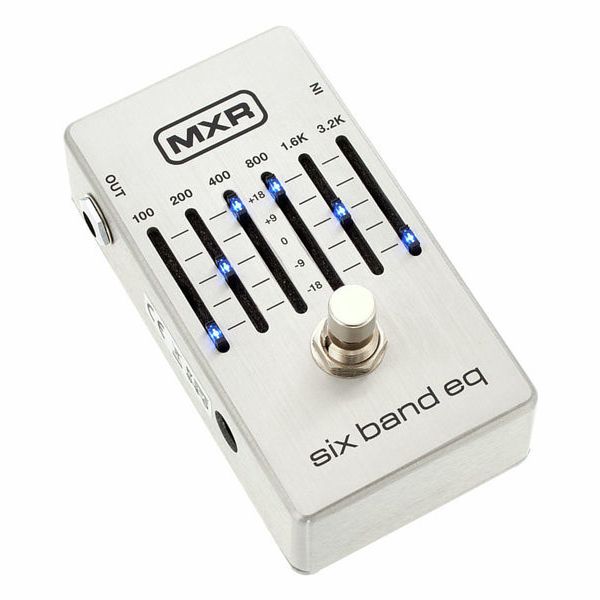
Power input is on the side, right next to the jack, which is mildly annoying if you’re routing a tightly-packed pedalboard — most other MXR pedals put it on top. Budget a little extra cable space for this one.
Tone — Genuine Shaping, Not Just Coloring
This is a true graphic EQ, not a tone-coloring „flavor” pedal, and it shows. Scoop the mids and boost the top and bottom bands and you’ll get a modern scooped-metal rhythm tone. Push the mids up instead and you’ve got an instant solo boost that cuts through a dense mix.
Running it in front of a distortion pedal shapes what hits the gain stage, which changes the character of the distortion itself. Running it after changes the EQ curve of your existing tone without touching the gain structure. Both are useful, and it’s worth experimenting with placement rather than assuming there’s one „correct” spot.
Noise floor is impressively low for an analog pedal with this much boost on tap — even maxing out the top band doesn’t introduce audible hiss, which isn’t something you can say about every EQ pedal at this price.
It also pairs surprisingly well as a always-on utility pedal alongside gain stages — try it before something like the Behringer SF300 Fuzz to tame the low end before it turns to mud, or after a drive like the JHS Morning Glory to carve out a lead boost.
Build Quality
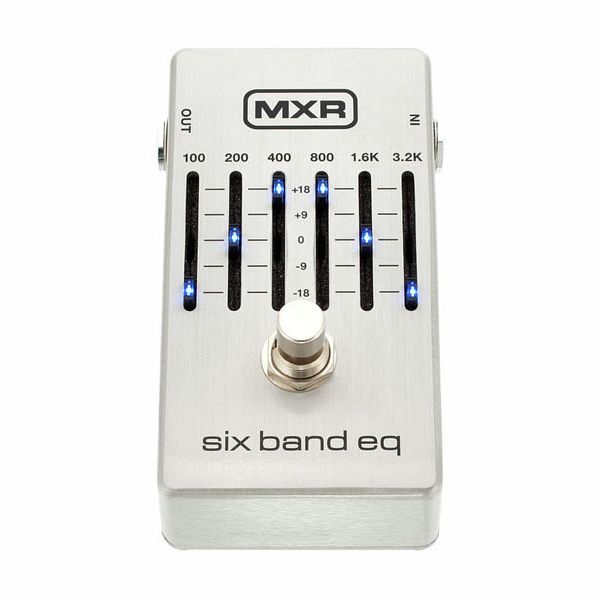
Classic MXR die-cast aluminum housing — small footprint at 110 x 60 x 50 mm, but genuinely tough. These things survive years of touring abuse without complaint, and the true bypass switching means it’s not coloring your tone at all when it’s off.
The sliders themselves are a common complaint point in owner reviews — some describe them as a bit small and slightly wobbly compared to full-size mixing console faders. They work fine, they’re just not the most premium-feeling part of the pedal.
Power
Runs on a 9V battery or a standard 9V DC adapter (not included), drawing a modest 14.5 mA — won’t strain a multi-pedal power supply even on a crowded board.
Who’s This Pedal For
Anyone who’s ever thought „I need my tone slightly different for this song” mid-set. Players who switch between rhythm and lead tones a lot, or who play through a house amp/backline that never sounds the same twice, get the most obvious use out of this.
It’s also genuinely useful for bass and even studio use, not just guitar — the frequency range covers enough ground to be broadly musical rather than guitar-specific. Check out our roundup of pedals for jazz players if tone-shaping subtlety is your priority.
Honest Niggles
- No master output level control — boosting bands raises overall volume too.
- Power jack placement on the side is awkward for tightly-packed boards.
- Sliders feel a little small and wobbly, not the most premium tactile experience.
- Six bands is plenty for tone shaping but not enough for surgical feedback hunting — the 10-band model exists for that.
None of these are dealbreakers for the price. If you specifically need feedback control on stage rather than tone shaping, look at something like a dedicated reverb pedal with built-in EQ options instead, or step up to the 10-band version.
Specs at a Glance
- Type: Graphic 6-band EQ
- Bands: 100 Hz, 200 Hz, 400 Hz, 800 Hz, 1.6 kHz, 3.2 kHz
- Range: ±18 dB boost or cut per band
- Bypass: True bypass
- Housing: Aluminum
- Power: 9V battery or 9V DC adapter (not included)
- Current draw: 14.5 mA
- Dimensions: 110 x 60 x 50 mm
- Weight: 350 g
Final Verdict
The MXR Six Band EQ isn’t flashy, and it’s never going to be the pedal you show off to your friends. But it might be the one that quietly does more for your live tone than anything else on your board.
It’s simple, it’s tough, and it does exactly what it says on the tin — reshape your frequency response without adding noise or coloring your signal when bypassed. For the price, it’s hard to argue with.
If your tone changes song to song more than you’d like, or you’re tired of never sounding quite right through unfamiliar backline gear, this is a genuinely practical fix rather than a novelty add-on. Stack it with something modulation-based like the Ibanez CS Mini Chorus and you’ve got a surprisingly complete tone-shaping corner of your board for not much money.