Watch It First
Multi-reverb pedals live and die by one thing: how many of those presets you’ll actually use after the first week.
The Mooer R7 X2 throws 14 reverb algorithms at you across two footswitches, true stereo I/O, and a freeze function that turns any chord into an infinite pad. That’s a lot of reverb for a pedal roughly the size of a deck of cards.
Let’s dig into whether it’s a genuinely useful workhorse or just a preset-count flex.
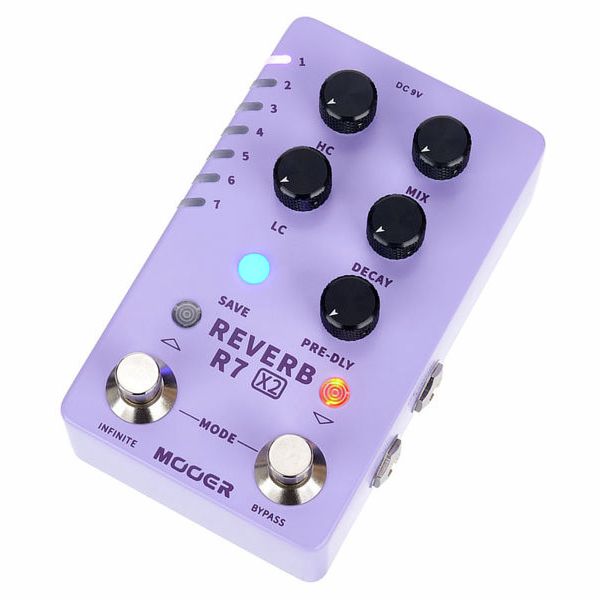
Fourteen Reverbs, Roughly Grouped Into Two Camps
The classic side covers Room, Hall, Church, Cave, Plate, Spring, and Studio — the bread-and-butter tones you’d expect from any serious reverb unit.
The modern side gets weirder, in a good way: Mod, Reverse, Wrap, Shake, Crush, Shimmer, and Dream. Shimmer alone is worth the price of entry if you’re chasing that lush, octave-up ambient wash popular in shoegaze and post-rock.
Two Footswitches Change Everything
One footswitch is standard bypass (with switchable trails, so the tail doesn’t get cut off mid-decay). The other is dedicated to Infinite mode — hold it down and the reverb freezes into a sustained pad for as long as you want.
That’s genuinely rare at this price point. Usually freeze/infinite functions show up on pedals costing twice as much.
The Controls Are Simple on Purpose
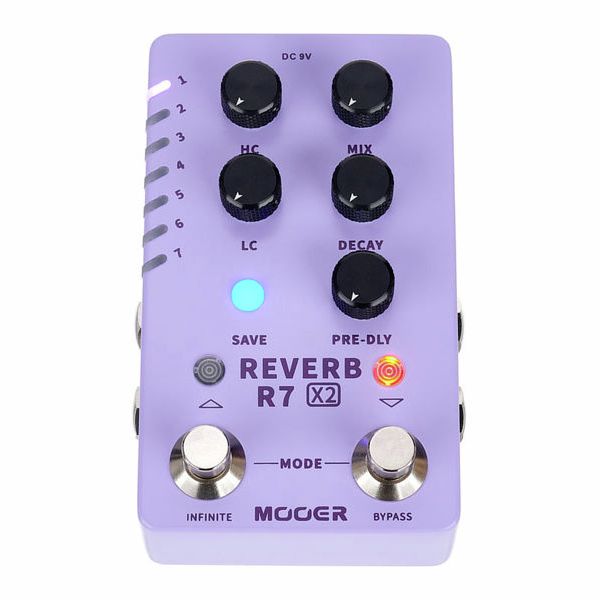
Mix, Decay, Pre-Delay, High-Cut, and Low-Cut. That’s five knobs covering everything you’d realistically want to shape per patch, plus a Save button so each mode remembers your last tweak.
True stereo in and out means it earns its place at the end of a chain running into a stereo rig or a pair of amps — the kind of setup where a mono-only reverb pedal starts to feel like a downgrade.
Setting It Up Right
Reverb pedals are almost always happiest at the very end of your signal chain, after drive, modulation, and delay — that way the reverb tail wraps around everything else instead of getting distorted by a gain stage sitting after it.
If you’re running the R7 X2 in true stereo, make sure both amps (or both sides of a stereo rig) are actually receiving separate signals — plugging in with just one cable defeats the whole point of the stereo I/O and you’ll wonder why it doesn’t sound as wide as the demos.
Pre-Delay is the knob most players skip past, and it’s a mistake. Even a small amount — 20 to 40 milliseconds — creates separation between your dry note and the reverb tail, which keeps chords from turning into mush, especially on the wetter modes like Cave or Dream.
Low-Cut is also worth using more than most players do by default. Rolling off some low end from the reverb signal keeps your low strings from turning into a muddy wash, while still letting the reverb shimmer on the higher notes.
Who This Actually Suits
Shoegaze and ambient players are the obvious audience — Shimmer and Dream modes alone will keep that crowd busy for a long time. If that’s your world, our list of the best guitars for shoegaze & ambient pairs nicely with a pedal like this.
But it’s not a one-genre pedal. Surf and rockabilly players get genuinely usable Spring and Plate tones, and jazz players chasing a warm, subtle room sound (the kind that suits something like the pedal picks in our best guitar pedals for jazz roundup) will find plenty to like too.
Running it behind a vintage-voiced guitar like a Fender Player II Jazzmaster is basically a cheat code for that hazy, reverb-drenched indie tone everyone’s chasing right now.
Compared to the Competition
Multi-algorithm reverb pedals are a crowded category right now, and Mooer knows it — the R7 X2 is priced to compete rather than to flex.
What sets it apart isn’t any single algorithm being „the best ever” — it’s the combination of true stereo operation, dual footswitches, and a genuinely usable Infinite mode all showing up together on one board-friendly unit. A lot of pedals in this price range make you pick two out of three.
A Note on Presets and Workflow
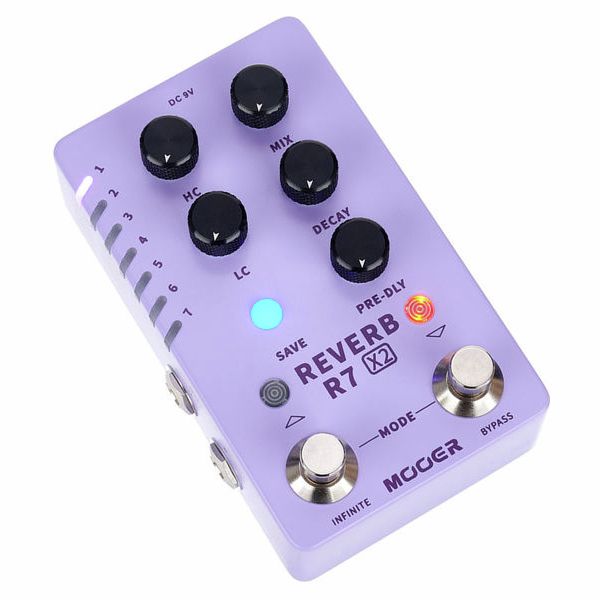
Every mode saves its own settings, which sounds minor until you’re mid-set and need to jump from a dry Room tone to a full Shimmer wash without stopping to twiddle five knobs.
That said, this isn’t a full preset-storage system with dozens of saved banks like something you’d get from a modeler or a pedal running alongside a EHX Mel9-style multi-effect box — it’s one saved state per mode. Simple, but it does mean you can’t stash a „backup” version of your favorite Hall setting somewhere else.
For most gigging or practicing guitarists that’s plenty. If you’re the type who needs 40 recallable presets across a MIDI setlist, you’ll outgrow this eventually — but that’s a „later problem,” not a launch-day dealbreaker.
Specs at a Glance
- Reverb modes: 14 total (Room, Hall, Church, Cave, Plate, Spring, Studio, Mod, Reverse, Wrap, Shake, Crush, Shimmer, Dream)
- Controls: Mix, Decay, Pre-Delay, High-Cut, Low-Cut, plus Save
- Footswitches: Bypass (with switchable trails), Infinite/freeze
- I/O: True stereo in/out (2x 6.3mm jack)
- Power: 9V DC, power supply included
- Build: Metal enclosure, compact standard pedal footprint
- Weight: 334 g
Final Verdict
The Mooer R7 X2 is proof that „budget” and „one-trick” don’t have to mean the same thing anymore.
It covers the classic reverb algorithms convincingly, then adds enough of the weirder ambient modes to keep experimental players happy for a long time. The dual-footswitch layout with a real Infinite/freeze mode is the standout feature — that’s the kind of thing that usually costs a lot more to get.
FYI, if you already own a pedal with a similar reverb spread, this might feel redundant. But as a first „serious” reverb pedal, or as a replacement for something that only does one or two algorithms, it’s one of the more complete options out there right now — and it punches well above its price tier.