Watch It First
Multi-FX units used to mean compromise – a decent amp sim buried under mediocre effects, or vice versa. The NUX MG-30 is one of the pedals that made that whole argument feel outdated.
For a price that barely clears a mid-range single overdrive pedal, you get 30 amp models, cab IR loading, a full effects suite, a looper, a drum machine, and a built-in expression pedal. On paper it reads like a spec sheet from something twice the price.
The „punches at Helix level” comparisons get thrown around a lot online, and they’re obviously a stretch in absolute terms. But the fact that people are even making that comparison at this price tells you something.
NUX built its reputation on exactly this formula – take features usually reserved for premium modelers and squeeze them into a sub-1200 zł box. The MG-30 sits in the middle of their multi-FX range, above the simpler MG-300 MKII and below the pricier MG-400, and it’s consistently one of their best-reviewed units.
Amp Modeling – The Actual Selling Point
30 amp models covers a genuinely usable spread: 25 guitar amps, 3 bass amps, and 2 acoustic simulations, paired with cab IR loading across 8 mic types and 3 positions. You can also load third-party IRs if you want to chase a very specific tone.
The modeling itself is convincing rather than perfect – it won’t fool a picky studio engineer A/B-ing against a real tube stack, but through headphones or a flat-response monitor for home practice and recording, it holds up impressively well across genres, from clean jazz tones to hi-gain metal.
NUX’s Quick Tone Edit software makes dialing in and tweaking patches far less fiddly than wrestling with tiny on-unit menus, which is where a lot of budget modelers fall down.
A global 3-band EQ sits on top of everything for quick tonal adjustments without diving into individual patches, which is handy when you’re jumping between very different amp voicings mid-session.
Build & Interface
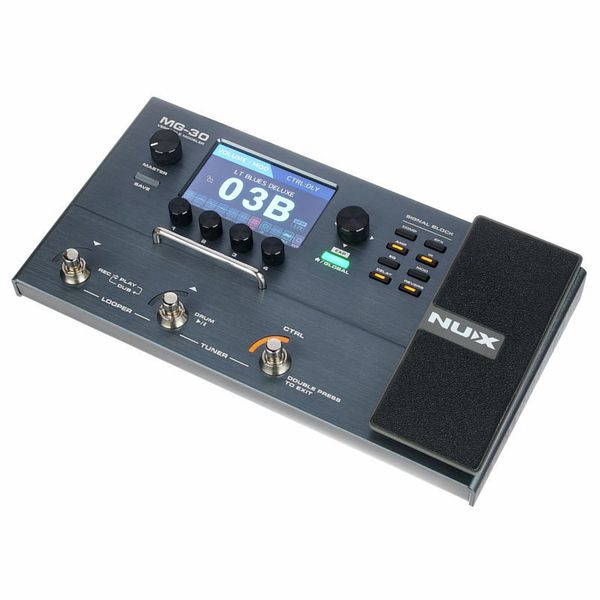
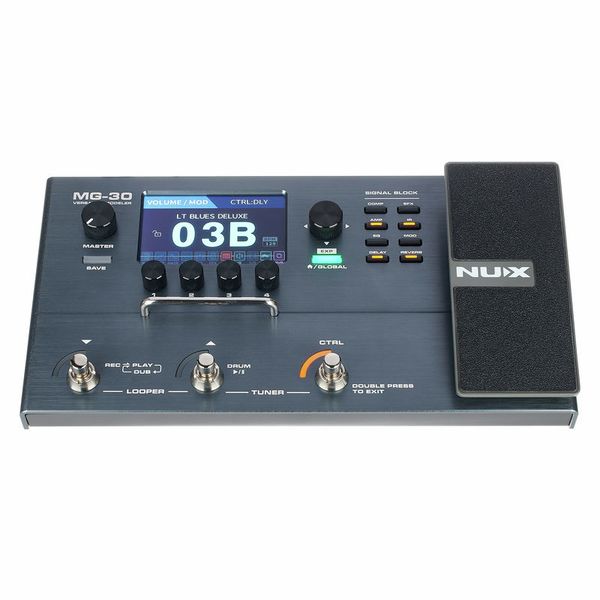
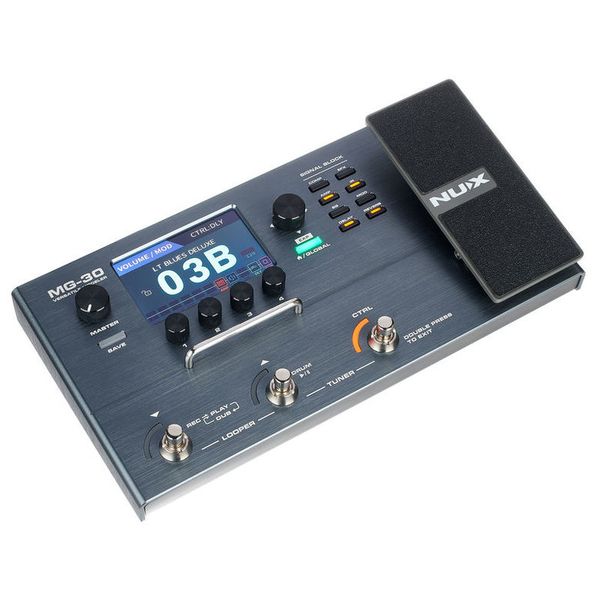
The 4″ LCD screen is genuinely bright and readable, and the control layout – Master, Exp, and four Control knobs, plus dedicated buttons for Comp, EFX, Amp, IR, EQ, MOD, Delay, and Reverb – means you’re rarely more than a couple of button presses from where you need to be.
The built-in expression pedal handles wah and volume duties without needing an external pedal, which saves real estate on a smaller board or desk setup. Dual footswitches also give you Looper, Tuner, and Ctrl functions on top of the standard bypass.
Physically it’s a solid, road-case-friendly footprint – not huge, not tiny, and light enough at 1.5kg to not weigh down a gig bag alongside a guitar.
Who’s This For?
Home players who want one box that does everything – practice, recording, silent playing through headphones via the 3.5mm output – get the most value here. It’s also a smart choice for anyone building a first pedalboard who’d rather have one flexible unit than assemble ten individual pedals.
Gigging players can absolutely use it too, thanks to send/return loops for running a real amp in the chain and stereo L&R outs for a PA, but it’s not built like a road-ready flagship processor – treat it accordingly if it’s living in your gig bag every weekend.
Honest Niggles
The onboard drum machine and looper are functional rather than inspiring – fine for practicing over a beat, not a serious songwriting tool. Several owners also note the wah/expression pedal feels a touch light compared to a dedicated wah pedal.
There’s no MIDI interface, which limits integration with more elaborate rigs or DAW-controlled setups. And while the amp models are genuinely good, chasing an exact tone does take patience – it’s not a plug-and-instantly-perfect experience for everyone.
None of that is unusual for the category – even far pricier modelers demand some patience to dial in – but worth setting expectations before you dive in expecting instant perfection out of the box.
How It Compares
Against something simpler like the Zoom MS-50G+ MultiStomp, the MG-30 trades pocket-sized simplicity for a full amp-modeling rig – different use case entirely. The Zoom G2 Four sits closer in concept and price, and is worth cross-shopping if you want to compare interfaces before deciding.
If you’d rather build a pedalboard from individual boxes instead of one all-in-one unit, pairing something like the Fender Hammertone Breakup Driver with a real amp is the more traditional (and pricier, once you add it all up) route. For players who just want an easy practice amp instead of a modeler, the Marshall MG50GFX is a solid alternative direction entirely.
Recording & Silent Practice
This is genuinely where the MG-30 shines hardest. Plug in headphones, dial up a cab IR, and you’ve got a convincing late-night practice rig that won’t wake the house. Route it into an interface and you’ve got usable DI-into-amp-sim tones for recording without mic’ing a real cab.
If delay and modulation textures matter to you as much as gain tones, it’s worth knowing the effects engine covers the full range you’d expect – chorus, phaser, flanger, multiple delay types, and reverb – all editable per patch rather than bolted on as an afterthought.
Specs at a Glance
- Amp models: 30 (25 guitar, 3 bass, 2 acoustic)
- Cab IR: 8 mic types, 3 positions, third-party IR support
- Display: 4″ LCD
- Controls: Master, Exp, 4x Control knobs, dedicated FX section buttons
- Footswitches: Bypass, Looper, Tuner, Ctrl (built-in expression pedal)
- I/O: 6.3mm in/out, send & return, AUX in, headphone out, stereo L&R out, USB
- Power: 9V DC (adapter included)
- Weight: 1500g
Final Verdict
The NUX MG-30 isn’t going to dethrone a flagship modeler, and comparing it directly to a Helix is more marketing hook than technical reality. But as a one-box practice, recording, and light-gigging solution at a genuinely budget price, it’s hard to argue with what you get.
If you want amp tones, effects, a looper, and silent practice capability in a single unit without spending Helix money, this is one of the smartest ways to get there. Just don’t expect boutique-pedal-level nuance from every single patch – you’re trading some of that for sheer flexibility.
For the price, it’s genuinely one of the easiest recommendations in the budget multi-FX space right now – and with a 4.6-star average across nearly 200 reviews on Thomann, it’s clearly not just marketing talk winning people over.