Watch It First
Big Muffs are fuzzy and loose by design. Sometimes you need the opposite of that.
Electro-Harmonix built the Nano Metal Muff for exactly that situation – tight, gated, EQ-shaped distortion instead of the sprawling Muff fuzz the brand is famous for.
I ran this through a few different rigs to see if the tiny box actually earns its „metal” name, or if it’s just a Big Muff wearing a costume.
Not Your Usual Muff Circuit
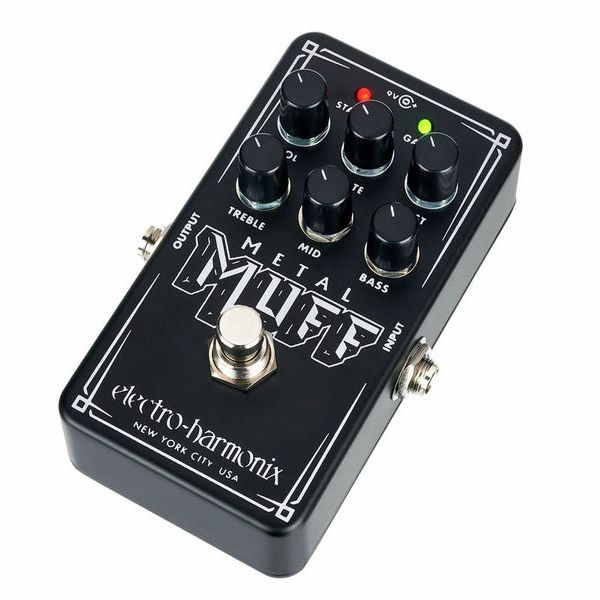
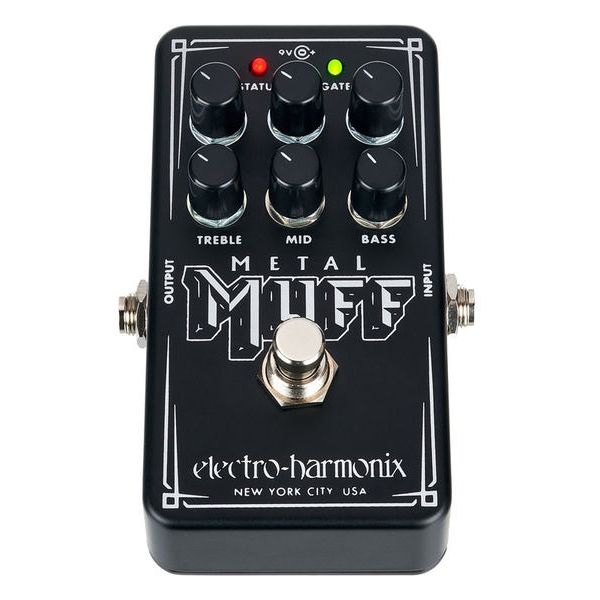
Six knobs crammed onto a tiny enclosure: Vol, Gate, Dist, Treble, Mid, Bass. That’s a real 3-band EQ on a pedal this size, which is honestly more tone-shaping than a lot of full-size distortion boxes offer.
The Gate Is the Whole Point
High-gain distortion without a gate turns into a hissing mess the second you stop playing. The built-in noise gate here chops that off cleanly – when it’s dialed in right. Set the Gate knob too aggressively and it clips the tail of your notes; too low and you’re back to hiss. Finding the sweet spot takes a few minutes but it’s worth the fiddling.
The EQ Actually Does Something
Unlike a lot of one-knob-tone distortion pedals, the Treble/Mid/Bass trio here genuinely reshapes the voicing. Scoop the mids and you get an 80s-thrash rhythm tone almost instantly. Push the mids back up and it’s closer to a modern high-gain amp channel, less scooped and more cutting for lead lines.
Using It In Front of an Amp
Plugged straight into a clean channel, it does a convincing job of standing in for an amp’s own distortion. I tested it in front of an Marshall JVM410H on the clean channel, and it delivered a tight, modern rhythm tone that held up well for palm-muted riffing.
Reviewers online mention it also works well in an amp’s effects loop rather than in front of the input, especially with amps that already have their own preamp gain – worth experimenting with both positions before deciding it’s not for you.
Compared directly to something like the MXR Fullbore Metal, the Nano Metal Muff is a bit more scooped and vintage-leaning by default, while the MXR sits more aggressive and modern out of the box. Both get you to similar places with enough EQ tweaking, so it comes down to which starting point you prefer.
If you want a gain stage stacked in front for extra push, pairing it with something like the JHS Angry Charlie V3 or a lower-gain drive like the JHS Morning Glory in front adds extra saturation without losing the gate’s tightness.
Battery Life and Build Quality
EHX rates the 9V battery at somewhere around 40-50 hours of use, which is genuinely solid for a pedal running an internal gate circuit – a lot of similar boxes chew through batteries much faster. The metal enclosure feels properly built too, no rattly knobs or cheap plastic switches, and the footswitch has a satisfying, positive click.
Weight-wise it’s light enough that it won’t matter on a pedalboard, and the compact footprint means it slots in easily even if your board is already crowded with modulation and delay pedals.
How It Stacks Up Against the Classics
The obvious comparison is Boss’s Metal Zone, which has a reputation for being unwieldy and scooped to the point of uselessness for a lot of players. The Nano Metal Muff’s EQ is more musical by comparison and easier to dial in a usable tone quickly, even if it lacks the Metal Zone’s sheer gain ceiling.
Against a simpler pedal like the Boss DS-1, it’s not really a fair fight – the DS-1 doesn’t have a gate or a real 3-band EQ, so if you specifically need those two features, EHX wins that comparison easily. If all you want is a simple, no-frills distortion, the DS-1’s simplicity might actually suit you better.
Specs at a Glance
- Type: Distortion with built-in noise gate
- Controls: Vol, Gate, Dist, Treble, Mid, Bass
- Bypass: True bypass footswitch
- Input/Output: 6.3mm jack
- Expression pedal input: 6.3mm stereo jack
- Power: 9V battery or 9V DC power supply (sold separately)
- Dimensions: 114 x 70 x 53mm
The Niggles
It’s not perfect, and it’s worth going in with realistic expectations.
- The knobs are small and close together, which gets fiddly if you have bigger hands or want to make quick adjustments mid-set.
- The Gate control needs babysitting – set wrong, it either doesn’t cut hiss or chops your sustain short.
- Output level can feel a touch quieter than some rivals when compared at matched gain settings, so you may need to boost volume to compete with a loud band mix.
- No power supply included, and it’s worth grabbing one rather than relying on a 9V battery if you play often.
Who Should Buy This
If you play modern metal or thrash and want a compact, affordable way to get tight, gated distortion without buying a whole new amp, this earns its keep on a pedalboard. It’s also a smart secondary distortion option if your main amp’s gain channel isn’t quite aggressive enough for certain songs.
If you’re chasing vintage fuzz tones or a looser, more organic breakup, this isn’t it – go look at something like the Behringer SF300 instead, which leans into exactly that vibe for very little money.
Bedroom players running a low-wattage amp like an EVH 5150 Iconic 40 at low volumes will also appreciate that the gate keeps things quiet between riffs – genuinely useful late at night when you can’t just crank an amp’s own gain.
Final Verdict
The Nano Metal Muff proves EHX can do tight and aggressive just as well as they do loose and fuzzy. The gate genuinely works once you learn to set it, the EQ is more capable than the tiny footprint suggests, and it’s cheap enough to try without much risk.
It won’t replace a proper high-gain amp for serious tonal purists, but as a pedalboard distortion for modern rock and metal, it’s one of the smarter budget picks out there. Small box, surprisingly big feature set – worth a look if that’s the tone you’re chasing.