Watch It First
Quick note before we start: we originally set out to cover the Ibanez ES2 Echo Shifter, a cult analog delay from the mid-2010s. It has been discontinued for a while and Thomann no longer stocks it.
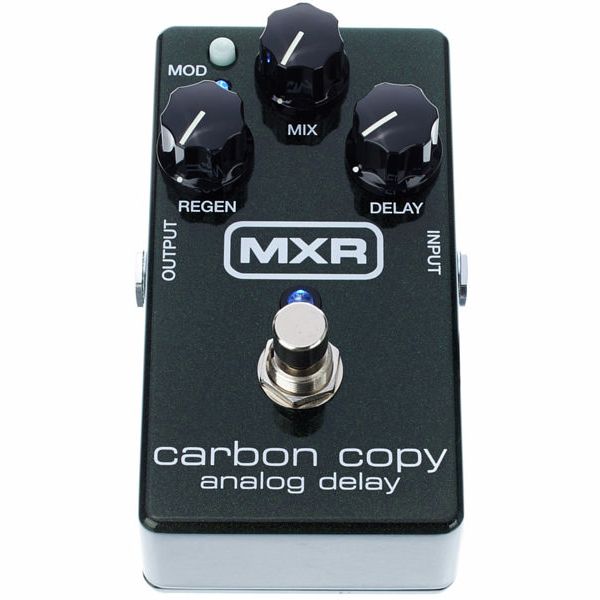
So instead we are looking at the pedal that basically everyone points to when they want that same warm, degrading analog delay character: the MXR M169 Carbon Copy.
It’s been the default „just get this one” answer on gear forums for over a decade, and after spending real time with it, that reputation holds up.
Three Knobs, Zero Confusion
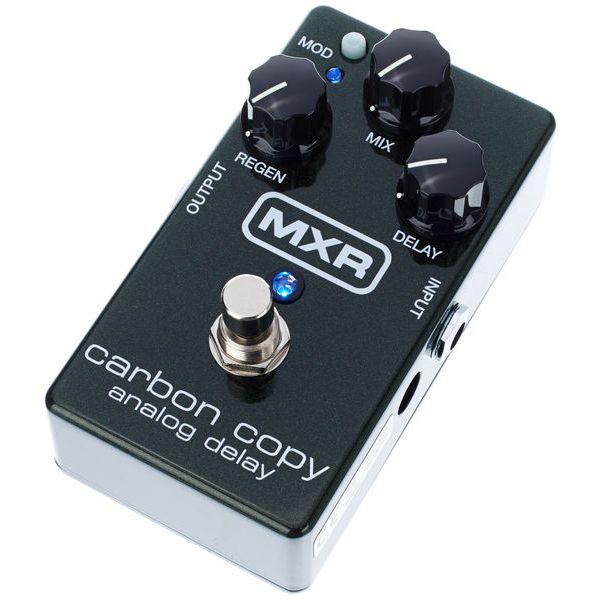
Delay, Regeneration (feedback/repeats), and Mix. That’s genuinely the whole interface, plus a small internal trim pot for modulation depth if you crack the pedal open.
Delay time tops out at 600ms, which covers slap-back through mid-length rhythmic repeats comfortably. It won’t do huge ambient washes on its own, but that’s not really the assignment here.
That Little Trim Pot
Pop the back cover off and there’s a small modulation depth trimmer most players never touch – but if you want subtle chorus-y movement on your repeats instead of a static analog decay, it’s there. A nice bit of hidden depth for a pedal this simple on the surface.
Tone – Warm, Dark, Genuinely Analog
This is a true bucket-brigade analog delay, so repeats get progressively darker and softer, never digital-clean. It sits behind your dry signal instead of competing with it.
For blues, rockabilly, surf, and indie tones it’s about as close to „just right” as a delay gets. Turn Regeneration up and it self-oscillates into a nice, controllable feedback swirl without falling apart into noise.
Compared to something like our Electro-Harmonix Memory Boy, the Carbon Copy is a touch cleaner and more predictable – the Memory Boy leans weirder and more experimental, while this one just quietly does its job every time.
Build and Playability
Classic MXR compact enclosure – small footprint, sturdy metal chassis, metal footswitch that’ll survive years of stomping. True bypass keeps your tone clean when it’s off.
Runs on a 9V battery or the Dunlop ECB-003 adapter, sold separately. Battery operation is a genuinely nice touch for anyone who likes a simple, self-contained pedal for practice or small gigs.
No tap tempo, no presets, no screen. If that sounds like a downgrade, it kind of is on paper – but plenty of players find that limitation freeing rather than frustrating.
Who It’s Actually For
- Anyone who wants „the” analog delay everyone recommends, without shopping around forever
- Blues, surf, rockabilly, and indie players chasing warm, organic repeats
- Players who’d rather turn three knobs than dig through digital menus
- Pedalboard minimalists who want reliable, no-nonsense delay in a small footprint
If you’re pairing delay with a clean, dynamic platform, our Ibanez TS9 Tube Screamer review and MXR Analog Chorus review both cover pedals that sit nicely on either side of a delay like this in the signal chain.
Honest Niggles
600ms max delay time is genuinely limiting if you want long ambient trails – the MXR Carbon Copy Deluxe fixes that with a longer max time and tap tempo, for more money.
No tap tempo on this standard version either, so live tempo-matching means turning a knob by feel rather than stomping along to the song. Fine for most uses, annoying if you play a lot of tempo-shifting material.
And it’s mono only, no stereo output – if width and spread matter to your rig, you’ll want something else further down the chain to handle that.
Why This Pedal Specifically Keeps Coming Up
There are dozens of analog delays out there, plenty of them cheaper. So why does this specific green box keep getting recommended over and over?
Mostly consistency. It sounds great on literally any amp, any guitar, any genre that wants warm repeats. It doesn’t need tweaking to sound good – three knobs, a few seconds, done. For a lot of players that reliability is worth more than a longer spec sheet.
Quick Specs
- Type: Analog delay pedal (bucket-brigade)
- Controls: Delay, Regeneration, Mix (plus internal mod depth trimmer)
- Delay time: Up to 600 ms
- Bypass: True bypass
- Power: 9V battery or Dunlop ECB-003 adapter (sold separately)
- Housing: Compact metal MXR enclosure, metal footswitch
If you play bass and want a similar warm, low-end-friendly texture, check out our Ibanez TMB30 review – it’s a fun pairing with delay pedals like this one.
Carbon Copy vs Carbon Copy Deluxe vs Mini
MXR sells three versions of this circuit now, and it’s worth knowing the difference before you buy. The standard M169 reviewed here is the full-size original – three knobs, 600ms max, no tap tempo.
The M299 Copy Mini shrinks the footprint and adds a switchable „Bright” voicing, handy if your rig tends to sound a bit dark already. The M292 Carbon Copy Deluxe is the big one – longer delay time, tap tempo, and modulation controls brought out to the front panel instead of hidden inside.
Unless you specifically need tap tempo or longer delay times, the standard Carbon Copy reviewed here is genuinely the sweet spot of the three – full price-to-performance, none of the extra complexity you might not use.
One more thing worth mentioning: resale value on this pedal is excellent, which tells you something about how much players trust it long-term. It rarely feels like a pedal people regret buying, even years later.
Final Verdict
The MXR Carbon Copy earns its reputation. It’s not the most feature-packed delay out there, but it is one of the most reliably great-sounding ones, and it punches well above its price every single time.
If you were hoping to track down an original Ibanez ES2 Echo Shifter, this is a genuinely worthy modern alternative that’s actually easy to buy new. Same warm, analog spirit, none of the used-market hunting.
For blues, surf, indie, and anything that wants organic, musical repeats without a learning curve, it’s hard to go wrong here. Simple as that.