Watch It First
Three Flying V reviews have landed on this site in about a week, so let me get ahead of the obvious complaint: this one is not really a Flying V review.
It’s a Prophecy review that happens to be V-shaped. Ebony board, 24 frets, Fishman Fluence pickups, locking Grovers – the spec sheet has almost nothing in common with the Vs you already know.
If you want the classic version of this shape, go read the Epiphone Flying V 70s review or the Gibson 70s Flying V. Still here? Good, because the Prophecy is the interesting one.
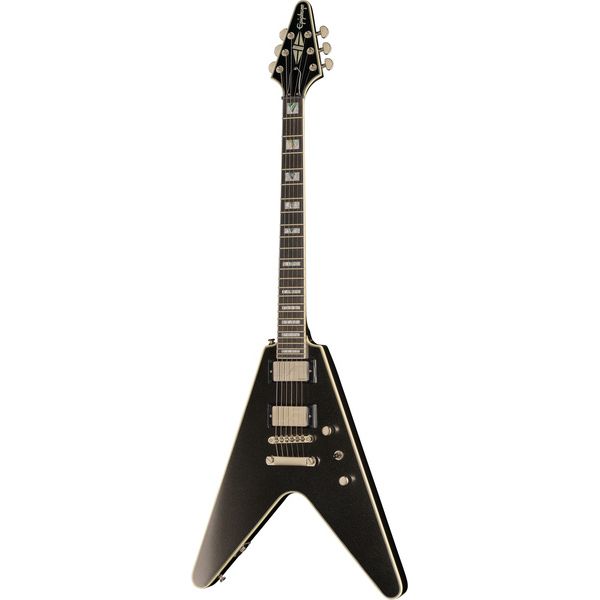
Fishman Fluence is the whole story
Two Fishman Fluence Modern humbuckers. Not passives with a fancy name – these are multi-voice pickups, which means one physical pickup carries more than one usable voice.
Pull up on the tone knob and the whole guitar changes character. One voice is the tight, scooped, high-output modern metal sound; the other is looser and more open, closer to a hot PAF.
And because Fluences are built with printed coils rather than wound wire, they are dead silent. No 60-cycle hum under high gain, no buzz when you stand near a laptop. If you’ve ever tracked a rhythm part and spent twenty minutes chasing a noise floor, you will appreciate this more than any tonewood argument.
The same pickups turn up on far more expensive guitars – the ESP LTD MH-1000 being an obvious example. Getting them at Epiphone money is genuinely a bit mad.
24 frets on a Flying V is not normal
A traditional V gives you 22 frets and a heel that fights you above the 17th. Epiphone binned that.
This has 24 frets on an ebony fingerboard, with abalone block and triangle inlays that look far more expensive than they have any right to. The V shape already gives unobstructed upper-fret access – now there’s actually something worth reaching for up there.
The scale is 628 mm, so the shorter Gibson-style measurement. Combined with 24 frets, the top of the neck is a slightly tighter squeeze than on a 25.5″ superstrat. Not a problem, just a thing to be aware of if you’re coming from an Ibanez.
The neck profile is the sneaky highlight
It’s an Asymmetrical Slim Taper – thinner on the bass side than the treble side, which sounds like marketing nonsense until you play one.
Your thumb sits flatter, your fingers get slightly more meat under the top strings. Fast without feeling like a pencil. It is comfortably the best neck Epiphone puts on anything at this level, IMO.
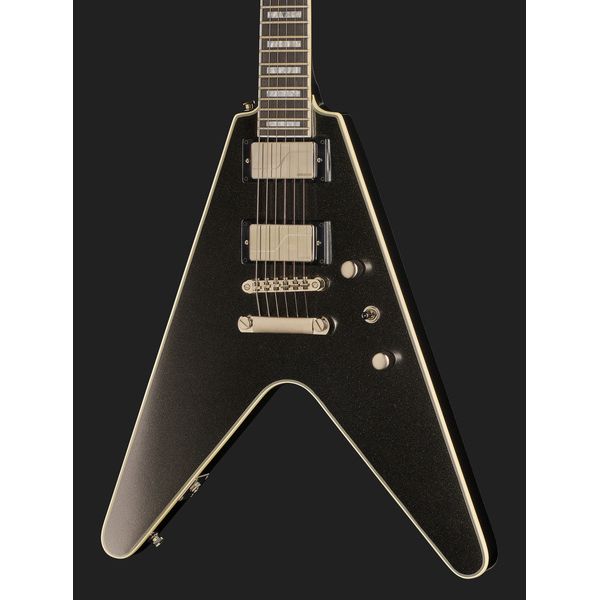
Build and hardware
Mahogany body with a maple top, mahogany neck, multi-ply binding all round. The Aged Jet Black Metallic finish has a slight satin-ish sheen rather than the mirror gloss you might expect – it looks meaner in person than in photos.
Hardware is a LockTone Tune-O-Matic and stopbar, which is a genuinely good detail: the bridge and tailpiece lock onto their posts so you can’t send them flying across the room during a string change.
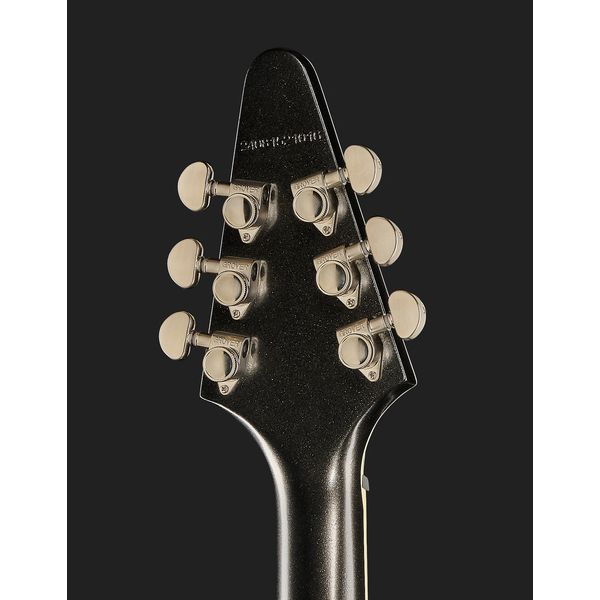
Grover Locking Rotomatics up top, a GraphTech NuBone nut, and a premium gig bag in the box. That last one matters more than it sounds, because good luck finding a cheap case that fits a V.
The Prophecy family resemblance
If you read my Epiphone Prophecy Les Paul review this will all sound familiar – same ebony boards, same Fluences, same idea of taking a heritage shape and specifying it for people who play in drop tunings.
The difference is ergonomic. A Prophecy Les Paul is a heavy slab that hangs where you expect. The V is lighter, but it balances completely differently: sitting down it wants to slide off your leg unless you play classical-position, and standing up the neck sits further out to your left than you’ll expect.
That’s the shape’s eternal tax, not an Epiphone flaw. Same reason people either love or refuse to touch a Gibson Explorer.
How it actually sounds through a real amp
Voice 1 on the bridge pickup is the reason people buy this guitar. Tight, fast-responding, with a low end that stays defined when you palm mute in drop tunings – the sort of chug that usually needs a noise gate and a lot of EQ to get right.
Flip to voice 2 and the same pickup loosens up considerably. More midrange, more bloom, and it takes a clean amp far better than any active pickup has a right to. Roll the volume back and you get something almost bluesy, which was not what I expected from a black metal V.
The neck pickup is the quieter surprise. Voice 2 there is genuinely warm rather than muddy, and lead lines around the 12th fret sing without that woolly boominess mahogany guitars often have.
Where it struggles is at very low gain with the modern voice engaged. It can sound slightly sterile – all attack, not much character. Just switch voices. That is, after all, the point of the thing.
Honest niggles
- Sitting down is a faff. No amount of good spec fixes a Flying V on a sofa.
- Fluences are a taste thing. Some players find them clinical. If you love the sag and bloom of a hot passive, you may not get on with them.
- Only two voices. No coil split, no third option – the push/pull does one job.
- Aged finishes divide people. The metallic aged look is deliberately not showroom-shiny.
- It is still an Epiphone. Fretwork and setup out of the box are good-not-flawless. Budget for a proper setup.
So is it worth it?
Depends entirely which V you actually want.
Want the 1958 icon, the sound of Albert King and Jimi and every classic rock photograph you’ve ever seen? This is the wrong guitar. Get the traditional one.
Want a modern metal machine that happens to be shaped like the coolest thing in rock, with silent active-style pickups and a fretboard you can actually use all of? Then yes, comfortably. It undercuts most things with Fluences in them by a distance, and it out-specs plenty of dedicated metal guitars in the same bracket, including some long-standing bargain kings.
Specs
- Body: Mahogany with maple top
- Neck: Mahogany, Asymmetrical Slim Taper profile
- Fretboard: Ebony, abalone block and triangle inlays
- Frets: 24
- Scale: 628 mm (24.724″)
- Nut: GraphTech NuBone, 43 mm
- Pickups: 2 x Fishman Fluence humbuckers
- Controls: Master volume, master tone with push/pull voice switching
- Bridge: LockTone Tune-O-Matic with stopbar tailpiece
- Tuners: Grover Locking Rotomatics
- Binding: Multi-ply
- Finish: Aged Jet Black Metallic
- Includes: Premium gig bag
Final Verdict
The Epiphone Flying V Prophecy is the best-specced V you can buy without spending Gibson money, and it isn’t close.
Ebony, 24 frets, Fluences, locking tuners, a genuinely lovely neck profile. On paper it reads like a custom order. In the hand it feels like Epiphone quietly decided to embarrass a couple of dedicated metal brands.
It won’t suit you if you want vintage tone or a guitar you can slouch with. Everyone else – this is a lot of guitar, and it looks absolutely lethal on a dark stage 😉