Watch It First
Paul Gilbert put his name on a guitar with a 22-inch scale length. Go on, read that again.
The Ibanez PGMM31 is a shrunken shred machine with two humbuckers, 24 frets and a signature on the headstock that belongs to one of the fastest players alive. It costs roughly what a mid-range overdrive pedal costs.
I already made the case for tiny guitars in my Jackson Dinky Minion JS1X review, so I won’t re-argue it here. The real question is different: if you’re choosing between the two mini shredders, why would you take the Ibanez?
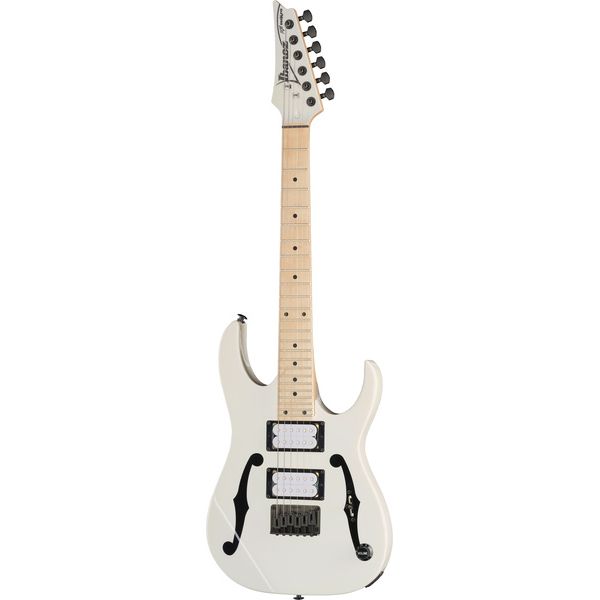
The Paul Gilbert bit is not just a sticker
Signature minis are usually cynical. Slap a famous name on a beginner guitar, charge twenty quid more, done.
This one earns it slightly better. The full-size PGM series has been a real, working Ibanez line since the late 80s – the one with the painted f-holes and the razor-thin neck. The PGMM is that idea shrunk down, and Gilbert himself demos it, plays it, and by all accounts actually keeps one around.
The PGMM31 is the plain white version. If you want the famous fake f-hole graphic, that’s the PGMM21 – same guitar, different paint job, and both sit at the same money. FYI the white one hides fingerprints far worse. Ask me how I know.
24 frets on something this small is faintly absurd
The scale is 564 mm, about 22.2 inches. That is properly short – shorter than a Mustang, shorter than most so-called “travel” guitars.
And Ibanez still crammed 24 medium frets onto it. On a full-size RG that top octave is a shred cliche. On a guitar this size, the frets up there are tiny enough that you’ll want to be precise, but they’re genuinely usable, not decorative.
The double-cutaway body means nothing gets in the way of your hand either. Whoever specced this clearly assumed people would actually solo on it.
The neck feels like an Ibanez
Nut width is 41 mm and the profile is Ibanez’s own PGMM shape – thin, flat-backed, nothing like the fat little clubs you get on most beginner guitars.
That’s the single biggest reason to pick this over a generic mini. Wizard-adjacent necks are what Ibanez does, and the muscle memory transfers when you move up to something like an Ibanez RG421.
Maple fretboard with black dots. Bright, snappy, easy to see in a dark room.
Two humbuckers, and a five-way switch (yes, really)
Bridge and neck are Infinity R humbuckers. Nothing exotic – ceramic, medium-hot, tuned to take gain without falling apart.
The clever part is the 5-way blade switch on an HH layout. You get more than the usual three sounds, including thinner in-between voices that a plain 3-way simply can’t give you. On a guitar at this price that’s a genuinely generous bit of wiring.
There’s one volume knob and that’s your lot. No tone control. Purist minimalism, or cost-cutting? Bit of both, IMO.
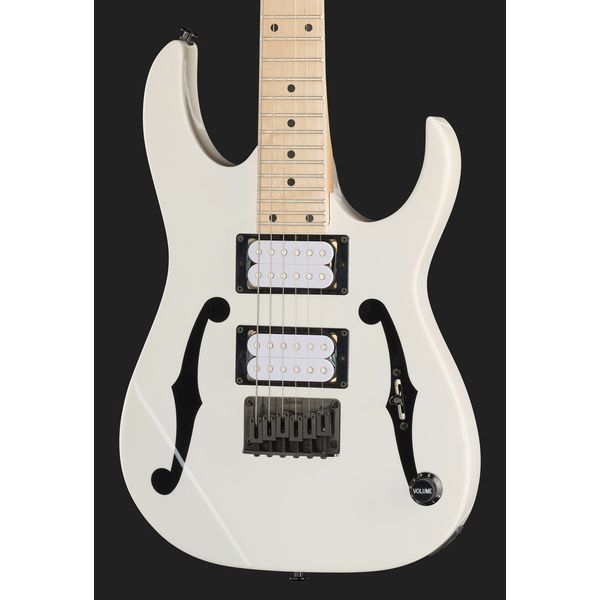
Plugged in: slinky, punchy, and smaller than it sounds
Short scale means low string tension, which means bends feel almost weightless. Full-tone bends that fight you on a 25.5-inch guitar just happen here.
That’s the fun bit. The trade-off is that standard 9s turn into wet spaghetti. Put 10s or even 11s on it and the whole thing tightens up dramatically – this is the single best upgrade you can make, and it costs the price of a coffee.
Tone-wise, be realistic. The body is poplar and it’s tiny, so the low end is thinner than a full-size guitar. Mids and upper mids are strong though, which is exactly the range that cuts through a distorted amp.
The fixed bridge helps too. No trem, no fine-tuning drama, no Floyd Rose faff – you tune it and it stays tuned, which matters a lot if this is a guitar you’re handing to a nine-year-old.
Honest niggles
It’s a cheap guitar and it does cheap-guitar things.
- Plastic nut. Fine, but a bone or TUSQ replacement is an obvious cheap upgrade.
- Factory setup is a lottery. Mine-adjacent examples I’ve played needed truss rod and intonation attention out of the box.
- No tone knob. Bright is the only setting. You’ll roll it back at the amp instead.
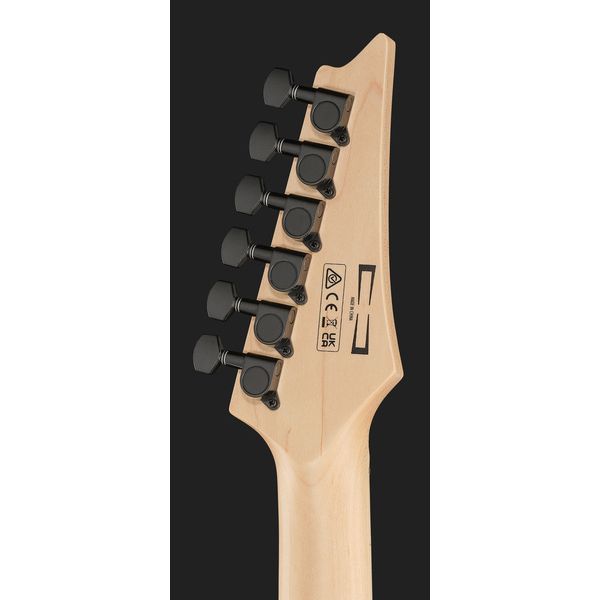
- Tuners are basic. They hold well enough with a fixed bridge, but they’re not silky.
- It is small. If you’re a full-size adult, sitting down with it feels a bit like playing a ukulele that got into weightlifting.
None of that is a scandal at this money. Just don’t expect the fit and finish of an Ibanez Prestige.
Who should actually buy one
Kids and smaller players, obviously. This is a serious instrument at a scale that fits, rather than a cut-down toy – the same argument I made for the Squier Mini Strat, but with proper humbuckers and a shred-shaped neck.
Also: anyone who travels. It fits in overhead lockers, it lives on the sofa, it gets picked up ten times a day instead of twice a week. That’s worth more practice hours than any boutique guitar.
Who should skip it? Anyone looking for a main gigging guitar. Go up a tier to an Ibanez JEM Jr or a slim-bodied Ibanez S instead.
Small guitar, real practice tool
Nobody warns you about this bit, but short scales change how you practise. Stretches that are a four-fret reach on a normal neck become three-and-a-bit here, so awkward legato runs and wide arpeggios stop feeling impossible.
Which cuts both ways. Build all your muscle memory on a 22-inch scale and a full-size neck will feel like a different instrument for a week or two. Use it as a supplement, not a replacement, and it’s brilliant.
The other practical win is weight. It’s light enough to stand and play for hours without your shoulder filing a complaint, which is more than I can say for most of the chunkier metal guitars I own.
Specs
- Body: Poplar
- Neck: Maple, PGMM profile
- Fretboard: Maple with black dot inlays
- Scale: 564 mm (approx. 22.2″)
- Nut width: 41 mm
- Frets: 24 medium
- Pickups: Infinity R humbucker (neck) and Infinity R humbucker (bridge)
- Controls: 1 volume, 5-way blade switch
- Bridge: Fixed, no tremolo
- Hardware: Black
- Finish: White (PGMM31-WH)
Final Verdict
The PGMM31 is the mini guitar for people who care how a neck feels.
It’s not the loudest, deepest or best-finished small guitar out there, and the missing tone control still bugs me. But the neck profile, the 24 frets and that surprisingly clever 5-way switch mean you can genuinely play this thing rather than just noodle on it.
Against the Jackson Minion, it comes down to feel: the Jackson is the pointier, more aggressive of the two, the Ibanez is the one that feels like a shrunken professional instrument. I’d take the Ibanez, but I’m biased toward thin necks.
Buy it for a kid, a couch, or a suitcase. Then be mildly annoyed at how often you reach for it instead of the expensive one 😉