Watch It First
We have already covered a fair few Muffs on this site. The bass one, the Op-Amp one, the angry little metal one. Somehow we never got round to the actual Big Muff Pi itself, which is a bit like reviewing four cover bands before mentioning the original.
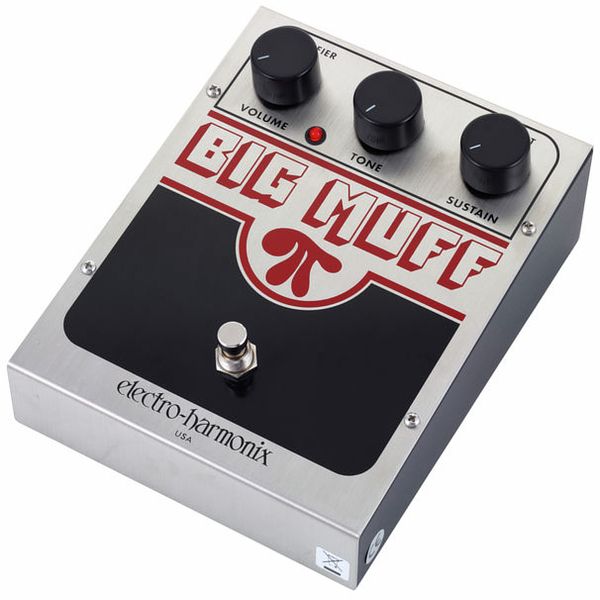
So here it is. The big NYC box, the one every other Muff is descended from, still made, still cheap, still enormous in every sense.
Three knobs, a footswitch, and roughly half of the guitar records you love. Let us talk about why it refuses to die.
The One All The Others Came From
Every variant on this site is a branch off this trunk. The Op-Amp Big Muff swapped the transistor gain stages for chips and got that scooped, gritty Siamese Dream thing. The Bass Big Muff Pi added a dry blend so your low end survives. The Nano Metal Muff tightened everything up and bolted on a gate.
This one does none of that. Volume, Tone, Sustain, four transistor stages, and a wall of saturation that is technically distortion but everybody calls fuzz anyway.
Thomann sells it as the Big Muff Pi Classic, article number 147853, and it has been sitting in their catalogue since May 2001. It was not new then either.
That Enormous Box
The first thing that hits you is the size. 140 x 175 x 75 mm. That is not a pedal, that is a small paving slab with knobs on it.
It weighs 450 g and eats the space of about three normal compact pedals. If your board is already full, be honest with yourself before you order.
How It Sounds, Honestly
Enormous. Violin-smooth on single notes, absolutely furious on chords, and endlessly sustaining in a way that makes you play slower than you meant to.
The Sustain knob is really a gain knob, and it goes from a fizzy, slightly broken-up snarl at the bottom to a thick sheet of saturated nonsense at the top. Most people leave it near maximum. Most people are right.
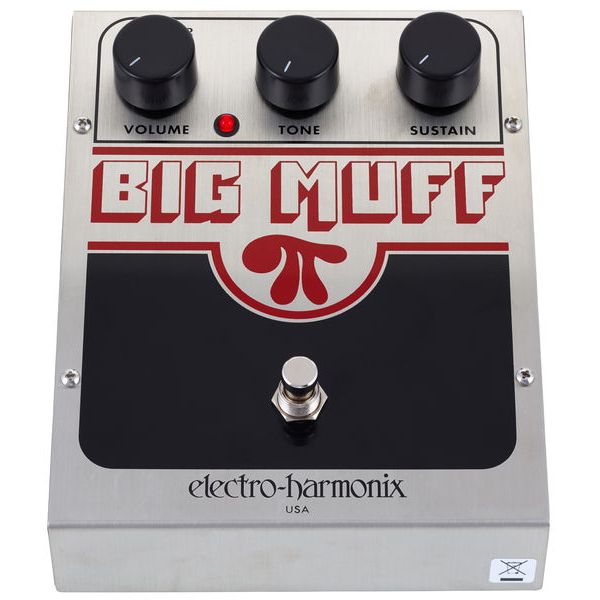
The Tone control is the interesting one. It is a passive mid-scoop network, which means as you turn it you are not really adding treble so much as choosing how much midrange to throw away.
- Tone at zero: dark, woolly, bass-heavy doom territory
- Tone around 10 to 11 oclock: the classic scooped grind that vanishes in a band mix
- Tone past 2 oclock: cutting, aggressive, slightly harsh, but it will be heard
That middle setting is the famous one and it is also the trap. It sounds spectacular in your bedroom and then disappears completely the second a drummer starts.
The Mid-Scoop Problem
This is the single biggest complaint about the Muff and it is a fair one. Scooped mids sound huge alone and thin in a band. FYI, the fix is not complicated.
Either keep the Tone knob past noon and accept a bit of bite, or park an EQ pedal after it and push 800 Hz back in. The second option is what most working players end up doing.
Stacking a mild overdrive in front works too. An OD-3 set as a clean-ish boost tightens the low end and drags some midrange back into the picture.
Where It Belongs
Big Dumb Riffs
Downtuned, slow, heavy. Nothing does sludge and stoner rock like a Muff into a loud amp. It is not tight or articulate and that is entirely the point.
Lead Sustain
Hit a note and walk away. It will still be ringing when you get back. Bends bloom into feedback with very little effort, which is a lot of fun and occasionally a live-sound problem.
Layered Noise
If you like your guitar sounding like a broken amplifier rather than a guitar, the Muff is a great starting point. Pair it with something like the Ripped Speaker and you will never make a clean sound again.
The Niggles, And There Are Some
It does not clean up with your volume knob. At all. Roll back and you mostly just get quieter mud. If you want a dirt pedal that responds to your guitar volume, buy an overdrive, not this.
The footprint is genuinely annoying on a small board. EHX make Nano versions for a reason, and if space is your constraint the Boss FZ-5 gets you three vintage fuzz flavours in a normal-sized box.
It also does not love sitting after a wah or in front of a buffered board. Fuzz circuits are picky about impedance, and the Muff is less picky than a Fuzz Face but not immune.
And there is no gate, so between riffs you get hiss. Loud hiss. That is fuzz life.
Specs At A Glance
- Analogue fuzz/distortion for electric guitar, made in NYC
- Controls: Volume, Tone, Sustain
- Status LED and true footswitch bypass
- Input and output: 6.3 mm jacks
- Power: 9V battery or 9V DC adapter, 5.5 x 2.1 mm centre negative (adapter not included)
- Current draw: only 3 mA, so it will not trouble any power supply
- Dimensions: 140 x 175 x 75 mm, weight 450 g
- Thomann article number 147853
So Which Muff Should You Buy?
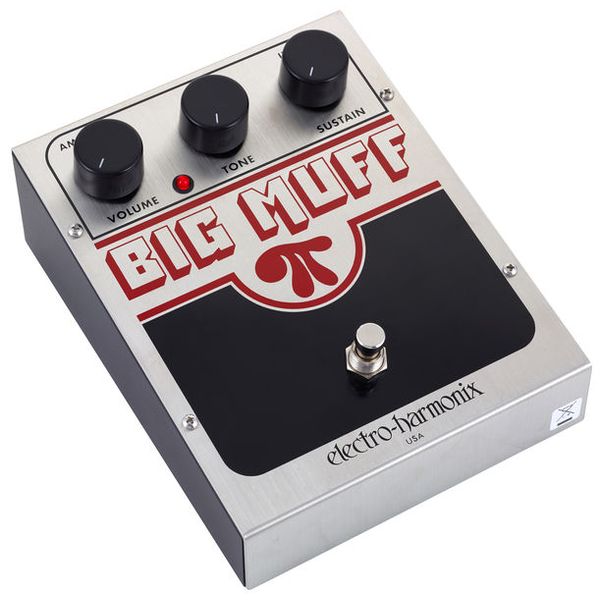
Start here. Seriously. The standard Big Muff Pi is the reference point, it is the cheapest of the family, and until you have lived with it you will not know which variant you actually want.
Play bass? Go straight to the Bass Big Muff for the blend control. Chasing that specific early-90s alt-rock scoop? The Op-Amp version. Want tight modern gain? You want a Metal Zone or something like it, not a Muff at all.
Everyone else: the original. It is the one that made all the others necessary.
Final Verdict
The Big Muff Pi is not versatile, not subtle, not small and not remotely modern. It is also one of the best value dirt pedals ever built and it has been for about fifty years.
You buy it for one sound. That sound happens to be gigantic, instantly recognisable and impossible to fake with anything else. Punches miles above its money.
If you have a spare row on your board and any interest in loud guitars, get one. Just leave the Tone knob past noon and everybody in the room will be happier 😉