Watch It First
Legend has it Dave Davies of The Kinks slashed his speaker cone with a razor blade to get that snarling tone on „You Really Got Me.” Whether or not that story is 100% true, EHX clearly loved the idea enough to build a whole pedal around it.
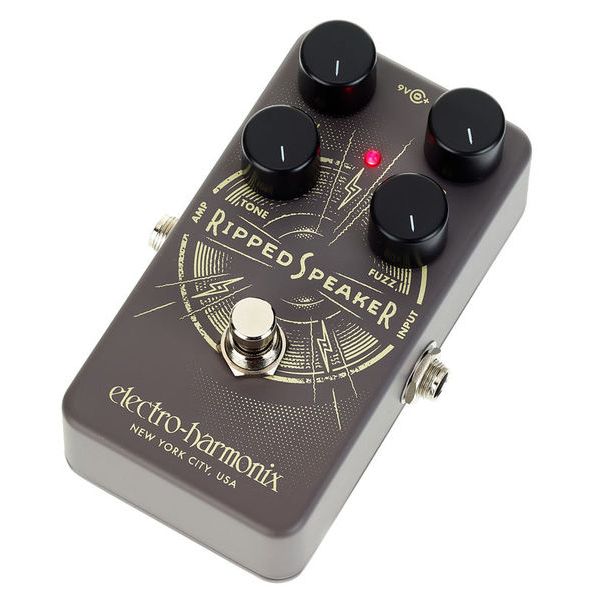
The Ripped Speaker Fuzz is exactly what it sounds like: a fuzz built to emulate torn cones, loose tubes, and busted mixer channels. Lo-fi chaos, on demand, without actually destroying any gear.
I plugged this into a few different rigs — clean combo, dirty amp, even straight into an audio interface — to see whether it’s a genuine tone tool or just a novelty box. Turns out it’s a bit of both, and that’s exactly the appeal.
What Makes This Fuzz Different
Most fuzz pedals are chasing either vintage germanium warmth or modern high-gain saturation. The Ripped Speaker splits the difference in a weird way — low Fuzz settings genuinely sound like a damaged speaker or a blown channel, all crackle and breakup, while cranking it up gets you a much more modern, fully saturated fuzz wall.
The secret sauce is the Rip knob. It’s not a gain control in the traditional sense — it dials in how „broken” the tone sounds, adding that torn-cone rattle on top of whatever fuzz character you’ve dialed in with the main Fuzz knob.
The Sound
At low Rip and low Fuzz, you get genuinely convincing vintage garage-rock breakup — think 60s recordings where the gear itself was the distortion source, not a purpose-built pedal. It’s dirty in a way that feels accidental, which is exactly the point.
Push both knobs up and it turns aggressive fast. Not a tight, modern high-gain distortion like you’d get from something built for metal — more chaotic, more textured, closer to a fuzz pedal having a mild seizure in the best possible way.
The Tone control here works more like a tilt EQ than a simple treble cut, which means you can actually rescue clarity even at extreme Rip/Fuzz settings. Compared to a straightforward drive like the Ibanez TS9 Tube Screamer, this is a completely different animal — the TS9 tightens and focuses your tone, the Ripped Speaker deliberately roughs it up.
Controls and Practical Use
Four knobs total: Vol, Tone, Rip, and Fuzz. That’s it — no hidden menus, no internal dip switches, no app required. Turn it on, start twisting knobs, and you’ll find a usable tone within about thirty seconds.
Power comes from either a 9V battery or a standard 9V DC adapter (not included), and current draw is low enough that battery life shouldn’t be a huge concern for most players who gig occasionally rather than nightly.
Who This Is For
Garage rock, stoner rock, and lo-fi indie players are the obvious home for this pedal. If your reference points include scuzzy 60s recordings or fuzzed-out 90s alt-rock, the Ripped Speaker was basically built with your pedalboard in mind.
It also works surprisingly well as an experimental texture tool for synths and other line-level sources, not just guitar and bass — several owners on Thomann specifically praise it for synth work, which says a lot about how flexible the circuit actually is.
If you’re comparing fuzz options, it’s worth putting this up against something like the Behringer SF300 for a budget angle, or a proper Big Muff variant like the one covered in the JHS Muffuletta review if you want something more classically voiced.
Playability & Usability
The Rip control is genuinely sensitive — small movements make a bigger difference than you’d expect, which several reviewers online have flagged too. It’s not a bad thing once you’re used to it, but expect to spend your first session just mapping out what each quarter-turn actually does.
Chords hold together reasonably well at moderate settings, but push it into full chaos mode and single-note lines and simple power chords will serve you much better than dense voicings. This is a lead and riff pedal more than a rhythm-chord pedal at extreme settings.
Honest Niggles
This isn’t a pedal for players who want one reliable, all-purpose fuzz tone. The whole point is instability and texture, and if that’s not what you’re after, a more classic fuzz — like the EHX Nano Metal Muff for higher gain work — will serve you better night to night.
Build quality is standard EHX fare, which is to say functional and roadworthy but not fancy. No true bypass buffering tricks or premium switches here — it’s a simple, honest little box, for better or worse.
It’s also genuinely easy to dial in a tone that’s more „broken pedal” than „cool broken pedal.” There’s a real skill to using the Rip control tastefully, and if you crank everything to see what happens, don’t be surprised if it sounds like garbage. That’s arguably the point, but it’s worth the warning.
Specs at a Glance
- Effect type: Fuzz with speaker/cone-breakup emulation
- Controls: Vol, Tone, Rip, Fuzz
- Footswitch: standard bypass
- Power: 9V battery or 9V DC adapter (adapter not included)
- Current draw: 10 mA
- Input/output: 1/4-inch jack in and out
- Dimensions: 70 x 114 x 53 mm
Final Verdict
The Ripped Speaker Fuzz isn’t chasing a polished, universally flattering tone — it’s chasing character, and it nails that brief. If garage rock grit, torn-speaker rattle, and fuzzed-out chaos are on your wishlist, this delivers all of it in a compact, affordable box.
It won’t replace a more general-purpose fuzz or overdrive like something covered in our MXR Six Band EQ review for shaping a clean tone, and it’s genuinely not for everyone. But for the players it’s aimed at, it’s a genuinely fun, characterful pedal that punches above its price.
If you want a fuzz that sounds like it’s actively falling apart in the best way possible, this is one of the more interesting options out there right now. Worth a look, IMO, especially at this price point.