Watch It First
Nobody dreams about buying an EQ pedal. It’s not sexy, it doesn’t make noise on its own, and it’s easy to skip when you’re building a board.
That’s exactly why the Boss GE-7 has been quietly essential gear since 1981. It fixes problems other pedals can’t.
Let’s talk about what it actually does, and why so many pros keep one around even when it’s the most boring-looking box on the board.
Build Quality
Standard Boss compact housing, which means it’s basically bombproof. Same footswitch, same metal chassis, same „will outlive you” energy as every other pedal in the line.
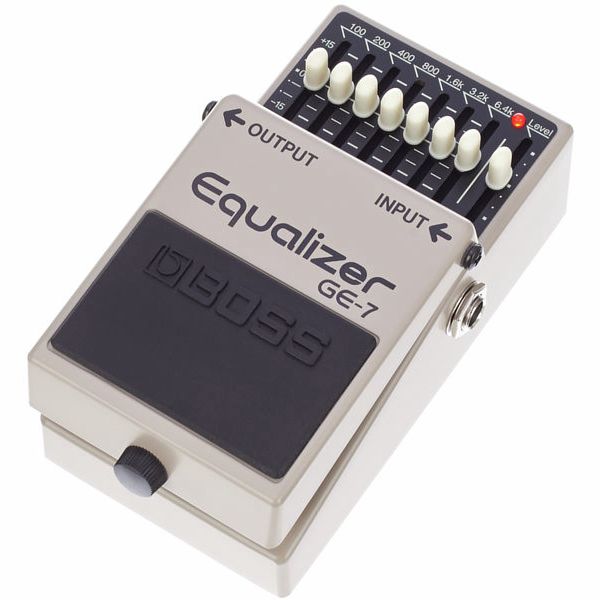
The seven sliders feel solid and stay put once set, which matters a lot for a pedal whose entire job is precise settings.
At 450g it’s a bit heavier than a typical single-knob pedal, but nothing that’ll throw off your board’s balance.
Tone and Sound
Seven bands, from 100Hz to 6.4kHz, each with +/-15dB of boost or cut, plus an overall level slider. That’s a lot of control in a small box.
It’s genuinely transparent when set flat – it’s not adding color of its own, which is exactly what you want from a tool like this.
As a Solo Boost
This is the classic use case. Scoop the low mids slightly, boost around 1-2kHz, push the level up, and your leads cut through the mix without needing more gain.
It’s a much more surgical way to get „louder and clearer” than just mashing another overdrive in front of your amp.
As a Tone-Fixing Tool
Got a guitar that sounds a bit boxy? A boomy room? An amp that’s a touch too bright for the venue? This fixes all of that without touching your amp’s own EQ.
Put it after a distortion pedal like the MXR Fullbore Metal and you can shape the exact frequency spread of the distortion itself, which is a trick a lot of players never think to try.
Playability and Usability
Sliders are laid out clearly and labeled by frequency, so it’s easy to see your curve at a glance, unlike a knob-based EQ where you have to remember which knob does what.
It takes a bit of trial and error to dial in your first „good” setting, but once you find it, it’s simple to recall by eye – just look at the slider positions.
Who It’s For
Gigging guitarists who need a reliable solo boost. Anyone whose amp or guitar has a specific tonal quirk they want to correct. And honestly, anyone who’s never used an EQ pedal and is curious what all the fuss is about.
If you’re mostly a bedroom player who never gigs, you might not need the precision this offers – but it’s still a great learning tool for understanding how frequencies actually shape your tone.
Honest Niggles
Seven fixed bands means you don’t get the surgical precision of a full parametric EQ. If you need to notch out one very specific frequency, this isn’t quite that tool.
It’s also easy to overdo it. Push every slider too far and you’ll get noise and a thin, weird sound. Subtlety is the name of the game here, even though the temptation to max everything out is real.
And yeah, it’s not an exciting pedal to show off at a jam. Nobody’s ever gone „ooh what’s that” about someone’s EQ pedal. That’s fine, it’s not there to impress anyone 😉
How It Stacks Up Against Alternatives
Compared to the MXR Six Band EQ, the GE-7 has one more band and covers a slightly wider frequency spread, giving you a bit more control for the same basic idea.
If you’re using it to shape an already-dirty tone, it pairs particularly well with pedals like the Boss SD-1 or the MXR Super Badass Distortion – both already have some built-in tone shaping, but a dedicated EQ after them gives you a final, precise polish.
Against a full-featured drive pedal like the Boss OD-200, the GE-7 obviously isn’t a distortion source at all – it’s a support tool, and honestly a lot of gigging guitarists run both.
A Few Starting Curves
For a solo boost, try a slight scoop around 400-800Hz, a gentle bump at 1.6-3.2kHz, and push the overall level a few dB above unity.
For taming a boxy-sounding amp, cut around 400-800Hz more aggressively and leave everything else close to flat.
For adding a bit of „air” to a dull-sounding guitar, a small boost at 6.4kHz goes a long way without making things harsh.
None of this is gospel – every rig is different, and the fun part is actually hearing what each band does to your specific setup rather than copying someone else’s numbers blindly.
Key Specs
- Type: 7-band graphic EQ pedal for electric guitar
- Bands: 100Hz, 200Hz, 400Hz, 800Hz, 1.6kHz, 3.2kHz, 6.4kHz
- Range: +/-15dB per band, plus overall level slider
- Power draw: 10mA
- Power: 9V battery or 9V DC adapter (not included)
- Dimensions: 73 x 129 x 59 mm, weight 450g
Where It Sits In Your Signal Chain
Placement matters more with an EQ pedal than almost anything else on your board. Most players run the GE-7 near the front, right after any drive pedals but before modulation and time-based effects.
That order shapes the tone before it hits your delay or reverb, so the shimmer doesn’t get muddied by uneven frequencies. Some players prefer it in the effects loop of an amp instead, especially if they’re using it purely as a corrective tool rather than a boost.
A Note on Noise
Push several bands hard and you’ll hear a bit more hiss creep in, especially through a high-gain amp. It’s not bad by pedal standards, but it’s worth knowing if your rig is already noisy.
Pairing it with a noise gate later in the chain sorts this out completely, and most gigging players already run one anyway.
Final Verdict
The Boss GE-7 isn’t a pedal you buy for excitement. It’s a pedal you buy to solve actual problems – a dull amp, a buried solo, a guitar that just needs a little correction.
Once you own one, you’ll wonder how you gigged without it. It’s precise, transparent, and built like a tank, which is basically the whole Boss formula in one box.
Not glamorous, genuinely useful. Recommended, especially if you’ve never used a dedicated EQ pedal before.