Watch It First
Boss has released something like a thousand overdrive pedals since 1977. Okay, that’s a slight exaggeration. But the Boss OD-200 Hybrid Drive is basically Boss’s own answer to the question „why not just put all of them in one box?”
It’s part of the same 200-series family as the DD-200 delay and the MD-200 modulation unit, and it crams twelve overdrive and distortion voicings — some modeled on classics, some cooked up in-house from scratch — into a footprint smaller than most single-trick boutique pedals.
I’ve had one bolted to my board for a good while now, running it into a couple of different amps in a couple of different rooms. So let’s actually dig into whether it earns its spot, or just looks impressive on paper.
Build and Design
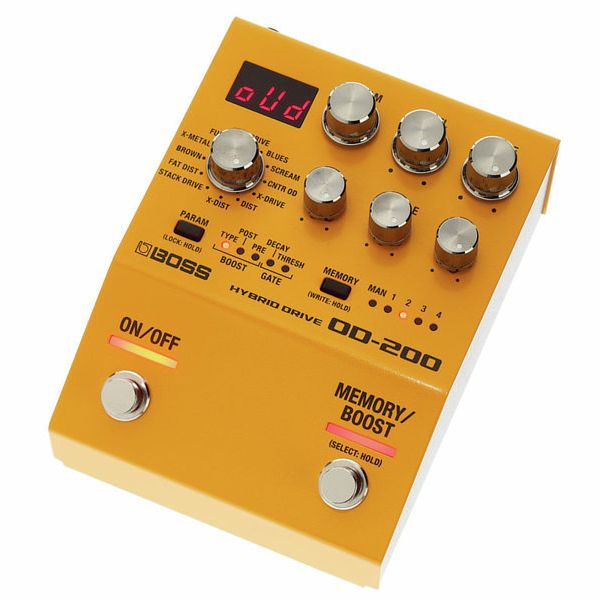
First impression: it’s dense. Boss packed a serious amount of stompbox into a fairly compact metal enclosure, and it still feels bulletproof in that way Boss pedals always do. You could probably use this thing as a doorstop after the apocalypse and it would still boot up fine.
There’s a small LED screen up top, a rotary Param knob, dedicated Level, Drive, Low, Mid and High knobs, and two footswitches. One cycles through your saved memories, the other toggles the effect on and off — though you can flip that assignment around if you’d rather.
The Screen and Menu
The screen is small, and honestly it’s the one place I think Boss cut a corner. Editing deep parameters means diving into sub-menus, and the printed manual is not exactly a joy to read. Give it twenty minutes of fiddling and it clicks. Just don’t expect it to be obvious the moment you open the box.
MIDI in and out plus USB are both here too, and that matters more than it sounds like it should. You can automate patch changes straight from a DAW, sync it to a MIDI switcher, or back up your presets before disaster strikes. Anyone who has lost a perfectly dialed patch knows exactly why that last bit matters.
Sound and Tone
Twelve drive engines is the headline number, and Boss didn’t just phone it in for the sake of a spec sheet. You get takes on Tube-Screamer-style mid-hump drive, a boutique Klon-adjacent transparent boost, British-voiced distortion, a fuzz mode, and heavier, metal-oriented gain stages.
The trick that actually sells the OD-200, though, is the ability to stack two gain stages — pre and post — inside a single patch. So instead of choosing Tube Screamer or fuzz, you can layer a clean boost in front of a fuzzier voice and dial the blend until it sits exactly right for the song.
Where It Really Shines
Blues and classic rock tones are genuinely excellent here. Warm, touch-sensitive, and they don’t fizz out when you dig into the strings. The metal-leaning voices are good, not incredible — if high gain is your entire personality, a dedicated distortion pedal will probably still edge it out for pure aggression.
The EQ section is fully parametric and saves per-patch, which is the kind of detail that separates a genuinely useful multi-pedal from a gimmick you stop using after a month.
Playability and Everyday Use
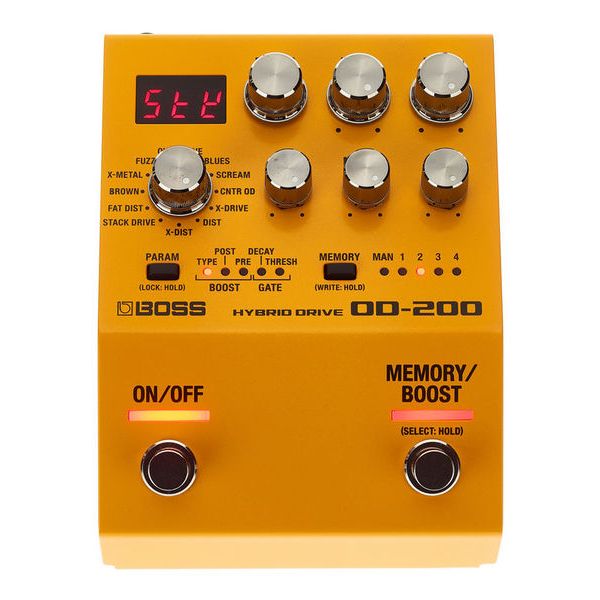
Twelve voices sounds overwhelming on paper, but Boss keeps four quick-access memory slots right on the surface, so live use is just stomp, stomp, done. You only dive into the full 128-preset library when you’re building your rig at home, not mid-set.
Boot time and switching are essentially instant — no digital lag, no weird pop or gap when the patch changes. That’s a bigger deal than it sounds if you’ve ever used a sluggish multi-effects unit live and felt that half-second of dead air.
Compared to something like the NUX MG-30, which throws everything — amps, cabs, full effects chains — at you in one modeling box, the OD-200 stays disciplined. It only does drive, and because that’s all it does, it does it properly.
Setting Up Your First Patches
Setting up your first few patches takes some patience, mostly because of that menu-diving I mentioned earlier. My advice: spend one evening with it before a gig, not the afternoon of. Map your four favorite voicings to the quick-access slots, set your EQ per patch, and you’re basically done tweaking for months.
Who It’s For
Session players and gigging musicians who need a wide gain palette without checking three pedals into a flight case are the obvious audience here. Worship and cover bands who jump from clean-ish blues crunch to full rock distortion between songs will get a lot of mileage too.
Pedal nerds who’ve been chasing one specific vintage overdrive sound and want to try a modeled version before dropping serious money on the real, often-discontinued thing will also find a lot to like.
If you’re a one-trick-pony player — you know exactly one overdrive tone you’ll ever use, forever — this is overkill. Grab a Boss DS-1 and call it a day.
Being Honest About the Niggles
The menu diving is real, and I won’t pretend otherwise. Editing beyond the front-panel knobs means learning Boss’s slightly clunky UI logic, and there’s no companion app to smooth that over, unlike some competitors in this exact price bracket.
It runs on batteries or a 9V supply, but that supply isn’t included in the box. A small annoyance when you’re already investing in a pedal at this level, and it’s the kind of thing that should honestly just be bundled by now.
Because it’s fundamentally digital under the hood, purists who insist digital drive can never touch a real discrete-transistor circuit won’t be fully converted. It gets close. It isn’t identical. IMO that gap keeps shrinking every generation, though.
How It Compares
Against a dedicated boutique overdrive, the OD-200 loses a little of that one specific bit of magic in exchange for flexibility — that’s just the tradeoff with any multi-voice unit. Against something like the MXR Sugar Drive Mini, which nails one Klon-style voice and nothing else, the OD-200 is the Swiss Army knife to that scalpel.
If your board already has a solid tuner and amp setup dialed in and you just need „the drive section” handled once and for all, this single box genuinely replaces three or four pedals. That’s not marketing spin, that’s just arithmetic.
It’s also worth a passing comparison to Boss’s own Katana amp line, since a lot of OD-200 buyers run one into a Katana’s clean channel and use the pedal for all their gain staging instead of the amp’s onboard drive voices — a setup that works surprisingly well and keeps your tone consistent no matter which amp you’re plugged into that night.
Specs at a Glance
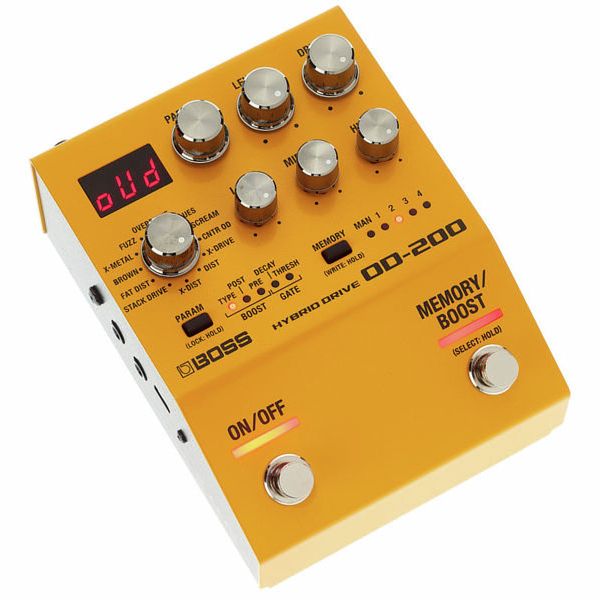
- Effect type: Hybrid digital/analog overdrive & distortion pedal
- 12 onboard drive and distortion voicings
- 32-bit / 96kHz sound processing
- 4 quick-access memory slots, 128 total presets
- Independent 3-band EQ per patch, fully parametric
- MIDI in/out and USB connectivity
- Dual footswitches, plus external switch/expression pedal input
- Runs on 3x AA batteries or 9V DC power supply (not included)
- Compact 101 x 138 x 63mm enclosure, 600g
Final Verdict
The Boss OD-200 isn’t trying to be the single best overdrive pedal on the market, and it knows it. It’s trying to be the last drive section you’ll ever need to shop for, and it mostly pulls that off.
If you gig often, cover a wide stylistic range, or just hate carrying five separate boxes for five separate flavors of gain, this thing earns its spot on the board without much of an argument.
It’s not going to steal your heart the way one perfect boutique pedal might. But it’ll do the job, every single night, without complaint. And honestly, that’s worth more than most of us want to admit.