Watch It First
MXR makes a lot of distortion pedals. This is the one that actually gives you an EQ section instead of just a single „tone” knob and a prayer.
The Super Badass Distortion has been quietly sitting in MXR’s lineup since 2013, overshadowed by flashier signature pedals. That’s kind of a shame.
I’ve run one on and off my board for years, through clean amps and dirty ones, so let’s get into whether it deserves a spot on yours.
Build Quality
MXR housings are basically indestructible, and this one’s no different. Die-cast metal, a status LED that’s visible even in a dark venue, and a footswitch that feels like it’ll outlive you.
It runs on a 9V battery or a standard 9V DC adapter (not included, and honestly, just buy the adapter – battery life on always-on gain pedals is never great).
True bypass means it stays out of your way when it’s off. No tone-sucking, no weird volume drop. Simple.
Tone and Sound
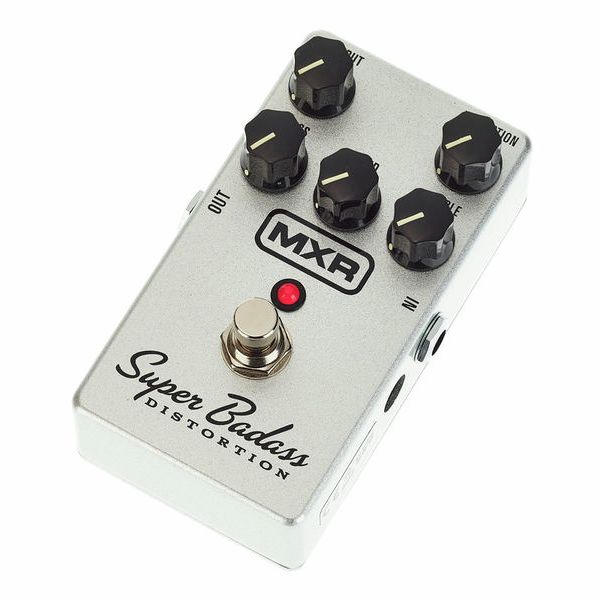
Here’s what separates this from a lot of one-trick distortion boxes: five knobs. Output, Distortion, Bass, Mid, Treble.
That EQ section is the whole point. Most distortion pedals give you gain and volume and maybe a single tone knob, which is fine until you plug into a different amp and suddenly everything sounds like a kazoo.
Low to Mid Gain
Rolled back, the Distortion knob gets you into crunchy rock territory pretty fast – think classic rock rhythm tones, not bedroom-fuzz mush.
It cleans up reasonably well with your guitar’s volume knob too, though it’s not as touch-sensitive as an Ibanez TS808-style overdrive. This pedal wants to be a distortion pedal, not a polite overdrive pretending to be one.
High Gain
Crank it and you get a thick, saturated distortion that scoops nicely if you want that mid-scooped metal thing, or keeps the mids up front for a more classic hard rock voice.
It won’t out-gain a dedicated metal pedal, and it’s genuinely not meant to. If you want death metal chug, you want something like the MXR Fullbore Metal, not this.
Playability and Usability
The controls are laid out sensibly and the knobs have enough resistance that you won’t knock a setting out of place loading gear into a van.
It’s not a tiny mini pedal, so budget a bit more pedalboard real estate than you would for something like an MXR Classic 108 Fuzz Mini. Worth it for the extra controls IMO.
Dialing in a good sound takes maybe five minutes the first time, then it’s muscle memory after that.
Who It’s For
Guitarists who want one distortion pedal that can cover rock, hard rock, and light-to-medium metal without switching pedals mid-set.
It’s also a solid pick if your amp’s own gain channel is a bit flat or boxy and you want a pedal that can actually reshape the EQ, not just add fuzz on top.
If you’re chasing a specific vintage fuzz tone, look elsewhere – this is a modern-voiced pedal through and through.
Honest Niggles
The size is the first thing. It’s not huge, but on a crowded board it eats more space than you’d expect from a „simple” distortion pedal.
Second, at very high gain settings with a lot of treble dialed in, it can get a touch harsh through brighter amps. Nothing an amp EQ tweak or the pedal’s own Treble knob can’t fix, but it’s there.
And no, it’s not a boutique pedal – it won’t compete with a $300 hand-wired distortion in terms of touch response. For what it is though, that’s a nitpick more than a real complaint.
How It Stacks Up Against Alternatives
Compared to a straightforward overdrive like the Boss OD-200, this pedal is voiced far more aggressively and doesn’t try to be a tube-amp emulator – it just wants to distort your signal, full stop.
Against fuzz-flavored options like the Electro-Harmonix Op-Amp Big Muff, the Super Badass is tighter and more controllable, with less of that wooly low-end sustain fuzz pedals are known for.
If your board already has a chorus or EQ pedal like the MXR Analog Chorus or a MXR Six Band EQ, this distortion slots in right alongside them – same footprint family, same build quality, no surprises.
Key Specs
- Type: Analog distortion pedal for electric guitar
- Controls: Output, Distortion, Bass, Mid, Treble
- Bypass: True bypass
- Housing: Die-cast metal, status LED
- Power: 9V battery or standard 9V DC adapter (not included)
- On the market since: 2013
Quick Settings to Start From
If you want a classic rock rhythm tone, keep Distortion around 10-11 o’clock, push Mid up a bit, and back off Treble slightly so it doesn’t get fizzy through a bright amp.
For a scooped hard-rock or light metal sound, drop the Mid, push Bass and Treble up, and run Distortion closer to 2-3 o’clock. This is where the pedal really wakes up.
Lead tones benefit from a Mid boost again – counterintuitive, but a mid-forward lead cuts through a mix way better than a scooped one, even if scooped sounds „heavier” on its own.
None of these are gospel, obviously. Every amp reacts differently, and half the fun of a pedal with this many knobs is just turning things until it sounds right for your rig.
Final Verdict
The MXR Super Badass Distortion is one of those pedals that doesn’t get talked about enough. It’s not flashy, it’s not a signature model, it just does distortion really well.
The full EQ section is what sells it for me – being able to actually shape bass, mid, and treble independently makes it useful across way more amps and guitars than a single-knob distortion box.
If you want one pedal that goes from crunchy rock to solid hard-rock/light metal territory, this punches well above its weight. Recommended.