Watch It First
Fuzz pedals are weirdly polarizing. Half the guitarists I know treat them like a novelty box that only comes out for one Hendrix cover a set, and the other half won’t leave home without one.
I fall into the second camp, and the MXR Classic 108 Fuzz Mini, better known around forums and gear shops as the MXR take on the Fuzz Face Mini, is the reason why. It’s a BC108 silicon Fuzz Face circuit crammed into MXR’s compact mini housing, turquoise Hammertone finish included.
Quick heads up before we go further, MXR sells this under the name Classic 108 Fuzz Mini rather than „Fuzz Face Mini” on the spec sheet, but it’s the same silicon Fuzz Face DNA everyone’s chasing when they search for that name. Same idea, official label.
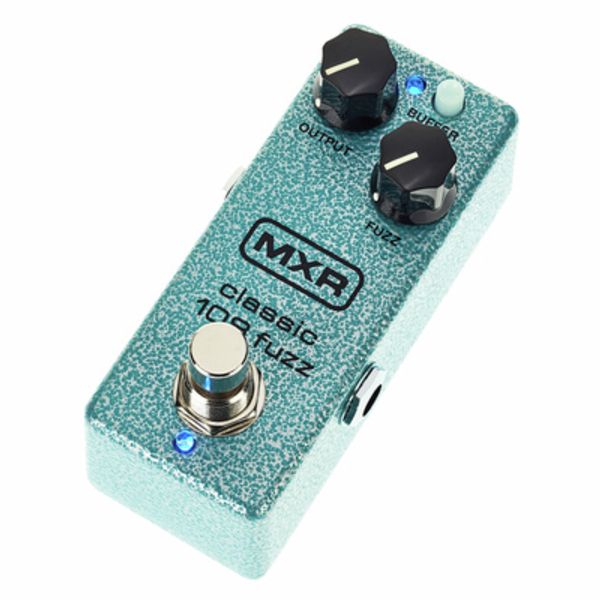
This isn’t some watered-down budget fuzz either. It’s a proper vintage-voiced circuit that happens to fit on even the most cramped pedalboard, and after weeks of gigging with it, I’ve got a clear picture of where it shines and where it doesn’t.
Where This Circuit Comes From
The original Fuzz Face is one of those circuits that basically defined an era of guitar tone, all thanks to a two-transistor design that’s almost stupidly simple on paper. MXR took that BC108 silicon transistor variant, the brighter, more aggressive cousin of the germanium originals, and shrunk the whole thing down.
You get exactly two knobs, Volume and Fuzz, plus a toggle switch to engage an internal buffer. That buffer switch matters more than it sounds like it should, more on that in a second.
Sound
No Tone Knob, And That’s The Point
There’s no tone knob, which trips up players expecting a modern fuzz with EQ shaping baked in. This is a guitar-volume-knob-is-your-tone-knob kind of pedal, the way the originals worked back in the sixties.
Roll your guitar’s volume down and this thing cleans up beautifully, going from full fuzz to a gritty, sparkly clean edge without ever feeling like you flipped a switch. That interactive cleanup behavior is the whole appeal of a real Fuzz Face circuit, and MXR nailed it here.
Dime the Fuzz knob and you’re in classic Hendrix or early Clapton territory, thick, slightly gated, and very vocal sounding. It responds to pick attack in a way that a lot of modern high-gain fuzzes just don’t bother with anymore.
The Buffer Switch Actually Matters
Vintage-style fuzz circuits hate being placed after a wah or in front of a buffered pedal chain. Impedance mismatches make them go thin, farty, or just weird sounding. That’s true of most Fuzz Face clones, and worth knowing if you’ve read my Ibanez TS9 write-up and assumed pedal order doesn’t matter much, with fuzz circuits like this, it really does.
That’s exactly why the internal buffer switch on this pedal is such a smart addition. Flip it on and the Classic 108 plays nicely with wahs, buffered boosts, and long cable runs. Flip it off and you get the raw, interactive vintage behavior purists want. Having both options in one box solves a decades-old fuzz pedal headache.
Build Quality
Build quality is straightforward MXR, a die-cast metal shell that’ll take a beating, a bright status LED, and a true bypass footswitch. At 90 x 40 x 55mm and 130 grams it’s genuinely tiny, easily one of the smallest full-size-sounding fuzzes you can fit on a board.
One thing to flag, there’s no battery option here, it’s 9V DC power only through a standard 2.1mm center-negative jack. If your board runs on a battery clip for some reason, this isn’t the pedal for you. Most gigging boards run isolated power supplies anyway, similar to what I covered when I reviewed the Boss TU-3W Waza Craft, so it’s rarely an actual dealbreaker.
Playability And Use Cases
Where this pedal genuinely shines is single-coil guitars into a clean-ish amp. Strats and Teles come alive with this thing, that spiky, vocal fuzz tone practically defines the classic rock and blues-rock sound. Humbucker guitars work too, just expect a thicker, less articulate fuzz character, less „quack,” more wall of gain.
For gigging musicians, the compact footprint is the real selling point beyond tone. A lot of boutique Fuzz Face clones are the size of a paperback book, this one takes up barely more room than a tuner pedal. If your board is already stuffed with delay, reverb, and a compressor like the ones I mentioned reviewing the MXR Sugar Drive Mini, that size difference actually matters when you’re planning real estate.
It’s also dead simple to dial in during a soundcheck. Two knobs, no digital menu, no saving presets, just turn it until it sounds right and go. There’s something refreshing about that kind of directness after spending time with more complex modern pedals.
Who It’s Actually For
If you play modern metal, djent, or anything that wants a tight, high-gain distortion character, this isn’t your pedal, full stop. Fuzz Face circuits are loose, vocal, and a little chaotic by design, that’s the whole point, but it’s the opposite of tight palm-muted precision.
If you’re chasing that specific sixties and seventies fuzz tone, or you just want an authentic Fuzz Face experience without hauling around a full-size pedal, this checks every box. It’s also a great option for players who already own a Tube Screamer style overdrive, similar to something like the Fender Hammertone Breakup Driver, and want a genuinely different flavor of dirt to stack alongside it.
Bass players occasionally reach for these too, though be warned, low end gets seriously fuzzy and compressed. Fun for a synth-bass texture, not something you’d want as your main tone live unless that’s specifically the vibe you’re going for.
Honest Niggles
The lack of a tone control is going to bother some players, and I get it, but it’s also kind of the point. Adding EQ shaping would move this further from the vintage circuit it’s emulating and closer to a generic modern fuzz, and there are plenty of those already on the market.
The buffer switch LED runs bright enough that a few reviewers online have mentioned it as mildly annoying on a dark stage. It’s a minor gripe, but worth knowing if you’re sensitive to stray light near your pedalboard during a show.
Interaction with wah pedals, even with the buffer engaged, isn’t always perfect. Try before you commit to a specific pedal order if wah into fuzz is a core part of your sound, some combinations still need a little trial and error.
MXR Classic 108 Fuzz Mini – Specs At A Glance
- Circuit: BC108 silicon Fuzz Face circuit
- Controls: Volume, Fuzz
- Extras: Internal buffer switch, status LED
- Bypass: True bypass
- Housing: Die-cast metal, turquoise Hammertone finish
- Connectors: 6.3mm mono input and output
- Power: 9V DC, center-negative, no battery option
- Current draw: 2.2 mA
- Dimensions: 90 x 40 x 55 mm
- Weight: 130 g
Final Verdict
This pedal is proof you don’t need a huge boutique box to get an authentic, interactive Fuzz Face tone on your board. MXR took a genuinely great vintage circuit, added one genuinely useful modern feature in that buffer switch, and shrunk the footprint way down.
It’s not for everyone, tight modern gain players should look elsewhere entirely, and the lack of a tone knob will frustrate anyone wanting fine-tuned EQ control on the fly.
But for players chasing that classic, touch-sensitive, cleans-up-with-your-volume-knob fuzz character in the smallest possible package, this is honestly one of the best values going right now. IMO it’s a no-brainer pickup if that’s the tone you’re after.