Watch It First
Squier’s Paranormal series is where Fender lets the design team off the leash, and the Troublemaker Telecaster Deluxe is the maddest thing to crawl out of it so far.
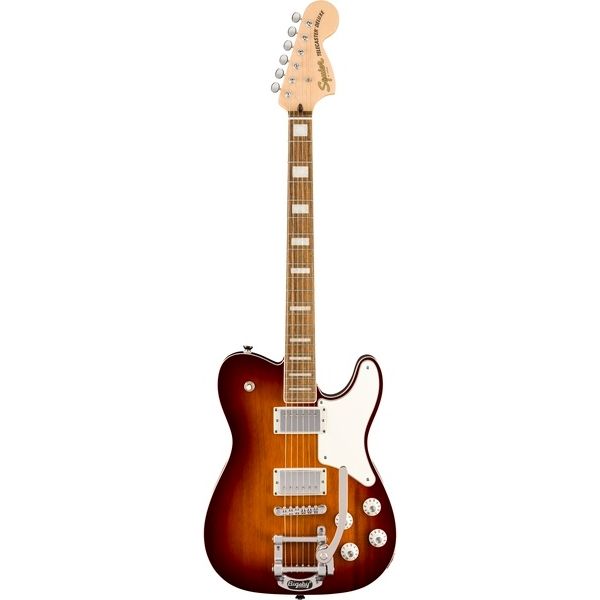
It is a Telecaster that clearly spent too much time hanging around Les Pauls. Two humbuckers, four knobs, a Tune-o-matic bridge and a Bigsby sitting on the tail like it owns the place.
I fully expected a novelty. Instead I got one of the more genuinely useful guitars in the budget bracket. FYI, that surprised me too.
So What Is a Troublemaker Telecaster, Exactly?
Take a standard Tele outline in nato, bolt on a maple neck, then chuck the traditional wiring straight in the bin.
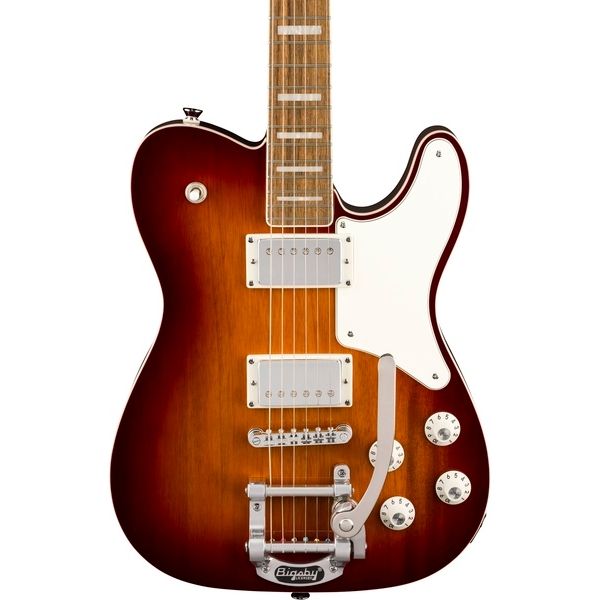
You get two Fender Designed Alnico humbuckers, two volumes, two tones and a three-way toggle. That is Les Paul control layout on a Tele body, and it works far better than it has any right to.
The bridge is a Tune-o-matic on a micarta base, with a Bigsby-style B50 vibrato behind it. No ashtray plate, no through-body stringing, none of the usual Tele furniture.
If you came here hunting spank and twang, this is not your guitar. Go and read my Squier Sonic Telecaster review instead – that one is the traditionalist of the family.
The Pickups Do the Heavy Lifting
The humbuckers are hotter than I expected but nowhere near as woolly as budget buckers usually turn out.
Bridge position is thick and slightly gritty with enough top end to cut through a band. Neck position is round and smooth without collapsing into mud, which is the usual failure mode at this money.
The Push-Pull Coil Splits Are the Secret Weapon
Both tone knobs pull up to split the coils. That is the moment this stops being a one-trick rock guitar.
Split the bridge and you get a thin, wiry snap that is not quite a real Tele bridge pickup but is a lot closer than you would guess. Split both and there is a hollow, chimey middle sound I ended up using far more than I planned.
Is it as convincing as the real thing? No. But four genuinely usable voices out of one budget guitar is good value in anyone’s book.
- Both humbuckers, clean – fat and jangly, perfect for indie chord work
- Bridge humbucker, driven – proper rock crunch with no flub in the low end
- Bridge split – sharp and cutting, close enough to Tele territory for country-ish parts
- Neck split – soft and glassy, lovely with a bit of reverb on it
The Bigsby: Genuine Fun or Just Faff?
Bit of both, honestly.
The B50 is the lighter, cheaper Bigsby variant, and it does exactly what a Bigsby is supposed to do – shallow, wobbly vibrato that makes every chord sound like it was tracked in 1963.
What it does not do is stay in tune if you are heavy handed. Pair a Bigsby with a Tune-o-matic and vintage-style tuners and you have three tuning-stability variables all working against you at once.
Stretch the strings properly, get some pencil lead into the nut slots, and it settles right down. Do that and it will hold for a whole set. Skip it and you will be tuning between every song, lol.
Playing It
The Neck
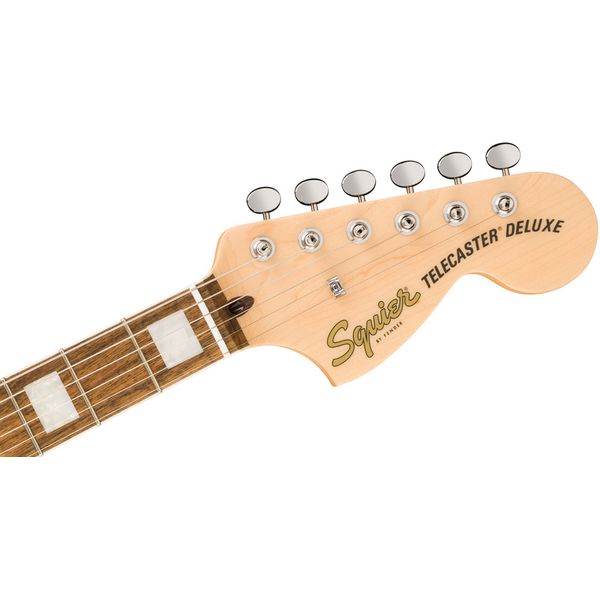
Standard C profile, 648 mm scale, 22 narrow-tall frets on Indian laurel with a 241 mm radius.
It is a completely normal, comfortable modern Squier neck, and I mean that as a compliment. Narrow-tall frets make bending effortless and the finish does not grab your hand when it gets sweaty.
The pearloid block inlays look far more expensive than they are. Small thing, but it changes how the guitar reads from ten rows back.
Weight and Balance
Nato body, so it sits on the heavier side of the Squier range without being punishing. It hangs level on a strap with no neck dive whatsoever.
The Bigsby adds mass at the tail, which honestly helps the balance rather than hurting it.
The Honest Niggles
- Factory setup was on the high side – a truss rod tweak and a bridge drop sorted it in ten minutes
- The B50 will test your patience until the strings are properly stretched
- Stock .009 gauge strings feel flimsy under a guitar this thick-sounding, I went to .010s immediately
- Pot tapers are abrupt – most of the useful range lives in the last third of the sweep
- Nato is not the world’s prettiest wood under a burst; Honey Sunburst hides it well, other finishes less so
How It Stacks Up Against Its Siblings
Against a Squier Affinity Stratocaster this is a completely different animal. The Affinity is the budget workhorse; the Troublemaker is the character piece you buy second.
The closer comparison is the Squier Affinity Starcaster Deluxe, which chases similar oddball territory for similar money. The Starcaster is airier and looser; the Troublemaker hits harder.
If what you actually want is a modern Tele with real Tele pickups, the Fender Player II Telecaster is a big step up in cash but a far more conventional buy.
And if the Les Paul thing is what pulled you in, an Epiphone Les Paul Standard 60s does that properly – you just lose the Tele outline and the Bigsby party trick.
Who Should Actually Buy This?
Indie and alt players who want jangle and grit out of the same instrument. Rockabilly and country-adjacent players who want a Bigsby without paying Gretsch prices.
Anyone whose collection is already full of sensible guitars and needs something with a bit of personality in it.
Metal players, obviously not. Purists chasing 1952 twang, also no – go and look at the Vintera III 50s Telecaster and enjoy yourself.
Specs at a Glance
- Body: nato
- Neck: bolt-on maple, C profile
- Fretboard: Indian laurel, 241 mm radius, pearloid block inlays
- Frets: 22, narrow/tall
- Scale: 648 mm (25.5”)
- Nut: micarta, 42 mm wide
- Pickups: 2x Fender Designed Alnico humbuckers
- Controls: 2 volume, 2 tone, 3-way toggle, push-pull coil splits
- Bridge: Tune-o-matic with Bigsby-style B50 vibrato
- Hardware: chrome, vintage-style tuners
- Strings: .009 – .042 nickel-plated steel
- Finish: Honey Sunburst, high gloss
- Thomann article number: 647149
Final Verdict
The Troublemaker Telecaster Deluxe is that rare budget guitar which is not trying to be a cheap copy of something famous. It is its own thing, and it commits to the bit completely.
It punches well above its money on tones, looks like it cost three times what it did, and the coil splits make it far more flexible than the spec sheet lets on.
You will need to spend an hour on setup and string stretching. Do that and you have a genuinely gig-ready guitar with actual character. IMO that is a very good trade.
Recommended – especially as the second guitar for someone who already owns something sensible.