Watch It First
Quick note before we start: that demo is the Floyd Rose and Sustainiac sibling. The guitar I’m writing about is the plain hardtail version, so ignore the whammy antics and listen to the pickups.
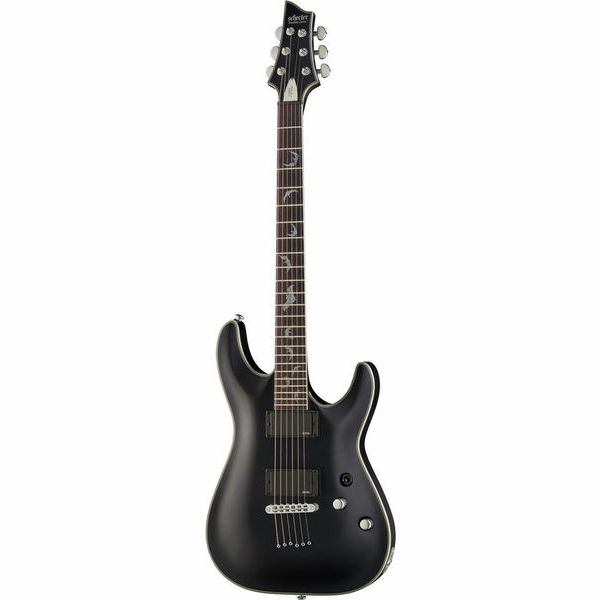
The Damien Platinum sits at the top of Schecter’s blackout tree – the tier that took over from the old Damien Elite. Mahogany body, set maple neck, real EMG actives, bat inlays. Matte black everything.
And it lands about a week after I wrote up the Schecter Omen Extreme-6, which is the pretty, flame-topped, passive-pickup one. Two Schecters, same brand, completely different arguments. Let me explain the difference properly.
Damien vs Omen: it’s not a price ladder, it’s a personality split
The Omen Extreme is the one you buy because it looks gorgeous. Quilted top, black cherry burst, passive Diamond humbuckers, bolt-on neck.
The Damien Platinum is the one you buy because you want a tool. There is no top. There is no burst. It is Satin Black from headstock to strap button, with silver multi-ply binding and Platinum Bat inlays as the only concession to decoration.
More importantly, the construction changes. This has a set-in maple neck rather than a bolt-on, and the maple-into-mahogany combination gives it a noticeably harder, more focused attack than the Omen. Different guitar, not a nicer version of the same one.
EMG 81 and 85: the pairing that defined a genre
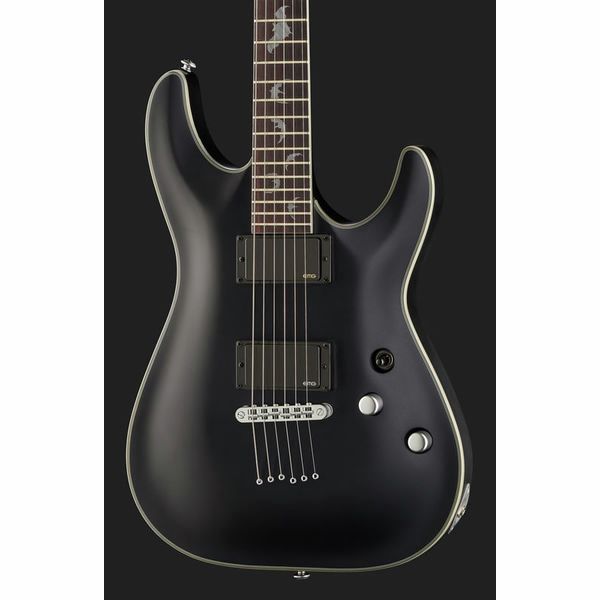
Bridge is an EMG 81. Neck is an EMG 85. If you’ve listened to metal made since about 1985, you have heard this combination roughly nine thousand times.
The 81 is ceramic, aggressive, and absurdly tight. Palm-muted chugs come out with a hard front edge and no flab underneath, which is exactly why it survived four decades of fashion changes.
The 85 in the neck is alnico and much rounder – thick, vocal, brilliant for leads. Together they’re the classic pairing rather than the also-classic 81/60 setup, and it’s the warmer of the two options.
The honest downside of actives
They’re a 9V battery in a box. Forget to unplug your cable and you’ll come back to a dead guitar. Been there, sworn about it.
They also compress. EMGs give you a fairly narrow dynamic window – hit harder and it doesn’t get proportionally louder, it just gets more of the same. Fantastic for rhythm consistency, less fun if you’re a player who leans on pick attack for expression.
If that sounds limiting, the passive route in something like the C-1 Hellraiser family or a Fishman-loaded ESP LTD MH-1000 might suit you better.
The neck is better than it needs to be
Thin C profile, 42 mm nut, a fairly flat 13.98″ radius and 24 jumbo frets. Standard 25.5″ scale.
Flat radius plus jumbo frets is a specific combination: it means you can set the action low without fretting out on big bends, and your fingers sit on top of the frets rather than pressing into the wood. It feels fast in the way a well-set-up shred guitar feels fast.
The nut is a Graph Tech XL Black TUSQ, which is a proper part rather than a bit of moulded plastic. Small detail, real effect on tuning stability.
Hardware and build
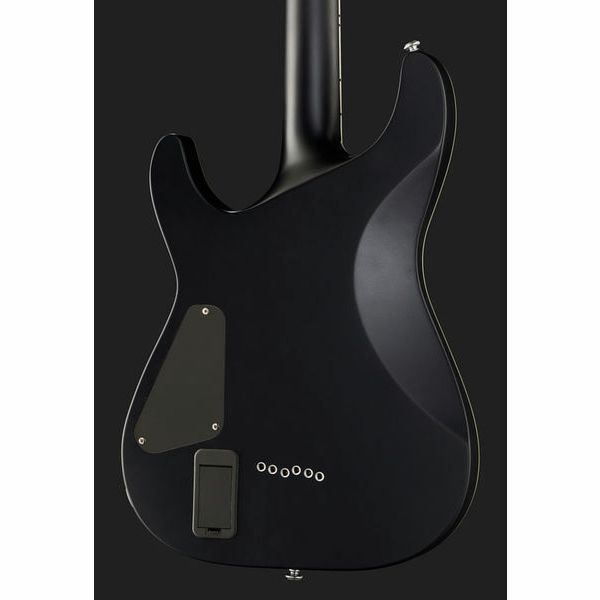
Tune-O-Matic bridge with string-through-body stringing, chrome hardware, Grover tuners.
String-through is the sensible choice here. It increases the break angle over the saddles and adds a bit of tension and sustain, and it means no floating bridge nonsense to set up. Restringing takes thirty seconds longer and rewards you with a guitar that stays in tune when you’re thrashing it.
The Satin Black finish is the one thing that’ll divide people. It feels great – no sticky gloss on the neck – but satin finishes show finger oils and shine up over time where your forearm rests. Some players love that worn-in look. Some really don’t.
What it sounds like in a room
Dial in a modern high-gain amp, no boost, and the first thing you notice is how little the guitar gets in the way. Low E chugs land with a hard click at the front and nothing muddy behind them.
Drop to D or C and it holds together far better than a bolt-on guitar in the same bracket. That’s partly the mahogany, partly the set neck, and partly the fact that an EMG 81 simply doesn’t know how to sound loose.
Clean, it’s more interesting than the reputation suggests. The 85 in the neck does a decent glassy chime if you roll the volume back a little, and the compression that annoys me under gain actually makes clean arpeggios sound very even.
What it will not do is anything vintage. There’s no bloom, no sag, no hair. Compared with something like the ESP LTD H3-1000FR and its Duncans, this is the more clinical of the two – which is either the point or the problem, depending on you.
Honest niggles
- Battery life anxiety is real with actives. Keep a spare 9V in the case.
- Satin black wears. Expect shiny patches on the body edge and behind the neck after a year of gigs.
- Rosewood board, not ebony. Perfectly good, but the old Elite tier had fancier appointments.
- Bat inlays are a commitment. You either think they’re brilliant or you’re thirty-five and slightly embarrassed. No middle ground.
- It’s a one-genre guitar. You can play jazz on it. You won’t want to.
Who should buy it
Rhythm players in heavy bands, mostly. If your job is playing tight, downtuned riffs that need to sit in a mix without turning to porridge, the 81 in a set-neck mahogany body is a shortcut to exactly that.
Also anyone who’s tired of guitars that try to be pretty. There’s something genuinely refreshing about an instrument with no ambition beyond sounding heavy.
Skip it if you want versatility, if you want a whammy bar out of the box, or if you play a lot of clean material. Something like the Sun Valley Super Shredder or the Banshee Mach-6 covers more ground.
Specs
- Body: Mahogany
- Neck: Set-in maple, Thin C profile
- Fretboard: Rosewood, Platinum Bat inlays
- Frets: 24 jumbo
- Scale: 648 mm (25.5″)
- Fretboard radius: 355 mm (approx. 14″)
- Nut: Graph Tech XL Black TUSQ, 42 mm
- Pickups: Active EMG 81 (bridge) and EMG 85 (neck)
- Controls: Volume, tone, 3-way switch
- Bridge: Tune-O-Matic with string-through-body
- Tuners: Grover
- Binding: Silver / platinum multi-ply
- Finish: Satin Black
Final Verdict
The Damien Platinum-6 is what happens when a company stops trying to make a metal guitar that also does other things.
Set neck, EMG 81/85, jumbo frets on a flat board, string-through bridge, and a finish designed to disappear under stage lights. Every decision points the same direction, and the result punches well above its money.
It won’t win a beauty contest against the Omen Extreme – it isn’t trying to. This is the one you take to the gig and leave in a flight case, and it’ll still sound identical in three years.
If you want black, tight and mean, this is a very easy recommendation 😉