Watch It First
The Starcaster is Fender’s weirdest good idea. A big offset semi-hollow with humbuckers, launched in 1976, ignored for thirty years, then quietly resurrected once everyone decided it looked cool.
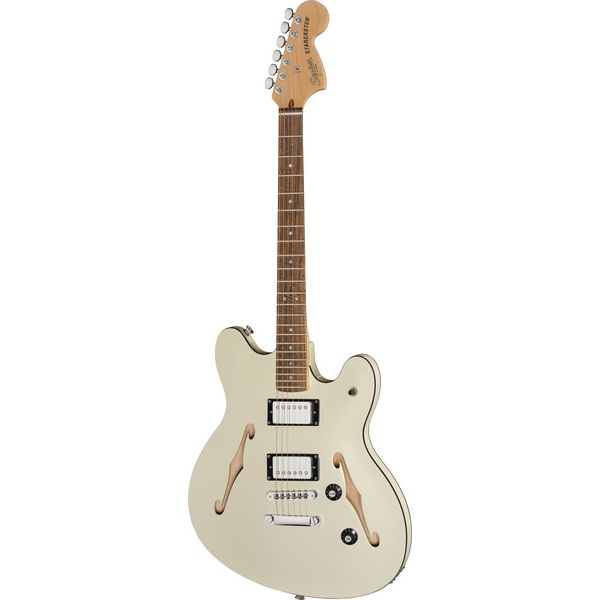
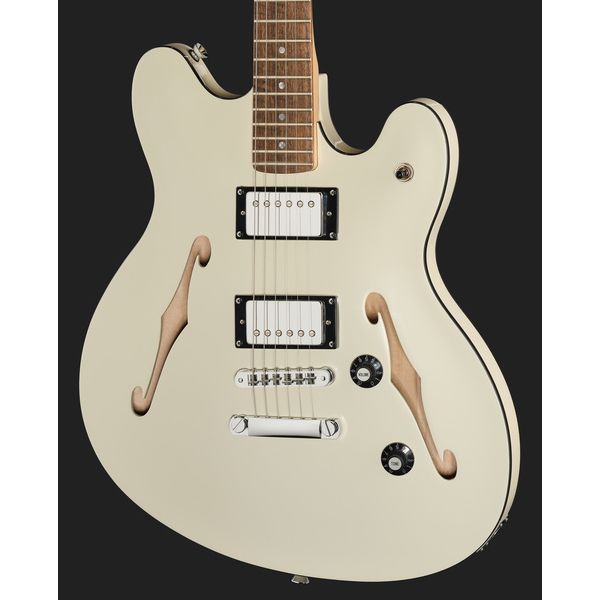
This is the Squier Affinity Deluxe version, which is the cheapest possible way to get that shape onto your strap.
I expected a shape-only novelty. I did not expect to spend a week refusing to put it down.
A Semi-Hollow That Is Not Trying to Be a 335
Almost every affordable semi-hollow on the market is chasing the same target. The Epiphone ES-335 owns that lane and everybody else queues behind it.
The Starcaster does not queue. It is offset, it is bolt-on, it has a 25.5 inch scale and a Fender headstock the size of a dinner plate.
That combination gives you semi-hollow warmth with Fender snap and sustain, which is a genuinely different flavour rather than a cheaper version of somebody else’s.
Build and Materials
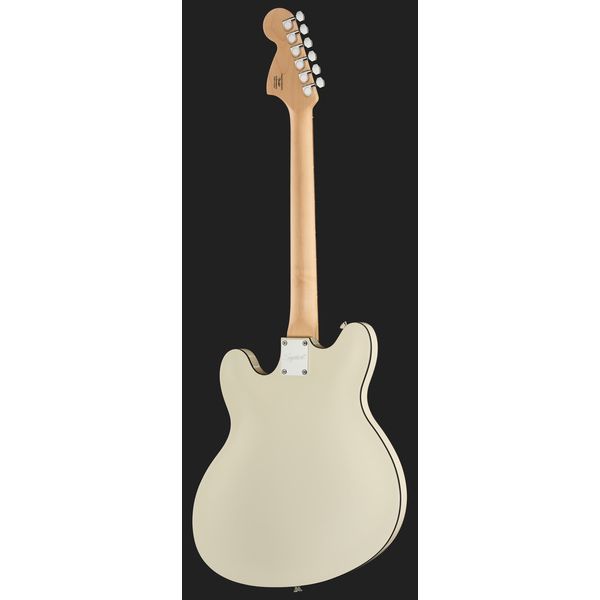
Laminated maple body, bolt-on maple neck, Indian laurel fingerboard with pearloid dots. Chrome hardware, closed die-cast tuners with split shafts.
Everything about the parts list says budget, and the Olympic White finish on mine was applied cleanly with no orange peel and no sloppy edges around the f-holes.
The neck pocket was tight. The nut slots were cut properly. Frets were level with no sharp ends, which is not something I could say about budget Squiers ten years ago.
The Neck
C profile, 42 mm synthetic bone nut, 241 mm radius, 22 medium jumbo frets. That is a fairly vintage-flavoured 9.5 inch radius rather than a modern flat board.
It feels exactly like a decent Squier Strat neck, because that is essentially what it is. If you have played a Squier Affinity Stratocaster, you already know the hand feel.
Medium jumbo wire on a 9.5 inch board means bends can choke slightly if your action is very low. Set it a hair higher than you would on a Strat and the problem disappears.
Two Ceramic Humbuckers, One Job
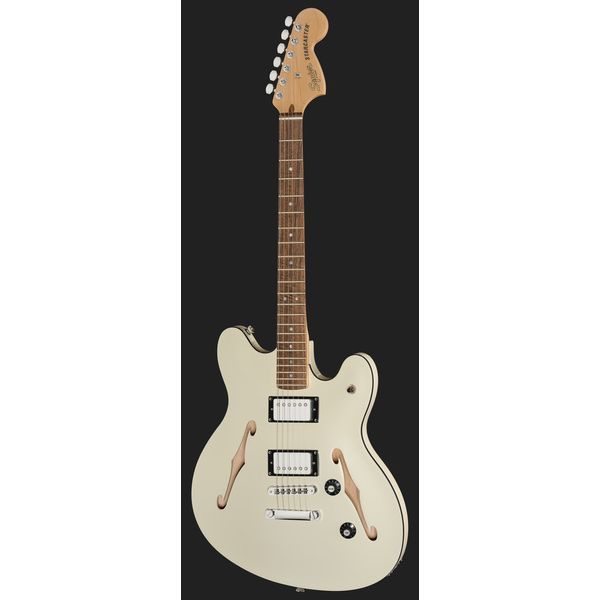
Master volume, master tone, three-way switch. No individual volumes, no push-pull tricks, no coil splits. Simple to the point of being blunt.
The pickups are ceramic, and you can hear it. Bright, a bit forward in the upper mids, plenty of output for the money.
Clean, that brightness plus the long scale gives a lovely jangle. Chords ring rather than blur, which is not something semi-hollows always manage at this money.
With drive it gets a bit spiky, and the tone control becomes your friend. It is nowhere near as refined as the Filter’Tron-flavoured voice of the Gretsch G2622 Streamliner, but it is also a whole different budget.
How It Sounds in a Band
Indie and alt-rock is where this thing lives. Big open chords, a bit of reverb, a fuzz pedal that it takes surprisingly gracefully.
The neck pickup rolled back does a passable smoky clean, though it never gets truly dark. There is always a bit of glassiness underneath.
Cut through a mix? Easily. Possibly too easily – I ended up shaving treble at the amp on two different rigs.
Specs at a Glance
- Body: laminated maple, semi-hollow offset
- Neck: bolt-on maple, C profile
- Fingerboard: Indian laurel, pearloid dot inlays
- Radius: 241 mm (9.5″)
- Scale: 648 mm (25.5″)
- Nut: synthetic bone, 42 mm
- Frets: 22 medium jumbo
- Pickups: 2 x ceramic humbuckers
- Controls: master volume, master tone, 3-way switch
- Bridge: fully adjustable, 6 saddles
- Tuners: closed die-cast with split shafts
- Hardware: chrome
- Finish: Olympic White
Comfort, Weight and the Offset Thing
Semi-hollow means light. Sitting down, the offset waist does what offsets always do and parks the guitar in a comfortable position without you thinking about it.
Standing up it balances better than the giant headstock suggests. There is a bit of neck dive on a thin strap, but nothing a suede one does not cure.
The body is wide, though. If you are used to a smaller semi like the Epiphone ES-339, this will feel like a step up in real estate.
The Niggles
The tuners are the weak point. They hold, but the ratio is coarse and getting a fussy tuning exactly right takes more fiddling than it should. First upgrade, easily.
There is no tremolo and no Bigsby option here. If wobble is part of your sound you are out of luck without surgery.
The ceramic pickups are the obvious limiting factor. They are perfectly usable, but a set of decent Alnico humbuckers transforms the guitar, and the rest of the instrument absolutely deserves that upgrade.
And the control layout is basic. Two knobs on a semi-hollow feels stingy when the competition gives you four. FYI, it also means no volume-swell tricks between pickups.
A Genuinely Good Platform
This is the part that surprised me. The bones here are properly good – the body, the neck, the geometry, the fretwork.
Everything that is mediocre about it is a bolt-on part. Pickups, tuners, maybe the nut if you are picky. All cheap and easy to change.
Spend a modest amount on those three things and you end up with a semi-hollow that will happily sit next to guitars costing several times more. That is a rare thing at this end of the market.
Who Should Buy One?
First semi-hollow buyers, obviously. It is a low-risk way to find out whether you actually like hollow bodies before spending serious money, and it costs less than a nice pedal.
Beginners moving up from something like the Squier Mini Strat will find the jump in build quality obvious and the jump in price fairly small.
Modders, definitely. See above.
And anyone who wants a semi-hollow that does not look like everybody else’s. If you want the twangier, centre-blocked alternative, the Gretsch G2655T Streamliner Jr is the one to compare against.
A Week of Actually Gigging It
I took it to a small pub gig, mostly to see whether it would embarrass me. It did not.
Feedback was a non-issue at pub volume. There is enough centre mass in the body that it behaves like a semi rather than a full hollowbody howling machine.
It also stayed in tune across a two-hour set with one quick check at the break, which given my comments about the tuners is better than I expected.
Three people asked what it was. Nobody guessed Squier. That is either a compliment to the guitar or an insult to my playing, and I have decided not to investigate further.
What I Would Change First
Locking tuners, then a set of Alnico humbuckers, then a proper bone nut. In that order, and none of them are expensive.
I would leave the bridge alone. The six-saddle unit intonates properly and there is nothing wrong with it beyond looking slightly plain.
And I would resist the urge to route for a Bigsby. On a laminated body with no proper block underneath, that is a project with more downside than upside.
Final Verdict
The Affinity Starcaster Deluxe punches a long way above its money, mostly because Squier got the boring stuff right. Good neck, clean build, sensible geometry.
The pickups are the compromise, and they are the compromise you would expect at this price. Everything else feels like it belongs on a dearer guitar.
If you want an offset semi-hollow and you are not made of money, there is genuinely nothing else in this bracket doing what this does. Easy yes from me.