Watch It First
Gretsch have a problem, and the problem is that everybody wants a Gretsch and almost nobody wants to pay Gretsch money.
The Streamliner range is the answer to that. Korean-built, sensibly priced, and aimed squarely at people who love the look but flinch at a Professional Collection price tag.
The G2622 is the double-cut center block model, and it might be the most useful guitar in the whole line.
What Makes It A Gretsch
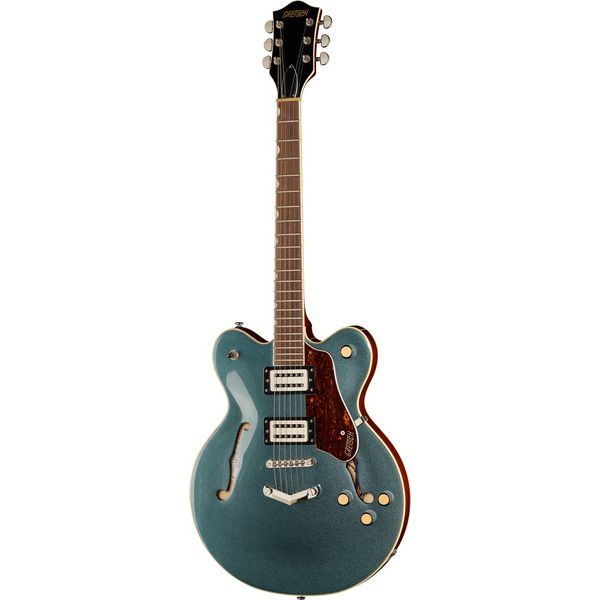
The shape, mostly. That big double-cut body with the f-holes is instantly recognisable from the back of a pub.
Underneath, it is a maple body with a center block running through it. That block is doing the important job – it kills the feedback that makes a fully hollow guitar a nightmare at volume.
You get the airiness of a hollowbody with about ten percent of the squealing. Fair trade.
The neck is nato, gloss finished, with a Soft C profile and a laurel fingerboard. Neo-Classic Thumbnail inlays, because of course.
The Broad Tron question
Streamliners run Broad Tron BT-3S humbuckers rather than the Filter Trons you get further up the range.
Purists get sniffy about this. They are also wrong, mostly. The BT-3S is a fatter, hotter pickup than a Filter Tron, and that is a feature, not a downgrade.
It means the G2622 does rock and indie noise properly, not just rockabilly. Which, if you are buying one guitar, is what you actually want.
The Controls Are Weirder Than You Think
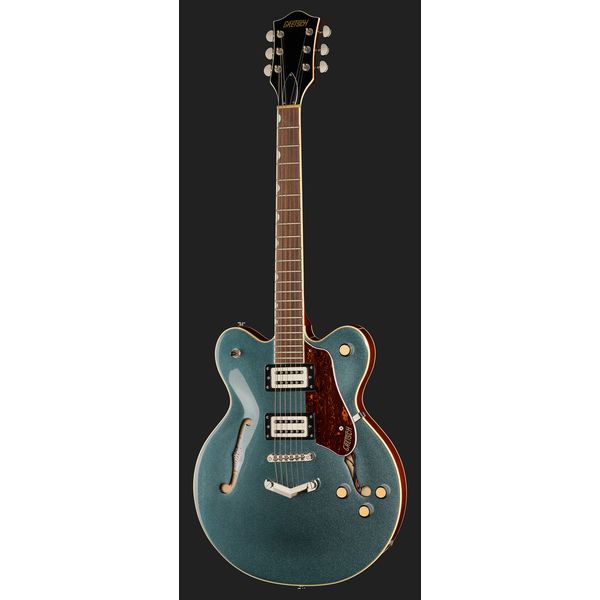
Two volumes, a master tone and a master volume. Very Gretsch. Very not-intuitive if you have spent your life on a Les Paul.
The master volume near the cutaway is the one you want under your little finger for swells. Once that clicks, it is brilliant.
The tone knob is push-pull for coil splitting, which is the genuinely useful bit. Split, the BT-3S thins out into a jangly, almost Rickenbacker-ish chime.
That single feature turns it from a rock guitar into something you could take to almost any gig.
How It Plays
The Soft C neck is medium. Not chunky, not skinny. It is the kind of profile that annoys nobody, which is harder to pull off than it sounds.
The 305 mm radius and 22 medium frets make it feel more modern than the retro looks suggest. Bends do not choke out.
Scale is 629 mm, so it is Gibson-ish rather than Fender-ish. Slinky, easy on the fingers, and it takes heavier strings well if you want more thump.
Body depth is the thing to be aware of. It is a big guitar. Sitting down with one for the first time feels like being handed a small suitcase.
Weight
Lighter than a Les Paul, heavier than a fully hollow archtop. Comfortable for a full set, which is more than I can say for a lot of center block guitars.
How It Sounds
Clean, it is gorgeous. Big, woody, slightly hollow in the low mids, with a top end that shimmers without turning into ice picks.
Push it into a slightly broken-up amp and it goes into that lovely spanky territory that half of British indie music was built on.
High gain is the limit. It will do it, and the center block keeps it under control, but it starts sounding a bit generic. This is not a metal guitar and nobody pretended it was.
Compare it to something like the Gretsch G5210 Electromatic Jet and you can hear the difference the hollow body makes – the Jet is punchier and more focused, the G2622 is bigger and more three-dimensional.
The Niggles
The nut work on mine was decent but not amazing. A couple of slots were a touch tight and the guitar would ping when tuning up.
The V-stoptail looks great and works fine, but string changes are more faff than a normal stopbar. You will get used to it.
And the gloss neck finish gets sticky if your hands sweat. Some people scuff theirs with a fine abrasive pad. I am not brave enough.
One more thing – the tortoise pickguard is either a highlight or the first thing you swap out. There is no middle ground on this.
Who It Is For
Anyone who wants a guitar with character that is not just another Les Paul or Strat copy.
Indie, alt-rock, blues, country, jangly pop, anything that benefits from air around the notes. It covers all of it.
If you want something smaller, the G2655T Streamliner Jr is the same idea in a more manageable body. If you want a fully hollow, more vintage voice, look at the Guild Starfire I DC or the Ibanez AM73G instead.
Specs at a Glance
- Construction: center block, double cutaway
- Body: maple
- Neck: nato, Soft C profile, gloss finish
- Fingerboard: laurel, 305 mm radius
- Inlays: Neo-Classic Thumbnail
- Nut: bone, 42.9 mm wide
- Scale: 629 mm
- Frets: 22 medium
- Pickups: 2x Broad Tron BT-3S humbuckers
- Controls: volume 1, volume 2, master tone with push/pull coil split, master volume
- Bridge: V-stoptail
- Tuners: sealed die-cast
- Hardware: nickel
- Colour: Gunmetal
Final Verdict
The G2622 is the Streamliner that makes the most sense. It has the shape, the noise and the vibe, without the feedback problems or the price of the proper vintage-spec stuff.
It is not a perfect guitar. The nut work is average, the controls take a week to learn, and it is physically large.
But it does something almost nothing else at this money does – it sounds like a specific thing rather than a competent generalist. That is worth a lot.
If you have been looking at Gretsch and telling yourself you cannot justify one, this is the model that quietly removes the excuse.
Gigging It
The center block earns its money the moment you turn up. That is the honest headline.
I have played fully hollow guitars at pub volume and spent the whole set standing at a specific angle to the amp like some kind of nervous statue. This does not do that.
You can stand in front of a cranked combo and it behaves. Push it further and you get controllable feedback rather than an air-raid siren, which is actually a usable effect.
The volume knob trick
Because the master volume sits separately from the two pickup volumes, you can set your dirty sound with the pickup volumes and then use the master to clean up.
It is basically a built-in clean channel. Once you have used it for a set you start wondering why every guitar does not work this way.
Strings and Setup Notes
It ships with light strings and honestly it wants heavier ones. Going up a gauge fattens the low end noticeably and stops the top strings feeling flimsy.
Watch the intonation after you change gauge though. The V-stoptail and the bridge combination is a bit sensitive and it drifts if you switch from 9s to 11s without adjusting.
Also worth checking – the bridge on some Streamliners is not pinned, so it can shift if you are heavy handed with a string change. Mark its position with a pencil before you take all the strings off. Learn from my mistakes.
The Colour Thing
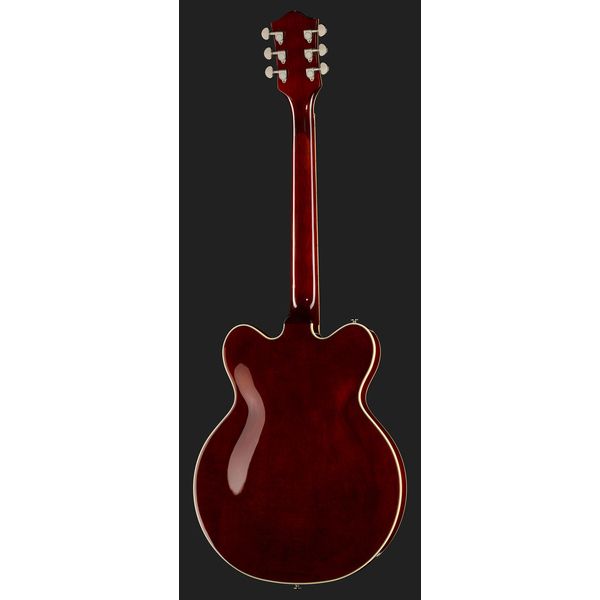
Gunmetal is the sleeper finish. It reads almost black in a dark room and then goes properly metallic under stage lights.
The walnut and sunburst versions are more traditionally Gretsch. The Gunmetal looks like a Gretsch that got into modern music, which suits the Broad Tron voicing.
Not that any of this matters to how it sounds. But you will look at it more than you play it, so it counts.
If you fancy the Streamliner recipe on a bass instead, the Streamliner Jet Club Bass is the equivalent oddity.