Watch It First
Plugged and unplugged, played by someone with better fingerpicking than mine.
There is a category of guitar that nobody writes love letters about and everybody quietly relies on. The GD30CE is the definition of it.
Solid top, cutaway, decent preamp, built-in tuner. Turn up, plug in, play the gig, go home.
Unglamorous? Completely. Also one of the most sensible things you can buy if you actually perform.
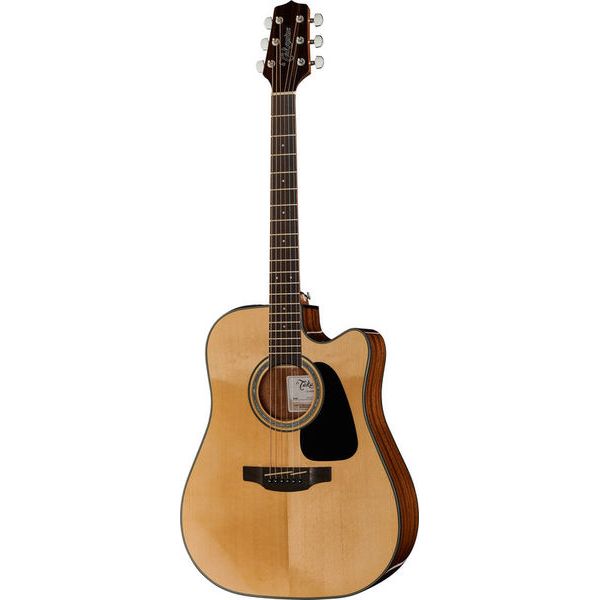
The Solid Top Matters More Than Anything Else
Solid spruce, not laminate. This is the single spec that separates a guitar that gets better with age from one that stays exactly the same forever.
Laminate tops are stable and cheap and they sound the same in twenty years as they do on day one. Solid tops open up.
Six months in you can hear it. The bass gets rounder, the whole thing loosens slightly. That is the point.
Mahogany Back and Sides
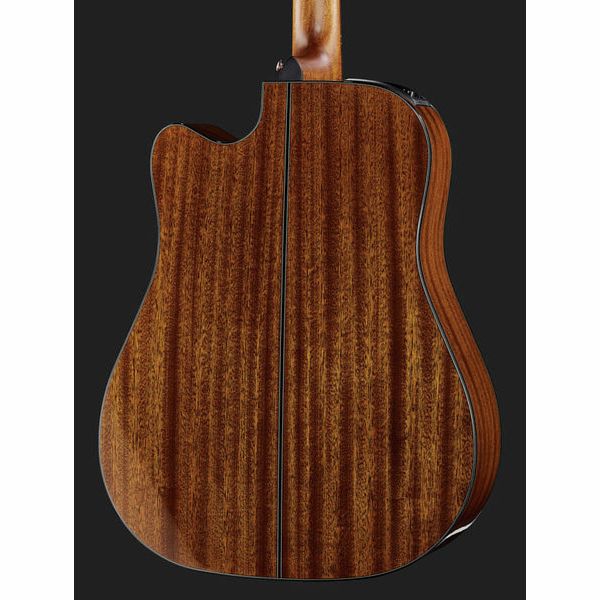
Laminated mahogany here, and that is fine. Back and sides matter far less than the top and laminate is genuinely more robust for a guitar that travels.
The tonal result is a mid-focused dreadnought – warm, punchy, not as scooped and boomy as a rosewood dread.
For strumming behind a vocal that is close to ideal. It leaves room in the mix instead of swallowing it.
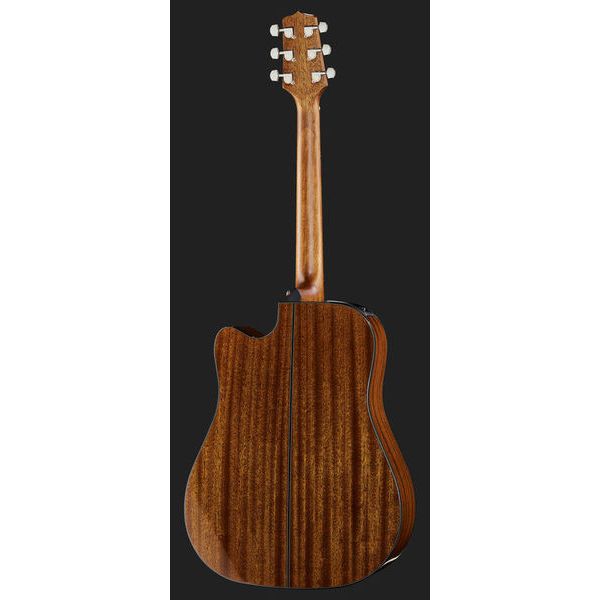
The Preamp Is the Real Reason to Buy It
TP-4TD preamp with a built-in tuner. Three-band EQ, gain, and a tuner that is actually readable on a dark stage.
Takamine has been doing acoustic electronics for decades and it shows. This plugs in and sounds like an acoustic guitar, not like a piezo squawk.
There is a mid control, which a surprising number of budget preamps skip. It is the one that saves you when a room is boomy.
Feedback and Stage Behaviour
It behaves. At sensible stage volumes it does not immediately howl, and the notch on the EQ gives you room to move if it does.
Battery access is on the side, tool-free. Small thing, enormous relief when a battery dies five minutes before you go on.
If you are pairing it with an amp, something like the Boss Dual Cube LX handles acoustic duty well.
Playability and Neck
Mahogany neck, ovangkol fretboard and bridge, 643 mm scale, 43 mm at the nut, 20 frets.
The matte neck finish is a genuinely good decision – no sticky thumb on a hot stage.
The cutaway gets you to the upper frets, which on a dreadnought is otherwise a polite fiction.
Out of the Box Setup
Action was slightly high on the one I played. That is normal for a shipped acoustic and a saddle adjustment fixes it.
Factory strings are D Addario EXP16 twelves, which is a proper gauge for a dreadnought rather than the thin stuff some brands fit to make guitars feel easy in a shop.
Once set up it is comfortable enough for long sessions without being so slinky that it loses volume.
The Honest Niggles
- Quartersawn X bracing is standard rather than special – this is not a hand-voiced instrument
- Laminated back and sides mean the ceiling on how good it gets is limited
- The high gloss natural finish is nice but shows scratches
- No case or gig bag at this price, which is a shame for a guitar aimed at gigging players
- Unplugged volume is good but not remarkable compared to an all-solid dread
None of these matter much given what it costs. They are just the things you should know.
Who Is It For?
Anyone who plays out. Open mics, function bands, church, weddings, busking. This is a workhorse and it is priced like one.
Also a very good second acoustic – the one you take places you would not risk an expensive guitar.
If you want more guitar for more money, the Taylor 214ce is the obvious step up and the Martin D-16E-01 goes all-solid.
If you want to spend less, the Fender CD-60SCE and the Yamaha FG830 are the usual suspects, and the Takamine GN71CE is the prettier sibling if you want a smaller body.
How It Sounds Unplugged
Strummed hard it is punchy and mid-forward rather than huge and scooped. Classic mahogany dread behaviour.
Fingerpicked it is clearer than I expected from a dreadnought. The cutaway takes a small amount of low end away and that turns out to help definition.
It is not going to out-boom an all-solid rosewood dreadnought, and it is not trying to. What it does is stay articulate when you dig in.
In a Room With Other People
This is where the mid focus pays off. It cuts through a bar without needing to be loud.
Sitting next to a second guitar it does not fight for the same frequencies as a brighter, boomier instrument. Handy in a duo.
Durability and Travel
Laminated back and sides are genuinely more humidity-tolerant than all-solid construction. If your guitar lives in a car boot, that matters.
The gloss finish is a decent barrier against knocks. It scratches, but it does not dent easily.
I would still not check it as luggage. But taking it to a rehearsal room in the rain is not something to lose sleep over.
Long-Term Costs
One battery a year, a set of strings every couple of months if you gig, and a saddle adjustment once in a while.
That is the entire running cost. There is nothing exotic to go wrong and the preamp is a known quantity with decades of service behind it.
The Spec Sheet
- Build: Dreadnought with cutaway
- Top: Solid spruce
- Back and sides: Mahogany
- Bracing: Quartersawn X
- Neck: Mahogany with matte finish
- Fretboard and bridge: Ovangkol
- 20 frets
- Scale: 643 mm
- Nut width: 43 mm
- Electronics: Takamine TP-4TD preamp with built-in tuner
- Factory strings: D Addario EXP16 .012 to .053
- Finish: Natural high gloss
Final Verdict
The GD30CE is not exciting and it is not trying to be. It is trying to work, and it does.
Solid top means it will sound better in five years. The preamp means it will sound good through a PA tonight.
The compromises are all in places that do not matter much for a gigging instrument – laminate back and sides, standard bracing, no case.
If you need one acoustic that turns up and does the job without drama, this is close to the sensible default. Boring is underrated.