Watch It First
There is a moment in a lot of guitarists lives where the 100 Series stops being enough and the 300 Series is still out of reach. The 214ce lives in exactly that gap, and it has lived there very comfortably for years.
It is the guitar people mean when they say they bought „a Taylor”. Grand Auditorium, cutaway, ES2 pickup, torrefied solid spruce top over layered walnut, and that instantly recognisable Taylor neck.
It is also the model that starts more arguments than any other in the range, because of one word: layered. We will get to that.
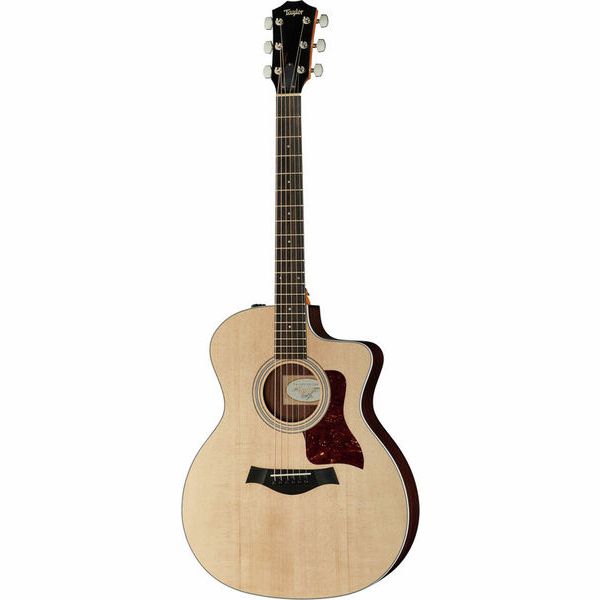
Grand Auditorium: Taylor Best Idea
Bob Taylor designed the Grand Auditorium in 1994 as a do-everything shape, and it worked so well that half the acoustic industry has since built something suspiciously similar.
The waist is tighter than a dreadnought, the lower bout is roughly dreadnought-sized, and the depth is a touch shallower. What that gets you is dreadnought volume with far better balance.
In practice it means you can strum hard without the bass turning to mud, then switch to fingers on the same guitar and still hear every string. Very few shapes do both convincingly.
The Neck Will Sell It To You
Taylor necks are famously thin, flat and fast, and the 214ce is no exception. Coming from an electric, it is the least intimidating acoustic neck on the market.
The 648 mm scale and 42.8 mm nut mean it plays tight and precise. Fingerstyle players with big hands sometimes find the string spacing cramped – if that is you, it is worth trying before you buy.
Factory action is consistently low. Taylor NT neck joint means a future reset is a bolt-on job rather than a steam-and-pray operation, which is a genuine long-term ownership perk that nobody talks about enough.
Layered Walnut: The Argument
The back and sides are layered walnut, not solid. Taylor is careful never to say „laminate”, and the internet has been sarcastic about that for a decade.
One thing does get lost in that argument, though. Layered back and sides are structurally more stable, less prone to cracking, and on a guitar where the top does most of the tonal work, the difference is smaller than the arguments suggest.
The top is solid torrefied spruce – roasted, essentially, to accelerate the ageing process. That is the part that matters, and it is why the 214ce sounds broken-in on day one rather than after five years.
Does an all-solid guitar at similar money sound better unplugged? Sometimes, yes. Something like the Guild D-240E Westerly will give you more raw wood for the money. You are paying Taylor for consistency, playability and the electronics.
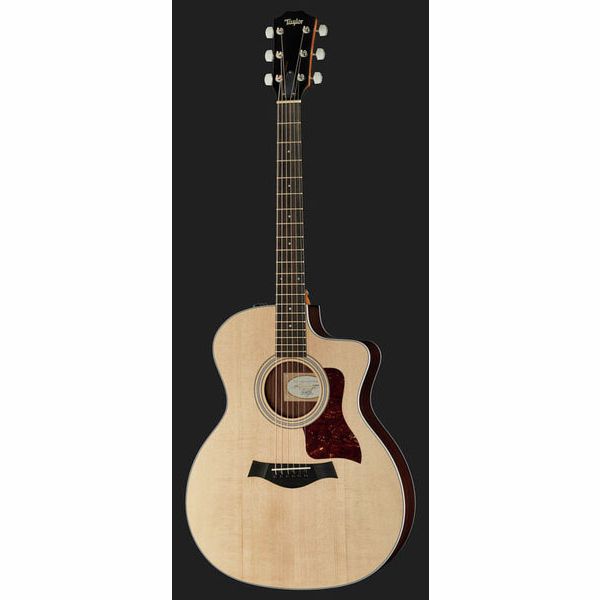
The Sound
Clear. That is the word. Taylor voicing is bright, articulate and modern, with a scooped-ish midrange and shimmering top end.
- Excellent string-to-string separation, so complex chords stay readable
- Fast, tight bass that never overwhelms
- Very responsive to light picking – it rewards a delicate right hand
- Walnut adds a slight midrange warmth compared to sapele, sitting between mahogany and rosewood
If you love the warm, thumpy, mid-heavy sound of a vintage Gibson-style flat-top, this will sound clinical to you. That is a taste thing, not a quality thing.
For anything involving a microphone or a mix, though, the clarity is a huge asset. Taylors sit in recordings beautifully with almost no EQ.
The ES2 Pickup
This is where the 214ce quietly beats most of its rivals. The Expression System 2 uses three behind-the-saddle sensors rather than a traditional under-saddle transducer.
The result is noticeably less piezo quack. It sounds like an amplified acoustic guitar rather than a rubber band being squeezed, and it handles dynamics far better than the systems on budget electros such as the Fender CD-60SCE.
Controls are three simple knobs on the upper bout: volume, treble, bass. No tuner, which is mildly annoying in 2026 but hardly fatal.
Straight into a PA it is gig-ready with no help. That alone justifies a chunk of the price gap over cheaper cutaway electros.
Honest Gripes
- Layered back and sides at this price will always be a sticking point for some buyers
- No onboard tuner on the ES2 system
- Gig bag rather than a hardcase, though Taylor bags are at least good ones
- Slim neck and tight string spacing do not suit every fingerstyle player
- Bright voicing can sound thin if you are used to mahogany warmth
- The Natural finish is handsome but very plain – there is not much visual drama here
None of these stop it being a great guitar. They do mean it is not automatically the right guitar for everyone at this money.
Who Should Buy One
Gigging singer-songwriters, first and foremost. Plug in, play, go home. The consistency is the selling point – every 214ce plays roughly the same, which matters when you are buying online.
Also anyone stepping up from a first acoustic. If you started on something like the Yamaha F310 or a Harley Benton D-120NT, the jump here is dramatic and immediately obvious.
Who Should Look Elsewhere
Tone chasers who want maximum solid wood per pound. Anyone who wants a warm, woody, old-school voice. And anyone who mostly plays at home unplugged, because you are paying for electronics you will never use.
For unplugged small-body character at less money, the Cort Core-OC SP is a smarter buy.
214ce Versus 114ce
The obvious internal comparison. The 100 Series uses sapele rather than walnut, a matte finish rather than gloss, and simpler appointments.
The 214ce gets the gloss body, the torrefied top, better binding and a nicer overall feel. Is it worth the step up? IMO yes, mostly for the torrefied top – it makes the guitar sound more mature immediately.
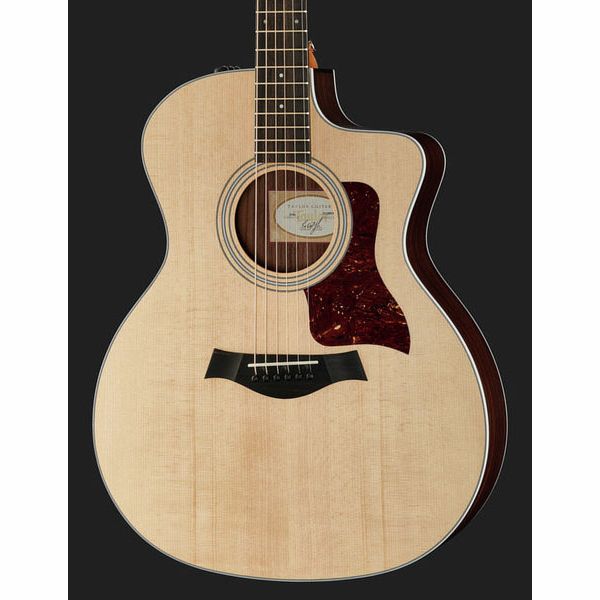
Specs at a Glance
- Style: Grand Auditorium with cutaway
- Top: Solid torrefied spruce
- Back and sides: Layered walnut
- Neck: Mahogany
- Fingerboard and bridge: Ebony
- Scale: 648 mm
- Nut width: 42.8 mm, Nubone nut
- Frets: 20
- Electronics: Taylor Expression System 2 (ES2)
- Saddle: TUSQ
- Finish: Natural, faux tortoiseshell pickguard
- Extras: Gig bag included; register for extended warranty
- Thomann article number: 483303
Final Verdict
The 214ce is the most sensible guitar in this article and possibly the most sensible acoustic Taylor makes. It is not romantic, it does not have a fascinating backstory, and it will never be described as characterful.
What it is, reliably, is excellent. It plays beautifully out of the box, it plugs in and sounds like an acoustic guitar, it survives touring, and it holds resale value better than almost anything else in the bracket.
If you want a workhorse that will not embarrass you at a gig, in a studio or in a shop, this is the obvious answer. If you want a guitar with soul and quirks, keep shopping – and that is a perfectly reasonable thing to want.