Watch It First
There is a point on the Martin ladder where the guitars stop being about the logo and start being about the wood. The D-16E is where that happens.
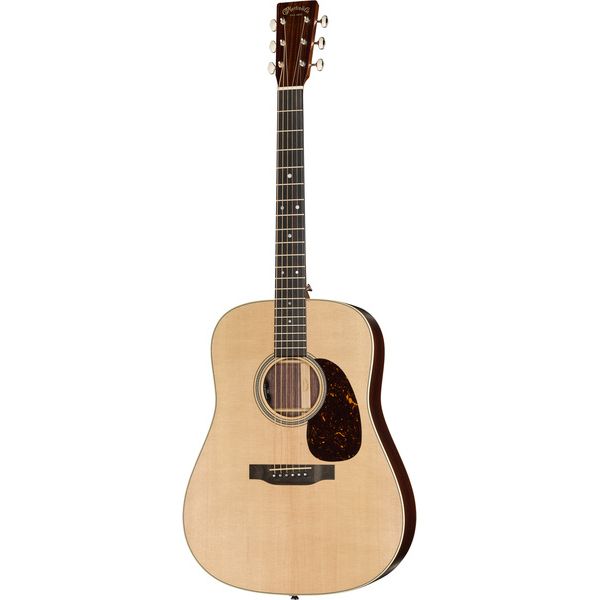
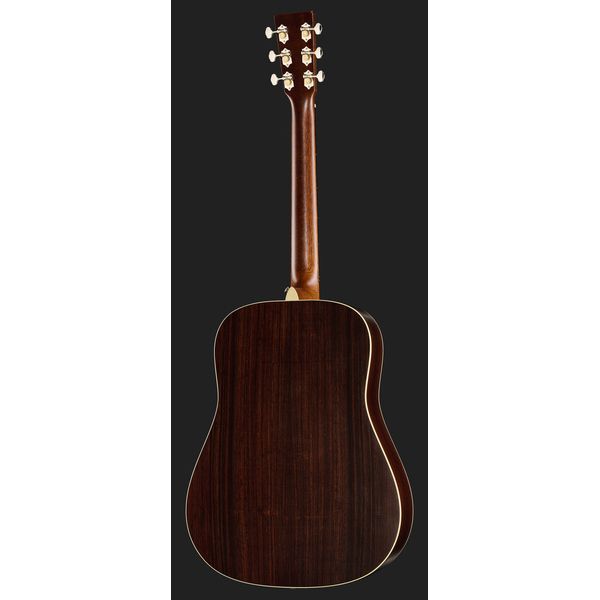
Solid spruce top, solid rosewood back and sides, built in Nazareth, Pennsylvania – and a pickup already fitted so you can plug in without a trip to a tech.
I have spent a good chunk of the last month with one. It has quietly rearranged my opinion of what a mid-priced Martin is supposed to be.
Where the 16 Series Sits
Martin’s line-up confuses people, and honestly it should. The X Series is laminate and HPL. The Road Series is solid but built with modern shortcuts. The 16 Series is the first proper all-solid, US-built rung.
I have banged on before about how good the Martin D-X2E is for the money, and I stand by it. But this is a fundamentally different animal.
Same shape, same scale, completely different voice – because solid rosewood does things laminate simply cannot.
The Rosewood Thing
Most dreadnoughts at sane money use mahogany or sapele for the back and sides. Warm, punchy, dry in the mids, very forgiving.
Rosewood is the opposite trade. Scooped mids, glassy highs, and a bass response that arrives about half a second after you think it should and then refuses to leave.
Strum a G chord and it blooms. It is a big, complicated, slightly showy sound, and once you have got used to it a mahogany dread starts to feel a bit polite.
The Satin Finish Matters More Than You Think
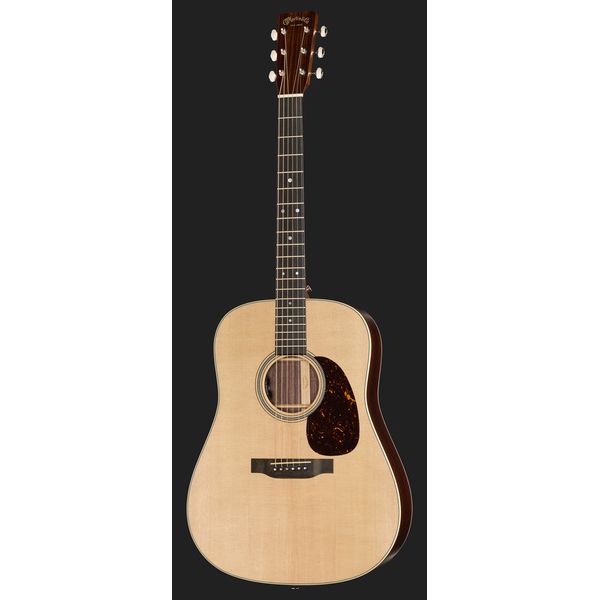
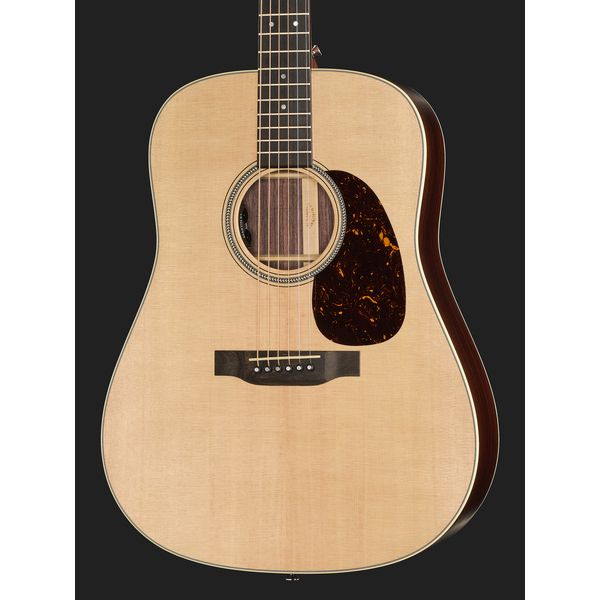
The D-16E wears a natural matte finish rather than high gloss. That is partly a cost decision and partly an acoustic one.
Thin satin lets the top move more freely, so the guitar sounds a bit more open straight out of the box than a heavily lacquered equivalent.
The downside is that it marks. Belt buckles, fingernails, the corner of a music stand – satin shows everything. Mine already has a story or two on the back.
Neck, Nut and the 1.75 Inch Question
Selected hardwood neck, ebony fingerboard, mother-of-pearl dots, bone nut, 20 frets. Scale is 645 mm, the long Martin measurement.
The nut is 44.5 mm, which is 1.75 inches. That is wider than the 43 mm most players are used to, and it is the single biggest thing to try before you buy.
Fingerstyle players will love it. String spacing is generous and your right hand stops tripping over itself. Strummers with small hands sometimes find the stretch to a full F a bit much.
I got used to it in about an hour. My partner, who has smaller hands and prefers the Little Martin LX1E, gave up after five minutes. Both reactions are valid.
The Martin E1 Pickup
Martin fits their own E1 system rather than the usual Fishman. It is an undersaddle transducer with the controls tucked out of sight.
No visible preamp box cut into the side, which I appreciate more than I expected. The top of the guitar stays untouched and it looks like an acoustic instead of a gadget.
Plugged in it is honest rather than spectacular. Slightly quacky in the upper mids, like every undersaddle piezo ever made, and it responds well to a bit of EQ or a decent preamp pedal.
For strumming in a band it is completely fine. For a solo fingerstyle recital, mic it.
Specs at a Glance
- Body shape: D – Dreadnought
- Top: solid spruce
- Back and sides: solid rosewood
- Neck: selected hardwood
- Fingerboard and bridge: ebony
- Inlays: mother-of-pearl dots
- Binding: antique white
- Scale: 645 mm (25.4″)
- Nut width: 44.5 mm (1.75″), bone
- Saddle: TUSQ
- Frets: 20
- Electronics: Martin E1
- Finish: natural matte
- Gig bag included, made in the USA
Playing It for a Month
Flatpicked bluegrass runs are where a rosewood dread earns its keep, and this one does. Notes separate instead of turning into a wall.
Open-chord strumming is huge, possibly too huge for a small room. Back off your pick attack and it settles down, but it wants to be played hard.
Fingerpicking is better than I expected from a dreadnought, largely thanks to that wide nut. It is not a parlour – the Yamaha CSF3M is a different tool – but it holds its own.
And it is already opening up. Solid tops do that. Ask me again in three years and the answer will probably be better.
The Niggles
You get a gig bag, not a case. On a US-built all-solid instrument that feels stingy, and a proper hardcase should probably be in your budget from day one.
The appointments are deliberately plain. Dot inlays, simple binding, no rosette drama. If you want a Martin that looks expensive, this is not it – the money went into wood, not decoration.
Rosewood is also fussy about humidity. Let it dry out over a Polish winter and you will get fret sprout and, if you are unlucky, worse. Buy a humidifier.
And the matte finish, lovely as it is acoustically, will not stay looking new. IMO that is character, but I know people who disagree loudly.
Who Is It For?
Anyone who has outgrown their first decent acoustic and wants the last dreadnought they will need to buy for a very long time.
If you want something smaller and more portable in the Martin family, my write-up on the Martin 000CJR-10E covers that end of the range.
And if the wide nut is a dealbreaker, the Taylor 110ce has a narrower neck and a completely different attitude for similar outlay.
Setup, Strings and the First Week
Mine arrived with a slightly high action at the twelfth, which is normal for a guitar that has been shipped across a continent and then sat in a warehouse.
A quarter turn on the truss rod and a light sanding of the TUSQ saddle sorted it in twenty minutes. Nothing structural, nothing worrying, just the usual settling in.
The factory strings are Martin MA540T in .012 to .054, and they suit the guitar well – heavy enough to drive that big top properly.
Dropping to .011s makes it easier to play and noticeably less impressive. I tried, went back within a week, and my fingertips have forgiven me since.
How It Compares in a Room
I put it side by side with a couple of well-regarded imports, including a Seagull S6, which is a guitar I genuinely rate.
The Seagull holds its own on midrange warmth. Where the Martin walks away is note separation and that long, glassy sustain on the top strings.
Against a Gibson L-00 Special it is simply a different job – the small-body Gibson is focused and punchy, this is wide and orchestral.
Final Verdict
The D-16E-01 is the cheapest way into a genuinely serious American Martin, and it does not feel like a compromise once you are playing it.
The rosewood voice is the reason to buy it. Everything else – the plain looks, the honest pickup, the gig bag – is the price you pay for that.
It punches well above its money in the only way that matters, which is the noise it makes when you hit it properly. Easy recommendation.