Watch It First
I’ll be honest, I didn’t expect much from a stompbox the size of a bar of soap that claims to replace an amp, a cab, and half your pedalboard.
Then I plugged in the NUX Amp Academy and spent an entire evening not wanting to turn my real amp back on.
IMO this is one of the sneakiest good releases NUX has put out, so let’s get into why.
What Is the NUX Amp Academy, Actually?
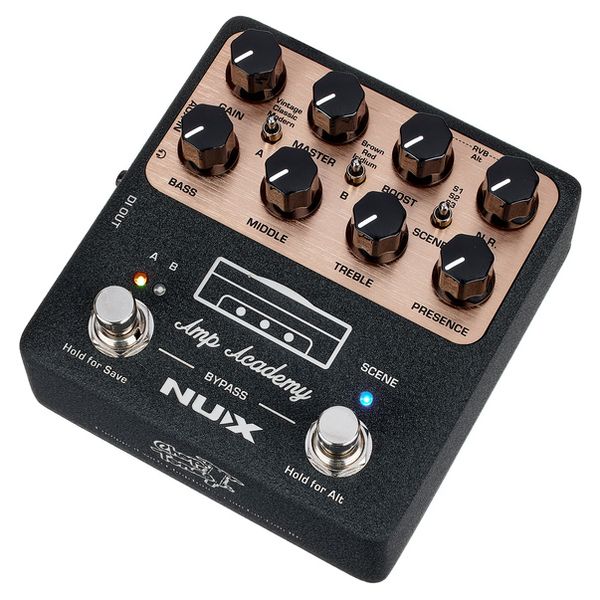
Short version: it’s an amp-and-cab simulator pedal built around NUX’s TSAC-4K modelling engine.
Long version: it separately models the preamp and the power amp section, then runs the result through a stereo IR-based cab engine.
That separation matters more than it sounds. Most budget amp sims blend preamp and power amp into one blob of a model, and you can hear the compromise.
Here you get three amp voicings (Brown, Red, Iridium – not-so-subtle nods to certain famous amps), three gain modes (Vintage, Classic, Modern), and three „scenes” per amp for instant tonal presets. Do the math and that’s a genuinely wide net of usable tones.
If this whole amp-modeler-in-a-box thing sounds familiar, it’s the same idea NUX explored on the NUX MG-30, just shrunk down and hyper-focused on amp tone instead of full multi-fx duties.
The Amp and Cab Sims, In Practice
The Brown mode is your high-gain modern rock/metal option. Red leans classic British rock. Iridium is the cleaner, more American-voiced option for pedal platform players.
Each one reacts to your guitar’s volume knob the way a real tube amp does, which is honestly the detail that sold me. Roll back the volume and the gain cleans up naturally instead of just getting quieter and staying fizzy.
The cab side uses the Cyber IR-Engine, running dual 1,024-sample IRs in stereo. You can load your own impulse responses too, which bumps this from „good little pedal” to „actually pro-capable” territory if you’re into cab IR hunting.
Scenes – The Feature Everyone Talks About
Each amp model gets three footswitchable scenes (S1, S2, S3), so you can go clean, crunch, and lead without ever touching a knob mid-song.
Set them up right and this thing genuinely replaces a pedalboard full of drive pedals for a gig. Set them up lazily and you’ll wonder what all the fuss is about – it does reward a bit of homework in the free NUX editor software.
Recording and Silent Practice
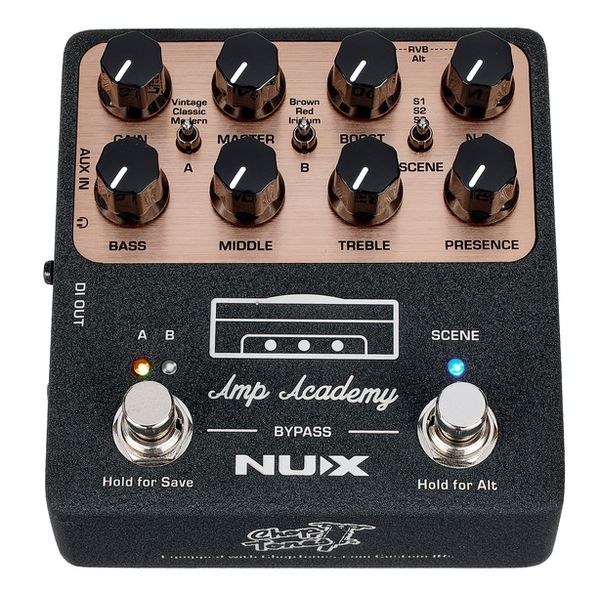
This is really where the Amp Academy earns its keep for a lot of buyers. USB-C out means straight into your DAW with zero extra interface needed, and the DI/XLR out with cab sim is a proper stage-ready direct box replacement.
Headphone jack on board too, so late-night riffing without waking the house is covered. If your whole rig right now is a laptop and a pair of headphones, this pedal alone could be your entire „amp”.
Compared to something like the Positive Grid Spark Mini, the workflow here is more „plug into your existing rig” than „standalone smart amp” – different tools for different jobs, and worth knowing which one you actually need before buying.
Where It Falls Short
No onboard drive/modulation effects beyond a boost and noise reduction – this is an amp and cab sim first, not a multi-effects unit. If you want delay, reverb, or chorus, you’re adding pedals in front or after, same as you would with a real amp.
Something like the Valeton GP-200 throws everything including the kitchen sink at you for similar money if that’s what you’re after instead.
Also worth flagging: no battery operation, so you’re tied to a 9V supply. Not a dealbreaker, just plan your pedalboard power accordingly – something like your delay pedal’s power draw adds up fast when you’re running several 9V devices off one supply.
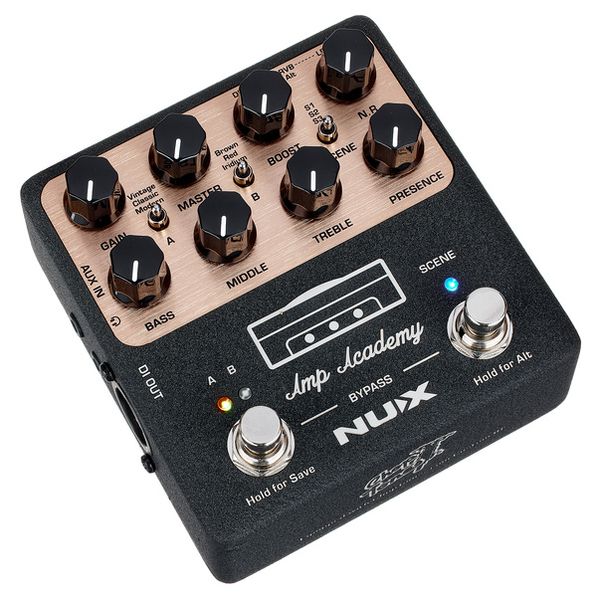
And the screen-less top panel means editing scenes on the fly takes a minute to learn. Once it clicks it’s fast, but the first hour with the manual open is real.
Who Should Actually Buy This
Gigging guitarists who want a compact backup rig or an amp-in-a-bag setup for fly dates. Bedroom players who record often and hate mic’ing cabs. Anyone tired of hauling a combo up three flights of stairs for rehearsal.
If you’re mainly a pedal-platform player who already loves an overdrive like the one covered in our Ibanez TS9 review, the Amp Academy gives you a blank, honest canvas to run it into rather than fighting a colored amp voicing.
Less ideal if you want one box that does drives, mods, and amp tones all in one – go look at a full modeler or the Boss Katana Air EX instead for that all-in-one convenience.
NUX Amp Academy Specs
- Physical modelling amp sim with separate preamp/power amp stages
- 3 amp voicings: Brown, Red, Iridium
- 3 gain modes: Vintage, Classic, Modern
- 3 footswitchable scenes per amp (S1/S2/S3)
- Stereo Cyber IR-Engine cab simulation, custom IR loading supported
- USB-C for recording, firmware, and the Amp Academy Editor
- DI/XLR output with cab sim, plus 3.5mm aux and headphone jacks
- Requires 9V DC power supply (not included, battery power not supported)
- Compact footprint: 105 x 115 x 58 mm, 440g
Final Verdict
The NUX Amp Academy punches way above its price bracket. For what it costs, getting genuinely gig-worthy amp and cab tones, USB recording, and a proper DI out in one tiny box is kind of ridiculous.
It’s not trying to be everything. No built-in delay, no reverb, no chorus. But for what it does – amp and cab simulation – it does it with a seriousness that budget gear usually skips.
If your pedalboard already has the drives and modulation sorted and you just need a brilliant, honest power amp and cab at the end of the chain, this is an easy recommendation. Give it a proper session before judging it on looks alone – it’s a grower.