Watch It First
Electro-Harmonix has a habit of cramming way more functionality into a box than the price tag suggests. The Canyon is a great example.
It’s a delay pedal AND a full looper, in a footprint barely bigger than a standard compact stompbox. On paper that sounds like a compromise. In practice, it mostly isn’t.
Here’s what you actually get for the money, and where the corners were cut to get there.
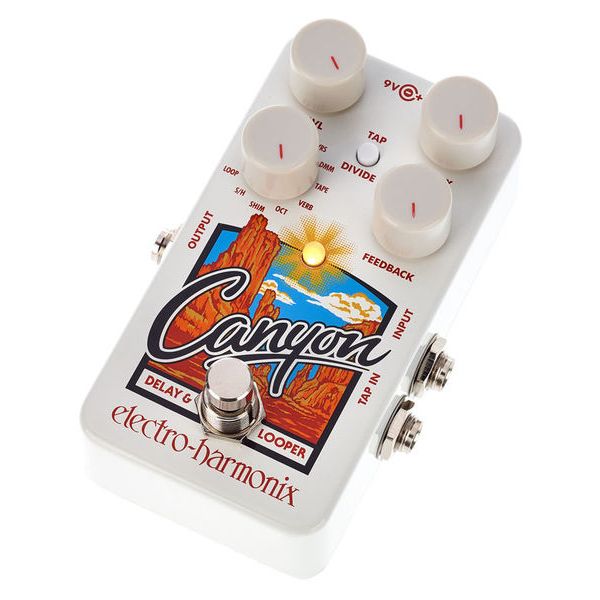
What’s Actually In the Box
At under 600 zł, this is priced closer to a basic single-mode delay than a delay-plus-looper combo unit, which is exactly why it keeps showing up on „best value pedal” lists.
Ten delay modes, up to 3 seconds of delay time, tap tempo, and a built-in looper – all controlled through four knobs: FX Level, Delay, Mode, and Feedback.
EHX also tucked „hidden” secondary parameters behind those same knobs, accessed by holding the footswitch while turning them. It’s a common EHX trick for packing more control into fewer knobs.
A tails switch lets your delay trails ring out naturally after you bypass the pedal, instead of getting chopped off mid-decay. Small detail, big difference live.
EHX has a long history of this approach – cramming synth-level flexibility into stompbox-sized enclosures – going back decades to boxes like the Memory Man. The Canyon feels like a modern continuation of that philosophy.
The Delay Modes
You get everything from clean digital repeats to tape-style warble, modulated delays, reverse delay, and lo-fi degraded modes.
It’s genuinely more variety than most single delay pedals in this price bracket offer. You could build an entire ambient rig around this one box.
True bypass keeps your tone clean when the effect is off, which matters if you’re running it alongside a bunch of other pedals on a board.
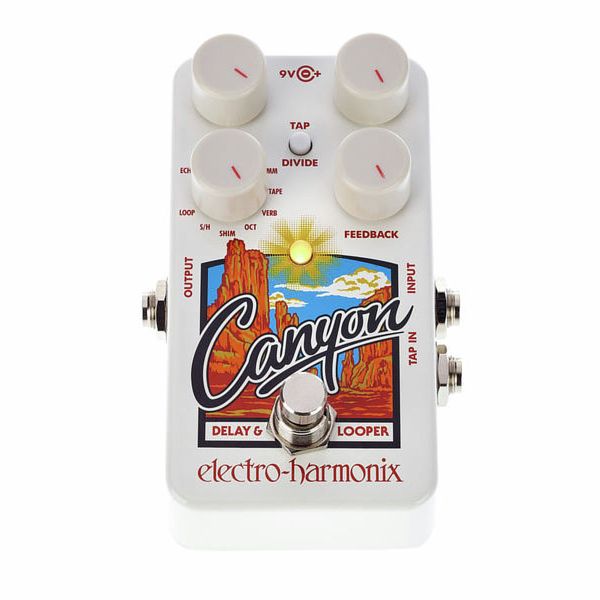
Analog-style tape delay emulation is a particular highlight – it captures that wobbly, degrading-repeat character people chase expensive standalone tape echo pedals for, without the maintenance headaches of an actual tape unit.
The Looper Side of Things
Switching between delay-only mode and looper mode is straightforward once you’ve read the manual once – it’s not the kind of interface you’ll fumble mid-gig after the first session with it.
This isn’t a token looper bolted on to justify the „and Looper” in the name. It’s a genuinely usable one, with a loop length long enough for real practice and songwriting use, not just a quick 10-second phrase.
You can layer delay effects over your loops too, which opens up some fun ambient textures for solo performers and songwriters building layers live.
It won’t replace a dedicated Boss RC-series looper if that’s your main use case, but as a bonus feature bolted onto a delay pedal, it’s excellent.
Who’s This For?
It also just makes sense for anyone who plays solo gigs regularly. Building a loop, then layering delay-drenched lead lines over top of it, is a genuinely fun way to fill a room with just one guitar and one pedal.
- Players who want maximum delay variety in one small pedal, without buying three separate delay boxes
- Solo performers and songwriters who want a bonus looper without dedicating a whole extra pedalboard slot
- Anyone building a first „real” pedalboard on a budget who wants their delay pedal to do more than one job
Bass players get real use out of this one too, based on owner reviews – the delay trails track low frequencies cleanly without the murky, undefined mess some cheaper delays produce on bass signals.
Honest Niggles
One more small thing worth flagging: the enclosure is compact, which is great for pedalboard space but means the knobs sit close together. Big-fingered players might find quick on-the-fly tweaks a bit fiddly.
Four knobs controlling ten-plus delay modes plus hidden parameters means there’s a learning curve. Don’t expect to grab this and instantly know what every knob position does.
Some owners mention the mode selector knob isn’t the most precise – fast mode changes can occasionally land you between settings. Not a dealbreaker, but worth knowing.
3 seconds max delay time is generous for most uses, but ambient players chasing huge Explosions-in-the-Sky-style washes might eventually want something with longer trail capability.
Power supply is included too, which shouldn’t be a selling point but sadly still is at this price range – some competitors expect you to buy that separately, adding real cost you don’t see on the price tag.
How It Compares
If you already own the EHX Freeze, the Canyon pairs beautifully with it for ambient soundscapes – sustain plus delay is a classic combo.
For a more boutique, analog-flavoured single-purpose delay, the Walrus Audio Julia is a completely different (and pricier) philosophy worth knowing about, even though it’s actually a chorus/vibrato, not a delay – a good example of how far boutique pricing can climb versus what EHX offers here.
Building a full board? The JHS Muffuletta and Boss DS-1 both make sensible pairings for the front end of your chain, feeding into the Canyon’s delay and looper section.
And if you’re still shopping for your first overdrive to sit before it, the Ibanez TS9 remains the classic, reliable choice.
Specs at a Glance
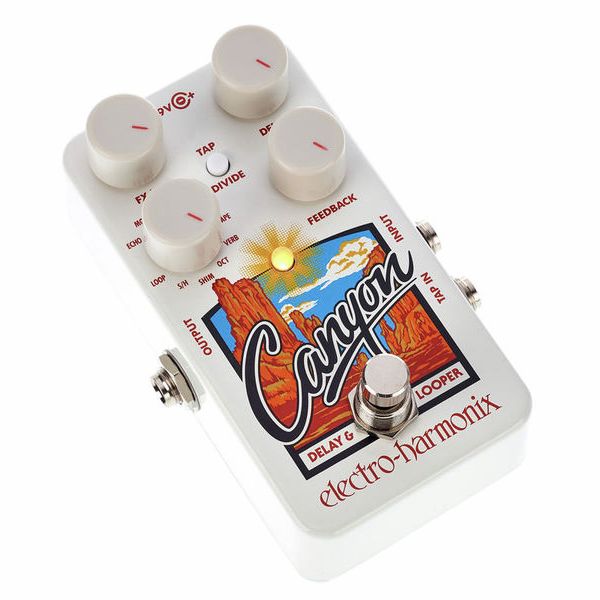
- Type: Delay and Looper
- Delay modes: 10
- Max delay time: 3 seconds
- Controls: FX Level, Delay, Mode, Feedback (plus hidden secondary parameters)
- Tap tempo: Yes, built-in or external footswitch
- Bypass: True bypass
- Tails switch: Yes
- Power: EHX 9.6DC-200 PSU included
- Dimensions: 70 x 115 x 54mm
Final Verdict
The Electro-Harmonix Canyon is one of those pedals that makes you double-check the price, because it really shouldn’t do this much for this little.
Ten delay modes and a genuinely usable looper in a compact, true-bypass box is a hard combination to beat at this price point.
If you want delay versatility without dedicating half your pedalboard and budget to it, this is an easy one to recommend.
It won’t replace a dedicated boutique delay for tone purists chasing one very specific analog flavor, but for everyone else, it’s genuinely hard to argue with the value here.