Watch It First
Chorus pedals have a reputation problem. Say the word and people picture 80s cheese, watery and thin.
Walrus Audio’s Julia has spent years quietly convincing people otherwise, and it’s become something of a cult favourite in the process.
The V2 update refined it further. Here’s why so many players end up recommending this one specifically.
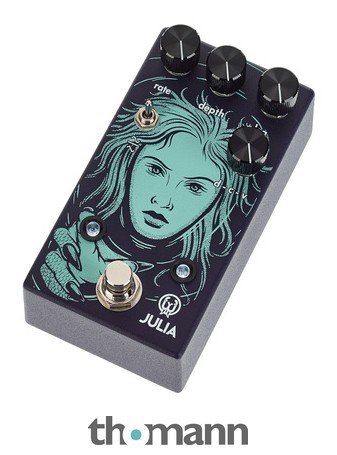
Not Just a Chorus Pedal
The Julia is fully analog, and it does chorus and vibrato from the same circuit, blended via a control called D-C-V – Dry, Chorus, Vibrato.
Turn that knob one way and you get a clean, dry-blended chorus. Turn it the other way and the dry signal drops out entirely, leaving pure pitch-wobbling vibrato. Everything in between is a genuinely usable blend, not just a gimmick control.
The „Lag” Knob Nobody Else Has
This is the control that actually makes the Julia stand out. Lag adjusts the delay before the LFO kicks in, which changes the fundamental character of the modulation rather than just its speed or depth.
Low lag settings feel tight and immediate. Higher settings introduce a looser, almost lazy swirl that a standard rate/depth chorus simply can’t replicate. It’s a small addition on paper that makes a genuinely big difference in practice.
How It Sounds
Rich and three-dimensional is the honest description. It never gets that thin, seasick warble that gives cheap chorus pedals a bad name.
Set subtly, it adds width and shimmer to clean arpeggios without drawing attention to itself – great for indie and shoegaze-leaning playing. Pushed harder, it gets genuinely lush and swirly, closer to a vibe unit than a standard chorus.
The sine/triangle LFO switch changes the modulation shape between a smoother, rounder wobble and a more pronounced, choppier one – useful for matching different playing styles and genres.
Dialling In Your Own Sound
A few starting points worth trying if you’re new to the Lag/D-C-V combo.
For a subtle, studio-clean chorus that just adds width to strummed chords, keep Lag low, Rate slow, Depth around 9-10 o’clock, and D-C-V mostly toward Dry with a touch of chorus blended in.
For that classic lush 80s-without-the-cheese sound, push Lag up a bit, Rate to a moderate speed, and blend more chorus into the mix. This is the sweet spot most players land on eventually.
For full vibrato – pitch wobble with no dry blend at all – push D-C-V all the way to the vibrato side and experiment with Rate and Depth together. This is where the Julia stops sounding like „a chorus pedal” entirely and becomes its own thing.
Pairing It With Other Pedals
Placement in the chain matters. Running it after any drive or overdrive pedals keeps the modulation clean and defined rather than smeared by distortion.
Stack it before a reverb or delay and the wet modulation carries through those effects beautifully, creating that dreamy, ambient wash that shoegaze and post-rock players chase. It’s a fantastic building block in a bigger modulation-plus-time-based-effects chain.
Bypass Worth Mentioning
Walrus fitted a soft-switch relay bypass with a „momentary” smart function – hold the footswitch and the effect only engages while you’re pressing down, release and it snaps back off.
It’s a small feature that turns out to be genuinely useful live – swelling in a chorus wash for a single chord or phrase, then snapping back to dry, without needing an A/B switcher or extra pedal.
Build and Practicalities
Compact standard-size enclosure, sturdy pots, and a form factor that won’t eat your whole board. Power draw is modest at 100mA on a standard 9V supply – no battery option here, so you’ll need a power brick regardless.
Weighing 270g and fitting comfortably alongside a modulation-heavy pedalboard, it’s an easy addition without major rethinking of your existing layout.
Who Should Buy This
- Indie, dream pop and shoegaze players who want lush, three-dimensional modulation
- Anyone tired of thin, cheap chorus pedals and wanting something more organic-sounding
- Players who want chorus and vibrato in one box rather than buying two separate pedals
- Gigging musicians who’ll actually use the momentary swell feature live
If you just need a basic, subtle chorus for the occasional clean passage and nothing more, a cheaper pedal will do the job fine – this is for players who want to actually explore modulation as an expressive tool, not just tick a box.
How It Compares
Against the Boss CE-2w, a classic reissue many players default to, the Julia feels more versatile thanks to the Lag control and vibrato blend – the CE-2w is fantastic at doing one thing, the Julia does several things well.
Against its own stereo sibling, the Julianna, this mono version is more affordable and still covers 90% of the same sonic ground unless you specifically need true stereo spread.
Against a budget option like the Electro-Harmonix Small Clone, there’s simply no contest on tonal depth and flexibility – the Small Clone is a great one-trick pedal, the Julia is a genuinely deep modulation tool.
The Niggles
- No battery operation, power supply required
- Mono only – stereo players will want the Julianna instead
- The D-C-V and Lag combo takes a bit of experimenting to fully understand at first
Full Spec Rundown
- Type: analog chorus/vibrato pedal
- Controls: Rate, Depth, Lag, D-C-V (Dry-Chorus-Vibrato), Level
- LFO wave shape switch: sine or triangle
- Bypass: soft-switch relay with momentary „smart bypass” mode
- Power: 9V DC, 100mA (no battery option)
- Dimensions: 121 x 66 x 41mm / Weight: 270g
- Available since January 2020, rated 4.9/5 from 75+ Thomann reviews
Final Verdict
A 4.9 out of 5 rating across 75+ reviews doesn’t happen by accident. The Julia earns its cult status through genuinely thoughtful design, not hype.
The Lag control and D-C-V blend give it range that most chorus pedals simply don’t have, and the momentary bypass is the kind of detail that shows Walrus actually thought about how people play live, not just how the pedal measures on a bench.
If modulation is your thing, or you’ve been burned by thin, cheap chorus pedals before, this is worth the price of entry.