Watch It First
Reverb pedals are one of those categories where you either overspend or you end up with something that sounds like a tin can.
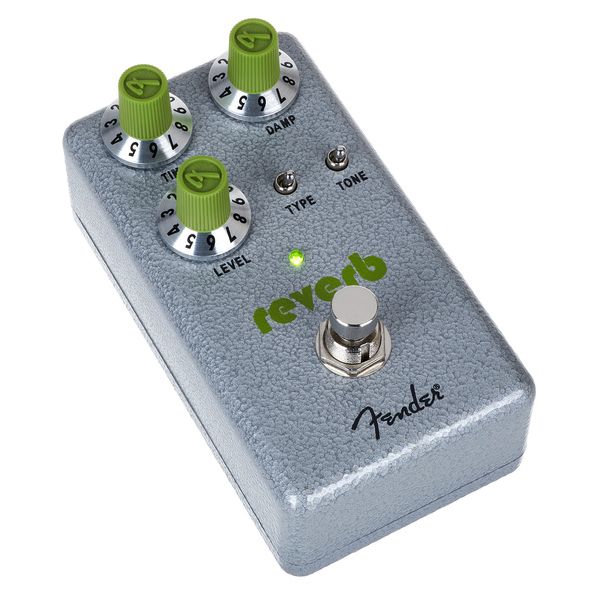
Fender’s Hammertone Reverb is aimed squarely at the gap in between – a proper spring/hall/plate box that doesn’t ask you to remortgage your pedalboard.
I’ve had one bolted to my board for a good while now, so let’s get into whether it earns its spot.
Build Quality: Solid, Not Fancy
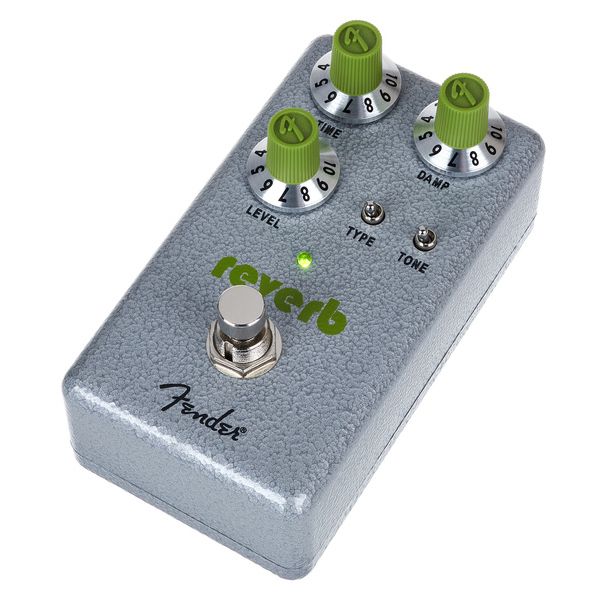
The Hammertone series uses a lightweight metal enclosure rather than the tank-like diecast housing you get on Fender’s pricier pedals.
It doesn’t feel cheap, exactly, but you notice it’s not trying to be a boutique unit either.
The footswitch is true bypass and clicks with a reassuringly solid action, and the status LED is bright enough to see on a dark stage.
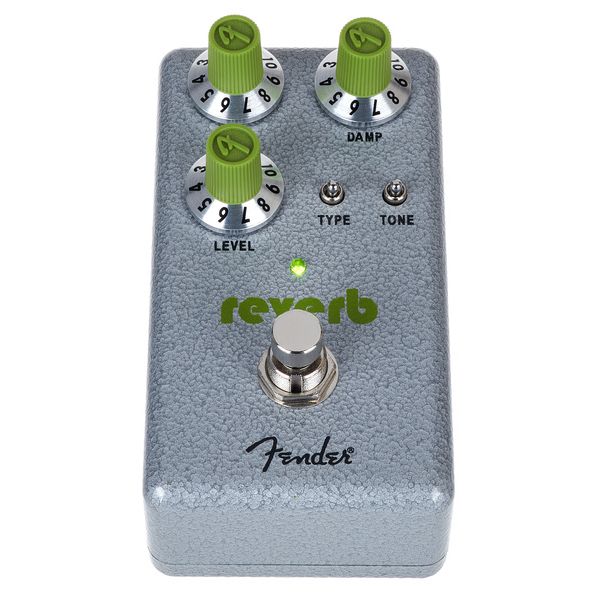
Knobs are a bit close together if you’ve got big fingers, but that’s a minor gripe on a pedal this size.
Fender rates it for standard 9V DC operation with a center-negative adapter, and there’s no battery option, so factor that into your power supply chain before you buy.
Tone and Sound
There are three reverb types on tap – Spring, Hall, and Room – selected via the Type switch, plus a second switch for standard or „Ambient” tone voicing.
Spring
This is the mode most players will reach for first, and it’s convincingly boingy without turning to mush at higher decay settings.
It’s not going to fool anyone who’s played through a real Fender tank, but for a compact pedal it holds up well, especially on cleaner amp settings.
Hall
Hall mode is where the pedal is a little more polarizing – some reviewers find it underwhelming at extreme settings, and I get why.
Push the Time and Level controls too far and it can smear out rather than blooming nicely, so I tend to keep it more restrained than I would on a dedicated ambient reverb like the one covered in this Holy Grail Nano review.
Room / Ambient
The Ambient toggle adds a wetter, more atmospheric character to whichever reverb type you’ve picked, and this is genuinely the pedal’s secret weapon.
It’s the setting that makes this little box punch above its price – if you like washy, ambient textures, flick that switch and thank me later.
Rolling the Damp control down a touch also tames some of the digital harshness that can creep in at long decay times, which is a nice bit of tone-shaping for a pedal this simple.
Playability and Usability
Three knobs – Time, Damp, Level – is about as simple as reverb gets, and that’s exactly the point.
You’re not wading through a menu system or holding down two footswitches to change presets.
Plug in, dial in Time and Damp to taste, set your mix level, and you’re playing within a minute.
It plays nicely on a crowded board too, sitting well after drive pedals or paired with a delay like the one in this Boss DD-200 review for a classic wet/dry-ish setup.
The footprint is compact enough that it won’t hog real estate on a small board, which matters more than people admit until they’re trying to Tetris five pedals into a Pedaltrain Nano.
Who Is This Pedal For
Honestly? Anyone who wants one good reverb pedal without agonizing over eleven algorithms and a MIDI implementation chart.
Bedroom players, gigging players who want a reliable backup, or anyone building a first „real” pedalboard after outgrowing a multi-fx unit – this fits all three.
If you’re the kind of player who tweaks modulation pedals like the Uni-Vibe reissue for hours, you might find this a bit basic – but that’s not really a knock against it.
It’s also a solid choice for home recording, where you just need a quick, musical reverb without opening a plugin and scrolling through presets.
Honest Niggles
- Hall mode can smear at extreme settings rather than blooming cleanly
- Plastic-feeling knobs that are a touch cramped together
- No true stereo I/O, so it’s mono in and mono out only
None of these are dealbreakers, but they’re worth knowing before you buy, especially if you were expecting studio-grade reverb algorithms.
How It Compares to Alternatives
Against something like the Boss RE-2 Space Echo, the Hammertone is simpler and cheaper, but it also doesn’t try to be a delay/reverb hybrid.
Compared to a Swiss-army-knife unit like the Boss GT-1000CORE, obviously this is a one-trick pony, but it’s a trick that costs a fraction of the price and needs zero setup.
If you already run a fuzz like the Op-Amp Big Muff and want something to wash out the back end of your tone, this slots in nicely at the end of the chain.
And if modulation is more your thing than reverb, pairing this with a phaser such as the one in this Boss PH-3 review opens up a lot of ambient territory without breaking the bank.
Setting It Up on Your Board
Position matters more than people think with reverb – put it after your drive and modulation pedals, near the end of the chain, right before any volume pedal.
If you run stereo amps or a wet/dry rig, remember this one’s mono only, so you’ll need a separate stereo widening trick if that’s your setup.
For most gigging and home setups, though, mono in and out is genuinely not a limitation – it just needs to be said upfront so nobody’s surprised at unboxing.
Key Specs
- Type: Analog-controlled digital reverb pedal
- Reverb modes: Spring, Hall, Room (plus Ambient voicing toggle)
- Controls: Time, Damp, Level
- Switches: Type, Tone/Ambient
- Bypass: True bypass with status LED
- I/O: 6.3 mm mono in, 6.3 mm mono out
- Power: 9V DC center-negative (adapter not included)
- Dimensions: 83 x 127 x 64 mm
Final Verdict
The Fender Hammertone Reverb isn’t trying to reinvent reverb – it’s trying to make a genuinely good one accessible.
For the money, it nails Spring and Ambient tones especially well, and it’s simple enough that you’ll actually use it instead of leaving it in menu-diving purgatory.
Is it the last reverb pedal you’ll ever buy? Maybe not. But as a first proper reverb, or a reliable backup for a gigging board, it’s hard to argue with.
Recommended, with the caveat that if you live and die by shimmering hall reverbs, try before you commit fully.