Watch It First
Phasers get overshadowed a lot. Chorus gets the 80s nostalgia, flanger gets the jet-plane party trick, and phaser just kind of… sits there being tasteful. The Boss PH-3 wants to change that.
Instead of one phase sound, Boss crammed seven distinct modes into this thing, from vintage 4-stage swirl all the way to weird rising and falling pitch-shift-adjacent sweeps that don’t sound like a „normal” phaser at all.
I’ve gigged with this pedal more than a few times now. Here’s what actually matters if you’re deciding whether it earns a spot on your board.
Seven Modes, Not One Trick
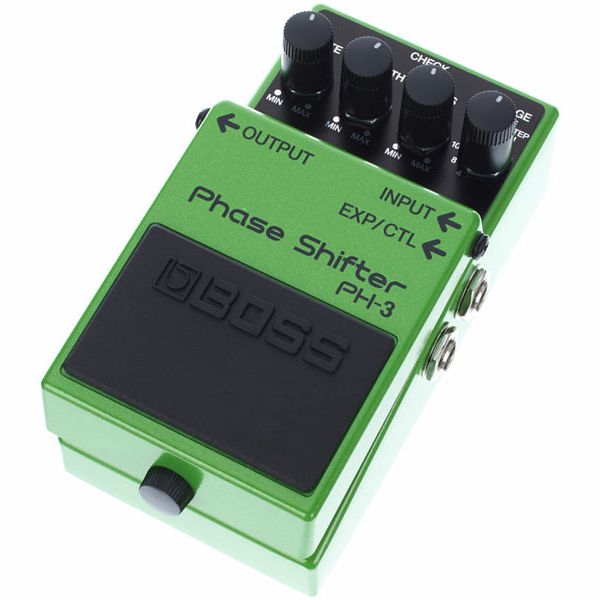
The mode dial is really the whole story of this pedal. You get 4-Stage, 8-Stage, 10-Stage and 12-Stage phasing (basically, more stages means a thicker, more complex sweep), plus Rise, Fall and Step modes that behave less like a classic phaser and more like a filter doing tricks.
Rate, Depth and Resonance round out the controls, and there’s tap tempo built in — hold the footswitch to set the rate to your song’s tempo instead of eyeballing a knob. Small feature, genuinely useful live.
Playability
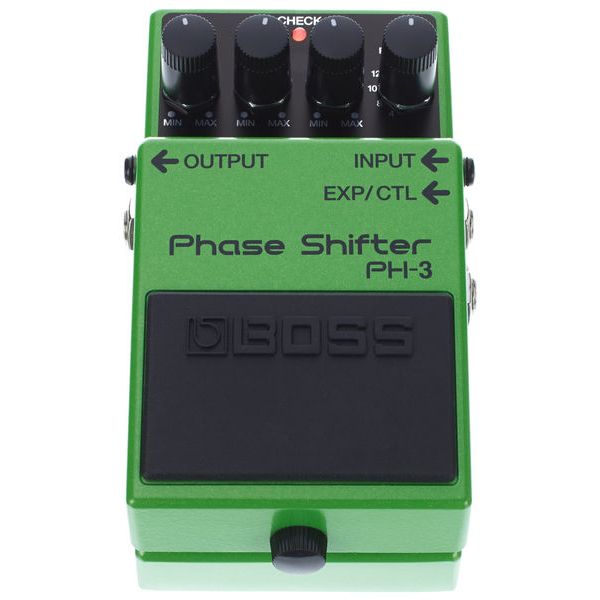
Standard Boss compact footprint again — 73 x 129 x 59mm, 420g. If you already run other Boss pedals like a chorus or EQ, this one just slots right in visually and physically, no surprises.
Tap tempo is a double-tap on the footswitch, no separate button, which keeps the layout clean but does mean you need to get used to the timing so you don’t accidentally retrigger it mid-set.
How It Sounds
4-Stage And 8-Stage
This is your classic funk-rhythm and Van Halen brown-sound phase territory. Smooth, musical, doesn’t fight with the rest of your tone. If you just want „a phaser” without overthinking it, start here and stop shopping.
10-Stage And 12-Stage
Thicker, more dramatic, closer to a light flanger in how noticeable the sweep gets at higher Depth settings. Great for ambient or post-rock textures where you want the pedal to be part of the arrangement, not just seasoning.
Rise, Fall And Step
These are the modes that make the PH-3 more than „just another phaser.” Rise and Fall sweep in one direction only and reset, which sounds bizarre described in text but genuinely cool through an amp — think pitch-bend-adjacent textures without an actual pitch shifter. Step mode jumps between settings rhythmically. Weird. Fun. Not for every song, but great when you need it.
Build Quality
Same story as every Boss compact — metal shell, tank-like footswitch, pots that don’t feel loose even after years of knob twisting. Power draw is a bit higher than some pedals at 50mA, so keep that in mind if you’re running a small isolated power supply with limited headroom per output.
Who It’s For
- Funk and rhythm players who want that classic swirl on tap
- Ambient and post-rock players who want unusual sweep textures beyond standard phase
- Anyone who wants tap tempo without buying a separate tap-tempo controller
- Players who like having options instead of committing to a single-voice boutique phaser
If you already know exactly what phaser sound you want and it’s a specific vintage voice, a dedicated single-mode pedal (an MXR Phase 90 clone, for instance) might get you there faster. The PH-3 is for people who want flexibility more than one perfect vintage recreation.
Honest Niggles
Seven modes is a lot to dial in live if you haven’t practiced switching between them beforehand — this isn’t really a „plug in and improvise” pedal for the weirder modes. Also, the tap tempo double-tap can occasionally misfire if you’re stomping around on a dark stage, so test it at soundcheck rather than trusting it blind.
And yeah, at higher resonance settings it can get a little harsh with single-coils. Nothing a quick Depth tweak doesn’t fix, but worth knowing going in.
Pairing It With Other Pedals
Phasers generally like to sit either right at the front of your chain (before drive, for a more vocal, sweeping character) or after drive and before delay/reverb (for a smoother, more ambient wash). Try both — it’s genuinely a different pedal depending on where you place it.
It also pairs nicely with an overdrive for that classic 70s rock swirl-into-crunch tone, or with a clean amp and reverb for spacey, atmospheric parts.
A Quick Word On The Vintage Angle
Worth mentioning: the PH-3’s lineage actually dates back to the original Boss PH-1 from the late 70s, one of the pedals that basically defined what a „phaser” sounds like on record, followed by the PH-2 Super Phaser in the 80s. The PH-3 carries that history forward instead of trying to reinvent it.
What that means practically: the 4-Stage mode here is deliberately voiced to sit close to those early Boss phasers, so if you’ve heard phase-heavy funk or disco records from that era, you already know roughly what to expect before you even plug in.
Bass players shouldn’t sleep on this one either. Set to a subtle Depth with 4-Stage mode, it adds movement without turning your low end to mush — something a lot of modulation pedals genuinely struggle with on bass.
Specs At A Glance
- 7 phaser modes: 4-Stage, 8-Stage, 10-Stage, 12-Stage, Rise, Fall, Step
- Controls: Rate, Depth, Resonance
- Built-in tap tempo via footswitch
- Connectors: 6.3mm input/output, 9V DC adapter input
- Power: 9V battery or 9V DC adapter (not included), 50mA draw
- Dimensions: 73 x 129 x 59mm
- Weight: approximately 420g
Final Verdict
The PH-3 isn’t trying to be the one true vintage phaser reissue. It’s the Swiss Army knife option — seven usable voices, tap tempo, and the kind of Boss reliability that means you’ll still be using it in ten years without a second thought.
For most players who just want „a great phaser” without committing to a one-trick boutique box, this punches well above its price and honestly makes most single-mode phasers feel a bit limited by comparison.
Also worth a look if you’re rounding out your modulation section: our notes on the MXR Analog Chorus and the Gretsch G2655T Streamliner Jr if you’re building a whole rig around ambient, swirly textures.