Watch It First
The original Uni-Vibe was never even designed as a guitar pedal. It was built to fake a rotating Leslie speaker, and it just so happened Hendrix and Robin Trower got hold of one and made it iconic.
Real vintage units are huge, fragile, and cost more than most people’s whole pedalboard. The MXR M68 shrinks all of that into a standard-size compact box without losing the plot.
I’ll be honest, I was skeptical a pedal this size could nail that specific throbbing swirl. Turns out I was wrong. Here’s why.
Chorus Mode Or Vibrato Mode
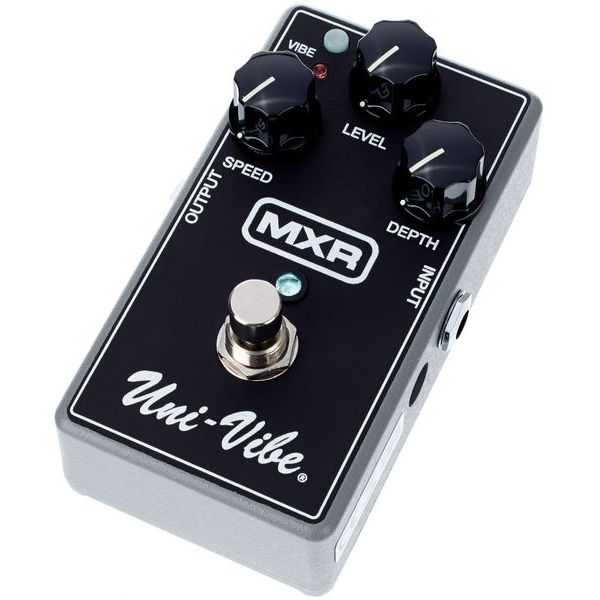
The whole pedal boils down to one switch and three knobs. The mode switch picks Chorus (your dry signal blends with the modulated one, so it thickens and swirls) or Vibrato (the pitch itself wobbles, no dry blend, much more intense and seasick in a good way).
Speed, Level and Depth handle the rest. Speed sets how fast the swirl cycles, Depth controls how dramatic the sweep is, and Level is your overall output volume, since the effect can change perceived loudness noticeably.
Playability
Standard MXR compact footprint, true bypass, rugged footswitch, 6.3mm jacks in and out. Runs off a 9V battery or an optional adapter that isn’t included, so grab a Boss-style PSU if you don’t already have pedalboard power sorted.
Three knobs and a switch means zero learning curve. You can dial in a usable tone in about ten seconds, which is refreshing after wrangling something like a seven-mode phaser.
How It Actually Sounds
Chorus Mode
Thick, warm, throbbing — this is the „spinning Leslie speaker” sound in its purest compact-pedal form. Great on clean tones for that watery, almost underwater texture, and genuinely gorgeous on rhodes-style keyboard voicings if you run a keys rig through it too.
Vibrato Mode
This is the more aggressive, more psychedelic setting. No dry signal blended in means the pitch wobble is front and center, which is exactly what gives Hendrix’s „Machine Gun” and Trower’s „Bridge of Sighs” that seasick, otherworldly quality.
Crank the Speed and Depth together and it gets genuinely disorienting in the best way. Back both off and it’s a subtle, almost tremolo-like pulse instead.
Build Quality
MXR’s compact pedals have a well-earned reputation for surviving decades of abuse, and this one’s no different — die-cast housing, true bypass switching, the kind of build that shows up on pedalboards from the 90s still working fine today.
Who It’s For
- Classic rock and psychedelic players chasing that specific Hendrix/Trower swirl
- Anyone who wants Uni-Vibe character without vintage-unit price tags or reliability headaches
- Keyboard players running rhodes or organ voicings who want that rotating-speaker texture
- Players who prefer simple three-knob pedals over deep multi-mode boxes
Honest Niggles
It’s a one-trick pedal, and that trick is specific. If you want a general-purpose chorus for shimmery clean tones, a dedicated analog chorus will probably serve you better day to day — this one’s voiced specifically for that vintage vibe character, not modern lush chorus tones.
Also, true vintage Uni-Vibe units used an actual expression-pedal-style foot treadle to control speed in real time while playing. The M68 doesn’t include that — it’s a fixed-knob Speed control, so you lose some of the real-time expressiveness die-hard vibe nerds chase.
Where To Put It In Your Chain
Traditionally, Uni-Vibe goes before any fuzz or drive pedal for that classic psychedelic-era signal chain order, though plenty of players run it after drive too for a smoother, more ambient result. Experiment — this is one of those pedals where „wrong” placement can still sound great.
A Bit Of Uni-Vibe History
The original Uni-Vibe was built by Japanese company Shin-ei back in the late 60s, using photocells and a light bulb to create its swirling modulation — genuinely strange engineering by today’s standards, and part of why original units are so finicky and expensive to maintain.
Hendrix used one live constantly during 1969 and 1970, and it’s all over his Band of Gypsys era tone. Robin Trower leaned on it even harder, to the point where „Uni-Vibe guitar tone” and „Robin Trower guitar tone” are basically interchangeable phrases among tone nerds.
MXR (under Dunlop, who also owns the original Uni-Vibe trademark) built the M68 to recreate that specific circuit behavior digitally-informed but analog at heart, without the photocell reliability issues of the originals. That’s the whole pitch: same swirl, none of the vintage-gear anxiety.
Uni-Vibe Vs. A Regular Chorus Or Phaser
It’s worth being clear about what makes this different from a standard modulation pedal. A typical chorus pedal splits your signal, detunes one copy slightly, and blends it back in for a shimmery, layered effect. A phaser sweeps notches out of the frequency spectrum for that swooshing sound.
Uni-Vibe does something in between, closer to true pitch modulation combined with a filter sweep, and it reacts to your picking dynamics in a way most standard chorus and phaser circuits don’t. Dig in harder and the swirl responds — that touch sensitivity is a big part of why it still feels distinct from newer, cleaner-sounding modulation pedals decades later.
If you’ve tried a handful of chorus and phaser pedals and none of them quite scratch the itch you’re after, there’s a decent chance what you’re actually chasing is Uni-Vibe character specifically. It really is its own thing.
Specs At A Glance
- Chorus and Vibrato modes via front panel switch
- Controls: Speed, Level, Depth
- True bypass switching
- Connectors: 6.3mm input/output jacks
- Power: 9V battery or optional 9V DC adapter (not included)
- Rugged die-cast MXR compact enclosure
Final Verdict
The MXR M68 takes a genuinely legendary, historically important effect and makes it accessible without gutting what made it special. It’s not trying to be a modern do-everything modulation pedal, and that focus is exactly the point.
If you’ve ever wanted that specific swirling, throbbing psychedelic texture without hunting down a fragile vintage original, this punches way above its price and honestly just sounds fantastic straight out of the box.
Chasing more vintage-inspired tones for your board? Also check out our take on the Ibanez TS9 Tube Screamer and the MXR Six Band EQ to round out a classic-rock signal chain.