Watch It First
A real Fender Deluxe Reverb weighs about 23kg and takes up half a car boot.
The UAFX Dream ’65 weighs 567 grams and fits in a gig bag pocket, and it’s trying to sound like exactly that amp.
Bold claim. Let’s see if Universal Audio actually pulled it off.
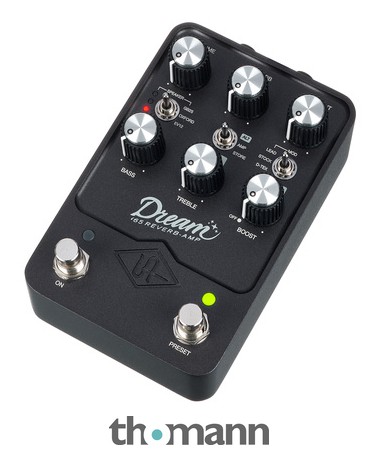
What This Thing Actually Is
The Dream ’65 isn’t a drive pedal or an overdrive with a cute name. It’s a full stereo amp-and-cabinet emulator built into a stompbox, modelled specifically on a mid-60s blackface American combo.
It ships with three 12″ speaker models built in – a vintage Celestion Greenback (GB25), an original Oxford 12K5-6, and an Electro-Voice EVM12L – plus the option to download more cabs for free via the UAFX Control app, including a Fender Twin Reverb cab and a Fender Super Reverb 4×10.
On top of that you get the classic tube-driven spring reverb and vibrato that made this amp so beloved in the first place, plus Live and Preset modes so you can switch sounds on the fly mid-set.
Two Chips, Doing the Real Work
Universal Audio uses a dual-processor engine here, the same approach used across their whole UAFX line including the practice amp modelling world is chasing right now. That’s why it can run full amp modelling, cab simulation, mic placement and reverb/vibrato all at once without sounding thin or digital.
How It Sounds
This is the part that matters and, honestly, it’s genuinely impressive.
Clean tones have that shimmery, slightly compressed blackface character – not quite as loose as a real tube amp under load, but close enough that in a mix nobody would clock the difference. Push the input harder and you get that lovely edge-of-breakup grind Deluxe Reverbs are famous for.
The spring reverb is a particular highlight – it has that slightly splashy, physical quality that digital reverbs usually fail to nail. Vibrato is lush too, more usable than most built-in amp vibratos I’ve tried.
Where it stumbles a little: pushed really hard with an already-hot pickup or an overdrive in front, some players report the front end clipping in a slightly digital way rather than smoothly breaking up like a real tube preamp. It’s not a dealbreaker, but it’s there if you go looking for it.
How It Compares to the Alternatives
The obvious rival here is the Strymon Iridium, which also does amp-and-cab emulation in a compact pedal. The Iridium covers three completely different amp voicings (Fender, Vox, Marshall-ish), so it’s more flexible on paper.
The Dream ’65 goes deep on one amp instead of wide across three. If blackface Fender tone is genuinely what you’re after, the Dream ’65 feels more authentic and detailed because that’s the only thing it’s trying to do.
Against the Universal Audio’s own siblings – the Woodrow ’55 and Ruby ’63 – this one sits in the middle for price and arguably has the broadest general appeal, since blackface clean tones are so widely useful across genres, from indie to jazz comping.
Living With the App
The UAFX Control app is where most of the actual tone-shaping happens – cab choice, mic type and placement, reverb dwell, vibrato depth. On the pedal itself you get a handful of physical knobs for the essentials.
This works fine at home, but it’s worth setting your patches before a gig rather than trying to tweak on your phone between songs. Once it’s dialled in, though, it’s genuinely set-and-forget reliable.
Build and Practical Use
It’s a solid, compact metal enclosure with two inputs and two outputs for full stereo operation, plus a USB-C port for firmware updates and app connectivity.
Power draw is a bit higher than your average pedal – it needs a 9V supply rated at least 400mA, so double-check your power brick can handle it before you add this to a crowded board. Universal Audio sell a matching PSU if you need one.
Headphone practice works nicely too, since the cab simulation is genuinely convincing straight into an interface or headphone amp – handy for late-night playing when you can’t crank a real combo amp.
Who Should Actually Buy This
- Guitarists chasing blackface Fender clean and edge-of-breakup tones without owning a heavy tube combo
- Session players who need a reliable, repeatable amp tone through a DI or interface
- Anyone downsizing from a full amp and pedalboard rig to a smaller pedal-based setup
- Home recordists who want believable amp tone without mic’ing a cab
If you already own the real amp and you’re happy hauling it to gigs, this is a „nice to have” rather than a „need to have.” It’s aimed at people replacing an amp, not necessarily people who already have a great one.
Where It Falls Short
- Only one onboard preset accessible without the app – most tone recall needs the UAFX Control app
- Front end can clip in a slightly digital way when driven hard with high-output pickups
- Needs a beefier 9V power supply than most standard pedal PSUs provide
- Universal Audio’s terms mean app access is tied to their platform, which some players understandably don’t love
None of these are surprising for a modelling pedal at this price point, but worth knowing going in.
Full Spec Rundown
- Type: stereo amp and cabinet emulation pedal
- Built-in speaker models: GB25 (Celestion Greenback), Oxford 12K5-6, EV12 (EVM12L)
- Free downloadable cabs via UAFX Control app
- Effects: spring reverb, vibrato, Live/Preset switching
- Inputs/outputs: 2x 6.3mm jack in, 2x 6.3mm jack out (stereo)
- USB-C for updates and app connection
- Power: 9V DC, min. 400mA, center-negative (adaptor not included)
- Dimensions: 9.2 x 6.5 x 14.1 cm / Weight: 567g
- Available since May 2022, rated 4.6/5 from 161+ Thomann reviews
Final Verdict
Is it exactly a Deluxe Reverb? No, not 100%. Nothing modelled ever quite is, and anyone telling you otherwise is selling something.
But it’s close enough, light enough, and flexible enough that for most players the trade-off is a no-brainer. You get 90% of the tone at about 2% of the weight, plus stereo reverb and vibrato most real amps of that era never had.
If blackface clean and edge-of-breakup tones are your thing and you’re tired of lugging a combo around, this earns its price tag. Worth it? Yeah, I’d say so.