Watch It First
Simple amps are having a moment again. After years of channel-switching, multi-effects everything, some players just want two knobs and a speaker that moves air.
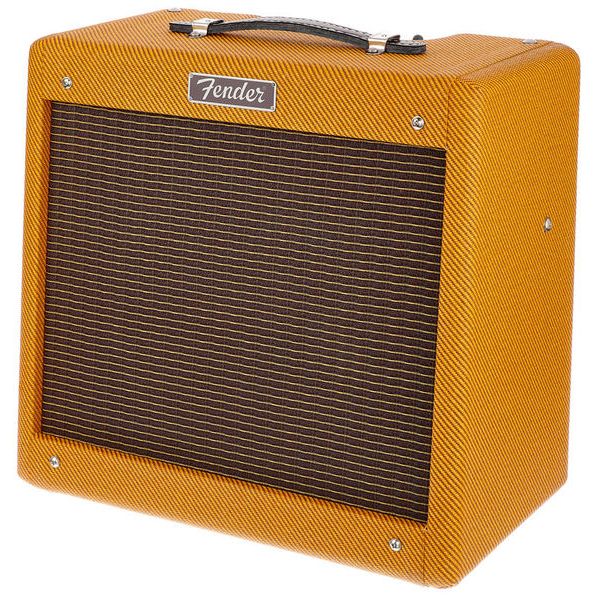
The Fender Pro Junior IV is about as minimal as tube amps get without going full single-ended boutique pricing – one channel, two knobs, one speaker.
I wasn’t sure two knobs could hold my attention for long. They did.
The Minimalist Pitch
15 watts through a single 10-inch Jensen P10R speaker, powered by two 12AX7 preamp tubes and a pair of EL84 power tubes. That’s it. No reverb, no channel switching, no effects loop, no footswitch jack.
Volume and Tone are your only two controls. If that sounds limiting, it kind of is – and that’s the entire point. This is an amp built for people who want tone decisions made at the guitar and their fingers, not at a control panel. It shares that stripped-back philosophy with something like the Orange Micro Terror, just in combo form rather than head-only.
Tone – Small Amp, Real Character
Clean to Breakup
Below about halfway on the volume knob, this is a genuinely lovely clean Fender tone – not as scooped or glassy as a bigger Fender combo, but warmer and a bit more compressed thanks to the smaller single speaker and EL84 power section.
Push past halfway and it starts breaking up in a really musical way. This is where the amp comes alive – EL84 power tubes compress and grit up earlier than the 6L6s in bigger Fender amps, so you get usable overdrive at a lower, more apartment-friendly volume than something like a Hot Rod Deluxe IV.
Pedal Friendliness
With just Volume and Tone, this amp leaves all the tone-shaping work to your pedalboard, and it takes pedals extremely well. Drives, fuzzes, and modulation all sit nicely on top of that simple, slightly compressed EL84 breakup.
Build and Everyday Practicality
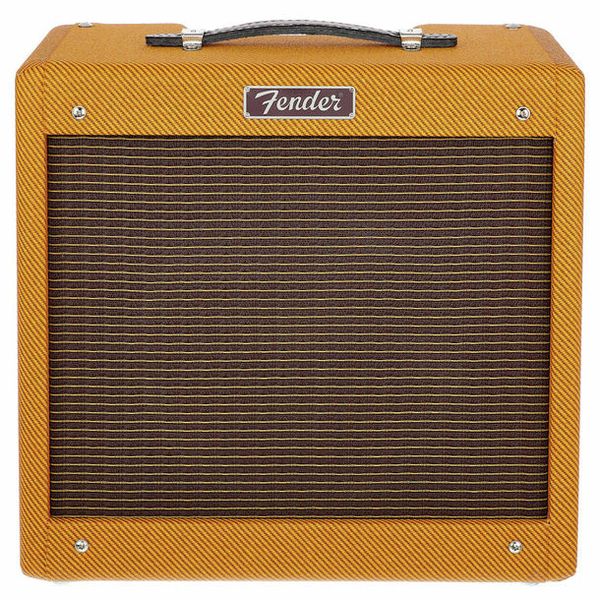
At 10.36kg, it’s genuinely easy to carry with one hand via the vintage-style leather handle. The lacquered tweed cabinet and 1950s-style grille cloth look the part, and the chicken-head knobs feel properly vintage rather than costume-y.
The trade-off for simplicity is a total lack of modern conveniences – no footswitch connection, no effects loop, no headphone out, no recording output. If you need any of those, this isn’t your amp.
Quality control has occasionally been an issue historically, based on user reviews – a small number of buyers report early tube or socket problems. Nothing that seemed like a genuine pattern rather than the usual variance you get with any mass-produced tube amp.
Who’s This Actually For?
Blues, roots, and classic rock players who want real tube breakup at a volume that won’t get you evicted. Anyone building a simple pedal-forward rig who doesn’t want an amp’s own channel-switching getting in the way. Home and small-room players who’d rather have character at low volume than headroom they’ll never use.
If you play in a loud band and need serious clean headroom, look at something like the Fender Blues Junior IV or a full-size Hot Rod Deluxe instead. If you want boutique refinement and don’t mind paying more for it, a Vox AC15 C1X or the Blackstar TV-10 A are worth comparing too.
Living With Just Two Knobs
After a few weeks, the lack of options stopped feeling like a limitation and started feeling like a relief. There’s no channel to forget you left switched, no onboard reverb level to second-guess, no menu to dive into before a rehearsal. You plug in, set Volume and Tone, and play.
That simplicity also makes it a genuinely good practice tool for working on dynamics and touch. With no compression or effects to hide behind, every pick attack and volume swell comes through clearly – which is either a feature or a mild wake-up call, depending on how tidy your technique actually is.
The Niggles
No reverb built in is the big one – you’re adding a pedal or living without it. No effects loop means time-based pedals go in front of the amp rather than after the preamp stage, which isn’t ideal for delay and reverb pedals specifically. And at 15 watts, gigging with a loud drummer will still push you into „everything cranked” territory faster than you’d like.
None of these are surprising given the amp’s whole reason for existing. It’s deliberately basic, and mostly succeeds because of that, not despite it.
Specs at a Glance
- 15W tube combo amp, 1 channel
- 1×10″ Jensen P10R speaker
- Tubes: 2x 12AX7 preamp, 2x EL84 power
- Controls: Volume, Tone
- Lacquered Tweed cabinet, vintage leather handle
- Dimensions 36.83 x 38.73 x 22.22cm, weight 10.36kg
- Available since January 2018
How It Compares
Within Fender’s own range, the Pro Junior sits below the Blues Junior IV in features – no reverb, one fewer knob – but arguably has more character per watt, since there’s nothing digital or overly polished getting in the way of the tubes doing their thing. If you’ve ever wanted the Blues Junior’s tone with even less to think about, this is that amp.
Against louder rivals – a Marshall from our best Marshall amps guide, for instance – it obviously loses on headroom and versatility. But for bedroom and small-room use, that’s rarely the deciding factor.
Final Verdict
The Pro Junior IV isn’t trying to do everything, and that’s exactly why it works. For players who want honest, simple tube tone without a control panel getting in the way, it’s one of the more characterful small amps around.
If you want more headroom and channel options, check our review of the Fender Blues Junior IV or the Harley Benton Tube 5 Celestion for louder or more feature-packed alternatives.