Watch It First
Ampeg built its whole reputation on being loud, heavy and impossible to ignore. The SVT rig is basically bass-amp royalty – if you’ve ever stood in front of one at full volume, you already know that feeling in your chest.
The Micro-VR Stack takes that whole vibe – the look, the growl, the „don’t mess with me” attitude – and crams it into something you can carry in one hand. A 200-watt head paired with a proper Eminence-loaded 2×10 cab.
I’ve spent real time behind this exact head-and-cab pairing, and I want to talk honestly about what it nails, what it doesn’t, and who should actually buy one instead of just admiring the SVT logo on the front.
Build and Design
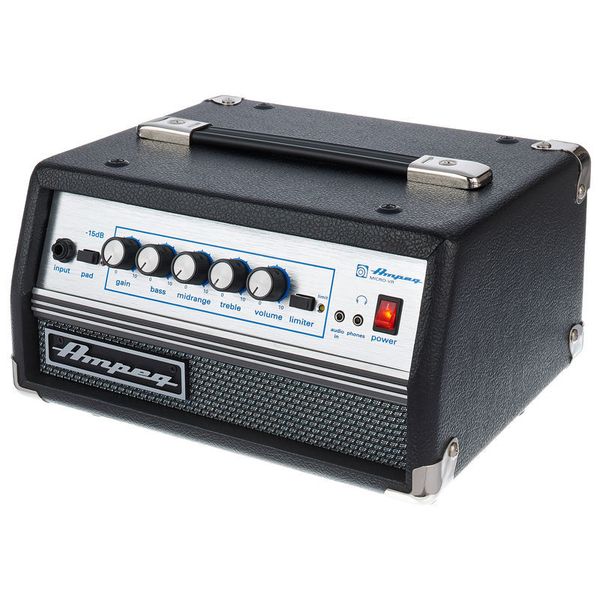
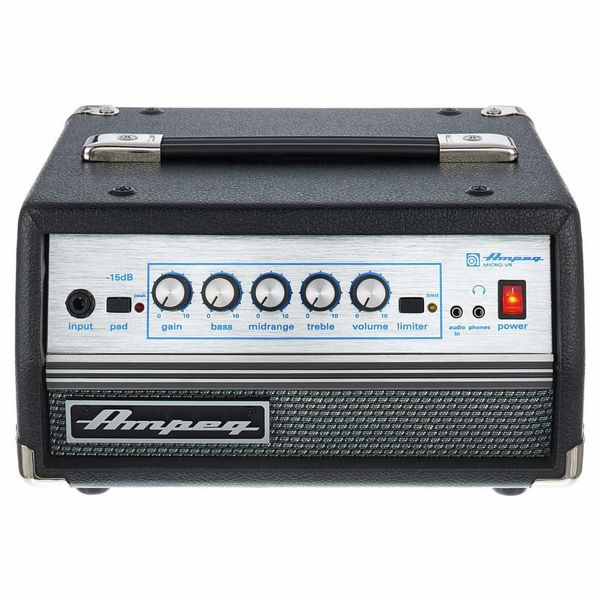
Visually this thing is an SVT shrunk in the wash. Silver front plate, black covering, chrome corners, that silver-and-blue grille cloth – it’s unmistakably Ampeg from ten feet away, just… miniaturised.
The head itself is tiny: about 30cm wide, 14cm tall, 25cm deep. It’ll fit in a backpack next to your pedalboard without anyone blinking.
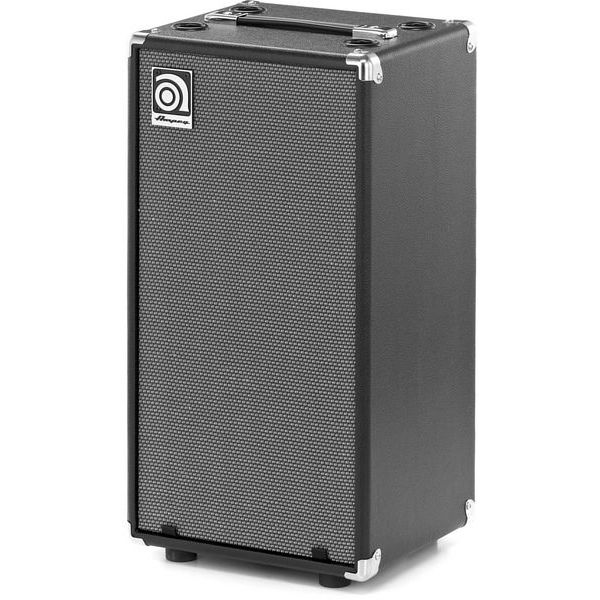
The matching 2×10 cab keeps things sensible too. Two Eminence drivers in a compact box that weighs around 14kg – light enough to carry with one hand up a flight of stairs, which if you’ve ever moved a full SVT rig, you’ll appreciate immediately.
What’s Actually Under the Hood
Power section is a 200-watt Mosfet amp feeding a solid-state preamp that Ampeg voiced specifically to mimic the tube SVT preamp circuit. It’s not tubes, and Ampeg isn’t pretending it is.
Controls are lifted straight from the big rigs: 15dB Pad, Gain, Bass, Ultra-Mid, Treble, Volume and a Limiter Defeat switch. If you’ve ever touched a full-size SVT, this layout will feel instantly familiar.
There’s also a stereo Aux input that mixes into the headphone output – genuinely useful for silent practice with a backing track or click. A DI output handles direct recording or sending a signal to FOH without miking the cab.
Playability and Sound
Does it actually sound like Ampeg? Mostly, yes. That mid-forward growl is there, and the way it pushes into breakup when you dig in feels right. It’s not literally tube warmth, but the voicing is close enough that most people in the room won’t clock the difference.
It pairs really nicely with a classic P-Bass. I tested it alongside a Fender American Professional Classic Precision Bass and the combo was pure Motown thump. A Squier Classic Vibe ’60s Precision Bass got surprisingly close to the same result for a fraction of the money, which says a lot about how much of the tone is coming from the amp.
Modern, hi-fi basses work well too. A Yamaha TRBX305 or a Sire Marcus Miller U5 both benefit from that mid push – it fattens up cleaner, more scooped instruments in a good way.
Headroom-wise, 200W into an 8-ohm 2×10 is enough for rehearsal rooms and small-to-mid gigs. It is not going to out-muscle a loud drummer with no PA support, so keep expectations realistic.
Who It’s For
Gigging bassists who need a real Ampeg tone without hauling a fridge-sized cab around. Session players who want something that fits in a car boot alongside everything else. Teachers running a small studio room. Basically, anyone who wants the SVT attitude without the SVT logistics.
Honest Niggles
It’s solid-state, not tube – put it head-to-head with a real vintage SVT and purists will hear the difference eventually, even if casual listeners won’t.
200 watts sounds like plenty until you’re in a loud room with an unmiked drummer. It handles rehearsals and small venues fine, but don’t expect arena headroom.
It’s also not cheap for what is, on paper, a „travel” rig. You’re paying partly for the badge and the tone recipe, and that’s worth being upfront about.
No onboard tuner out is a small miss on a head clearly designed for gigging musicians who’d appreciate one.
Reliability on the Road
One thing worth mentioning: solid-state gear like this tends to be more forgiving on tour than tube amps. No valves to baby, no warm-up time, no worrying about it surviving a bumpy van ride between gigs.
That reliability angle matters more than people give it credit for. A tube SVT head is a beautiful thing until it’s 20 minutes before doors and a preamp tube decides to die on you. The Micro-VR just doesn’t have that failure mode, and for working musicians that peace of mind is worth something on its own.
I’d also add that the speakon/jack combo on the back means you’re not locked into proprietary cabling either – standard speaker cables work fine, so replacing one if it ever gets lost or damaged on the road is a five-minute fix, not a scavenger hunt.
Ampeg Micro-VR Stack vs the Alternatives
The obvious in-house comparison is the Ampeg Micro-CL Stack – cheaper, simpler, and honestly a bit less versatile with fewer tone controls. If budget is the deciding factor, it’s worth a look, but the Micro-VR earns its extra cost with a preamp that just feels more dialled-in.
If you want a full combo instead of a head-and-cab setup, something like the Ampeg RB-110 is worth cross-shopping, though you lose the modularity of swapping cabs later.
Worth noting: guitarists have been doing the exact same shrink-the-rig thing for years. Check the Marshall MG10 vs MG15 comparison or the Fender Mustang LT25 review if you’re curious how the guitar side handles the same problem – different tech, same idea.
Specs
- Head power: 200W RMS @ 4 ohms
- Preamp: solid-state, SVT-voiced
- Power amp: Mosfet
- Cab: 2×10″ Eminence speakers, 200W RMS @ 8 ohms
- Controls: 15dB Pad, Gain, Bass, Ultra-Mid, Treble, Volume, Limiter Defeat
- Connections: Stereo Aux in, DI out, headphone out (mixed with Aux)
- Head dimensions: 304 x 140 x 254mm
- Cab dimensions: 610 x 330 x 280mm, approx. 14kg
- Available since 2009
Final Verdict
The Ampeg Micro-VR Stack isn’t trying to be a full SVT rig, and it’s smart enough not to pretend otherwise. What it does is give you a genuinely usable slice of that tone in a package you can actually carry without a dolly.
For gigging bassists, teachers, and anyone who wants Ampeg character on a budget of both money and back pain, it’s a smart pick. Just go in knowing it’s solid-state, and that 200 watts has real limits at louder gigs.
If that trade-off works for you, this is one of the easiest ways to get real Ampeg DNA into a small room or a small gig bag.