Watch It First
I will admit it: I bought the EHX Mel9 mostly to mess around with. I did not expect to still be reaching for it a year later.
The pitch is simple – plug your guitar, bass, or keyboard in, and get nine different Mellotron-flavoured sounds out the other side. Orchestra, cello, strings, flute, clarinet, sax, brass, and two choir settings.
It sounds like a novelty on paper. It is not. This thing has genuinely changed how I write parts.
What It Actually Does
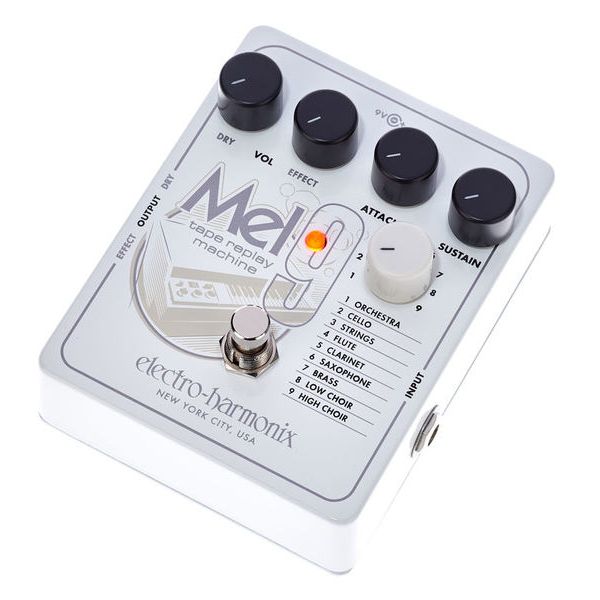
The Mel9 is not trying to be a perfect Mellotron recreation. It is closer to a stylised impression, which is honestly closer to how the original tape-based Mellotron sounded anyway, all warble and imperfection.
Two independent volume knobs (Effect and Dry) mean you can blend the Mellotron tone under your regular guitar signal instead of replacing it entirely, great for washy pads under a clean arpeggio.
Attack and Sustain knobs shape how the effect responds, from quick and percussive to long swelling pads that just hang in the air.
Tracking and Playability
This is where the Mel9 earns its keep. Pitch tracking is genuinely impressive – bends, slides, and chords all come through cleanly, which a lot of cheaper synth pedals fumble badly.
Chords are where it gets interesting, since real Mellotrons were monophonic tape players per key, not synths. EHX handles chords better than expected, though dense voicings can get a little smeared on some presets.
If you already play something with a smooth, expressive neck, a semi-hollow or a boutique-style build like the PRS SE Paul’s Guitar, the Mel9 rewards clean technique. Sloppy bends get exposed fast on the string and choir patches.
Where It Shines (and Where It Does Not)
Ambient and shoegaze players are going to get the most obvious mileage here. If that is your world already, it slots straight into the sort of pedalboard I talk about in my roundup of guitars for shoegaze and ambient tones.
But it is not just a one-trick pedal. I have used the Flute and Clarinet settings for quiet, textural intros on otherwise straightforward rock songs, played on something as ordinary as a Yamaha Revstar Standard RSS20.
The honest niggle: some presets are stronger than others. Orchestra and Strings are gorgeous. Saxophone, in my experience, is the weakest patch on the pedal, usable, but the one I reach for least.
It also is not cheap for a single-effect pedal, and there is a bit of a learning curve to get sounds that feel musical rather than gimmicky. Give it a week before you judge it.
Who It Is For
Bedroom producers layering guitar textures, prog and psych players chasing vintage keyboard tones, and anyone bored of standard reverb-and-delay ambient setups will get real use out of this.
If you are just building your first pedalboard around a beginner-friendly guitar like the Squier Sonic Strat, this is probably a second or third pedal purchase rather than your first, get your drive and reverb sorted before you go chasing Mellotron sounds.
And if you are pairing it with something with a bit more rock attitude, like the Ibanez GRGA120, try the Brass and Low Choir settings blended low under a clean channel, it adds a surprising amount of depth to otherwise simple chord progressions.
Setup Tips
Run it near the front of your chain, before drive pedals, if you want a synthy, saturated tone. Put it after drive and before reverb if you want a cleaner, more orchestral texture layered under your dirt.
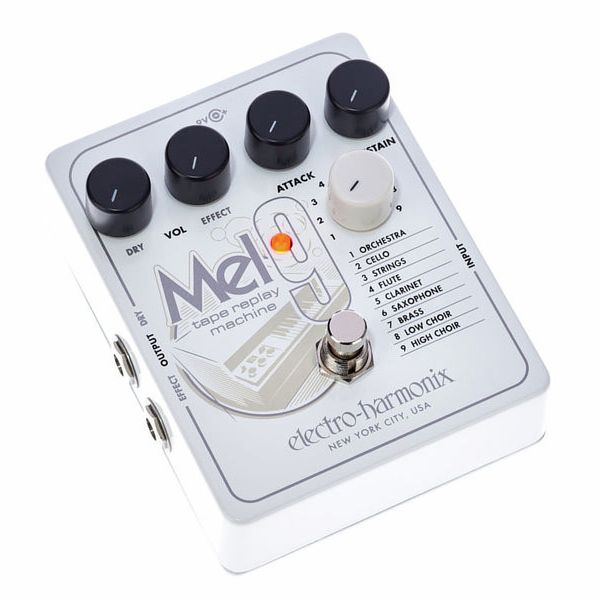
The separate Dry output is worth using if your amp or interface has two inputs, you can run your clean guitar tone to one channel and the full Mellotron wash to another, then blend them in the mix.
Start with the Attack knob low and Sustain moderate. It is the fastest way to find the sweet spot where it actually sounds like a Mellotron, rather than something more synthetic.
Specs at a Glance
- Type: Mellotron tape emulation pedal
- Presets: 9 (Orchestra, Cello, Strings, Flute, Clarinet, Saxophone, Brass, Low Choir, High Choir)
- Controls: Effect volume, Dry volume, Attack, Sustain, preset selector
- Outputs: Effect out plus independent Dry out
- Works with: guitar, bass, keyboard
- Power: 9V PSU included
- Dimensions: 102 x 121 x 89 mm
Quick FAQ
Does it work well with bass? Yes, EHX specifically designed it to track bass and keyboard signals too, not just guitar.
Can I use it live? Absolutely, the preset switch is instant and it is a solid, road-worthy build like most EHX floor pedals.
Is it worth it if I am not into prog or ambient music? It is more versatile than the marketing suggests, but if your style is straight blues or country, this is probably not your first pedal purchase.
The Verdict
The EHX Mel9 is one of those pedals that sounds like a gimmick until you actually spend a week with it. Then it quietly becomes one of the more creatively useful things on your board.
It is not a pedal for everyone, and a few presets are stronger than others. But for texture, atmosphere, and genuinely inspiring new parts, there is very little else like it at this price.
How It Compares
There are cheaper ways to get a vague choir or string pad, chorus and reverb stacked together will get you somewhere close. But none of them track pitch the way the Mel9 does, and none of them give you nine distinct instrument voicings in one box.
EHX also makes a companion piece, the KEY9 Electric Piano Machine, which covers electric piano and clav tones using the same platform. If you like the Mel9 concept, that is worth a look for a completely different flavour.
Compared to full-blown synth pedals like the Boss SY-200, the Mel9 is far more limited in scope, but also far simpler to dial in a usable sound on within a minute of plugging in. That trade-off is exactly the point.