Watch It First
I’ll admit it – I was skeptical of the whole UAFX line at first. A studio plugin company making pedals? Feels like a marketing exercise more than a real product, right?
Then I spent a weekend with the Starlight Echo Station and that skepticism mostly evaporated. This thing genuinely sounds like the studio gear it’s modeled on.
It’s not cheap, and it’s not perfect. But here’s why I keep reaching for it anyway.
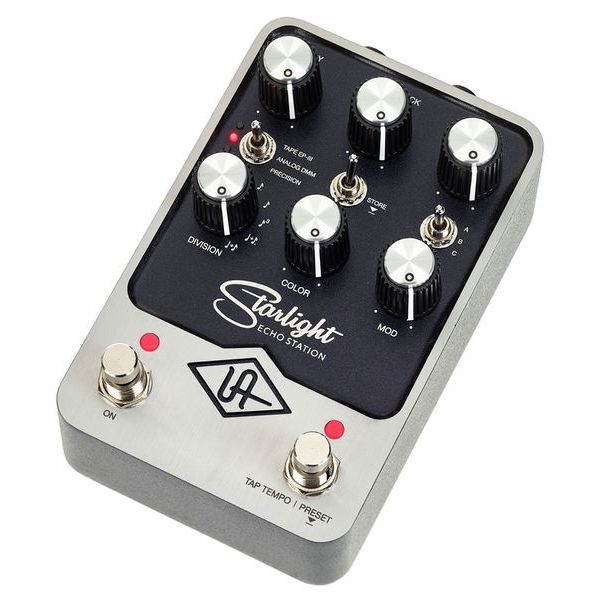
Three Delays, Three Completely Different Personalities
The Starlight packs three distinct delay algorithms behind a single toggle switch, and Universal Audio didn’t half-ass any of them.
Tape EP-III is modeled on the old Echoplex tape echo – warm, slightly wobbly, with that gorgeous saturation as repeats build up. This is the one that makes people go „ooh” when you demo it.
Analog DMM is their take on the Electro-Harmonix Deluxe Memory Man – darker, murkier repeats that fold into the background rather than sitting on top of your dry signal. Great for ambient washes.
Precision is the clean digital delay for when you just need clarity – crisp, transparent repeats with none of the character (deliberately). Handy for cutting through a busy mix.
Genuinely, all three are usable in a way a lot of „multi-mode” pedals aren’t. Normally one mode is clearly the reason you bought the pedal and the rest are filler. Not the case here.
The stereo imaging deserves a mention too. Run it in stereo through two amps, or into a stereo interface, and the width genuinely opens up – repeats bouncing left and right rather than just piling up in mono. It’s a different pedal in stereo, honestly.
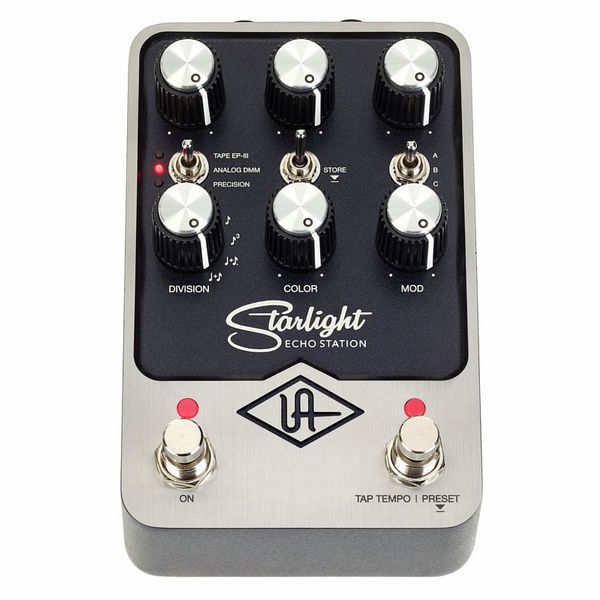
Build, Controls, and the App Situation
Physically it’s a solid, road-ready enclosure with the classic Delay, Feedback, and Mix knobs plus tap tempo. Stereo in and out on quarter-inch jacks, USB-C for firmware updates. Straightforward.
The companion UAFX Control app is where things get a bit messier. It’s Bluetooth-based and lets you tweak parameters and grab bonus algorithm downloads, but reviewers (myself included) have found it clunky – no tempo control from the app, limited preset management, and the Bluetooth connection isn’t always rock solid.
You genuinely don’t need the app to use the pedal well, which is the important bit. But if Universal Audio ever polish that software, this pedal gets noticeably more useful live.
Only one onboard preset without the app is a real limitation for live players who need to switch sounds mid-set. Worth knowing before you buy if that’s your use case.
Compare that to something like the Roland Cube-10GX approach to onboard tech – simpler, but honestly more predictable in a live setting. There’s a real tradeoff here between sonic depth and live-friendliness that you should weigh against how you actually play. Check our Roland Cube-10GX review if you want a sense of that „simple but solid” philosophy applied to an amp instead.
Who It’s For
Studio players and home recordists who want tape-echo character without babysitting an actual tape machine – that’s the sweet spot. If you’re into ambient or shoegaze textures, this pairs beautifully with the kind of gear covered in our best pedals for shoegaze roundup, and it plays nicely alongside guitars built for that ambient, wash-of-sound style.
It also makes a lot of sense for jazz players chasing a subtle slapback – check our best guitar pedals for jazz piece for context on where this fits into that world.
If you’re gigging every weekend and need bulletproof, instant preset recall, there might be simpler, more live-friendly delays out there. This one rewards patience and a bit of studio mindset.
The Honest Niggles
This is a premium pedal, and it’s priced like one. That’s not a knock exactly, but it means you’re competing against some serious alternatives at this budget tier.
The app frustrations are real – I mentioned it above but it bears repeating because it’s the single most common complaint in user reviews. No BPM display, patchy Bluetooth, minimal preset control.
Input levels can also feel a touch conservative with hot pickups or preamped signals, occasionally introducing unwanted crackle before you’d expect it. Nothing dramatic, just something to be aware of if you run a hot signal chain.
If you want more overdrive and modulation flavor alongside your delay rather than a dedicated delay-only box, something like the MXR Custom Shop Timmy or a pitch-based texture pedal like the DigiTech Whammy 5 might round out your board better than a second delay would.
And if you’re building a whole ambient rig, pairing this with something like the EHX Mel9 for texture layering is a genuinely fun combo – between the two you’ve basically got a mini studio on your board.
One more thing worth flagging: the power supply isn’t included, and this pedal is picky about current draw. Make sure whatever power brick or isolated supply you’re running can comfortably deliver 400mA, or you’ll get noise and instability that has nothing to do with the pedal itself.
Specs at a Glance
- Stereo delay pedal with 3 algorithms: Tape EP-III, Analog DMM, Precision digital
- True or buffered bypass
- Tap tempo mode
- Dual-processor UAFX engine
- Live/preset mode, additional downloadable effects via app
- 2x 6.3mm stereo inputs, 2x 6.3mm stereo outputs
- USB-C for firmware updates
- Powered by 9V DC 400mA (PSU not included)
Final Verdict
The UAFX Starlight Echo Station is one of those pedals where the sound completely justifies the price, even if the software experience lags behind.
If you record at home, chase ambient textures, or just want tape-echo warmth without an actual tape machine falling apart on you, this earns its spot on the board. It’s a premium purchase, no doubt about it, but it doesn’t feel like it’s coasting on the Universal Audio name.
Just go in knowing the app is more „nice to have” than „essential”, and you’ll be fine. Honestly, once you dial in a sound you like, you’ll barely touch it again anyway. That’s kind of the whole appeal – set it, forget it, let the tape emulation do its thing.