Watch It First
Phasers get overshadowed by chorus and delay these days, which is honestly a shame.
The EHX Small Stone has been swirling since the 70s, and the Nano version just shrinks it down without touching the circuit that made it famous.
I’ve owned one for years, and it’s one of those pedals I keep buying again whenever I sell my board and start over. Here’s why.
Build Quality
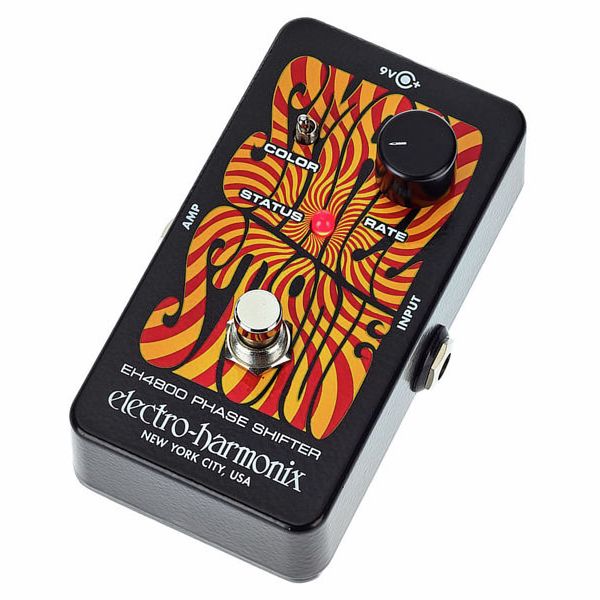
EHX Nano pedals are small, light, and honestly a little plasticky feeling compared to a tank like a Boss pedal. That said, mine has survived years of gigs and moves without complaint.
True bypass keeps it transparent when off, and the footswitch is reliable even if it doesn’t feel quite as „clicky premium” as pricier boutique units.
At 65 x 110 x 57mm, it’s tiny enough to squeeze onto even the most overcrowded pedalboard.
Tone and Sound
One knob. Rate. That’s genuinely it, plus a small toggle switch for the intensity/color of the sweep.
The sweep is warm and a bit woozy in the best way – it’s less „space-age robot” than some digital phasers and more „classic 70s swirl.” Think Van Halen, think funk rhythm guitar, think psychedelic lead tones.
Slow Settings
Rate low gets you a slow, breathing modulation that’s great under clean arpeggios or ambient textures.
Stack it with something like an Electro-Harmonix Op-Amp Big Muff for a genuinely spacey, gooey lead tone – it’s a combination that never gets old.
Fast Settings
Crank the Rate up and it turns into a warbly, almost tremolo-adjacent effect. It’s a bit much for constant use, but great for a brief solo section or a specific song moment.
Playability and Usability
There’s nothing to overthink here. One knob, one switch, one footswitch. You’ll have a usable tone within seconds of plugging in.
That said, if you want expression pedal control or tap tempo, this obviously isn’t the pedal for you – it’s deliberately, happily simple.
Who It’s For
Anyone chasing classic rock, funk, or psychedelic tones. Also a great budget entry point if you’ve never owned a phaser and want to hear what the fuss is about.
Rhythm players will get a lot of mileage stacking it lightly under a clean or lightly overdriven tone – it adds movement without being obnoxious about it.
Honest Niggles
One knob is either liberating or limiting depending on your personality. If you like deep-editing your modulation effects, you’ll hit the ceiling on this one fast.
The plastic-feeling housing (common across the whole EHX Nano line) isn’t as confidence-inspiring as a diecast metal Boss or MXR pedal, even though it holds up fine in practice.
And no stereo output, so if you’re chasing a big stereo-width phaser sound for recording, you’ll want to look elsewhere.
How It Stacks Up Against Alternatives
Against the Boss PH-3, the Small Stone is far simpler but arguably more „authentic” to the vintage phaser sound the PH-3’s extra modes are trying to emulate.
Compared to the MXR Uni-Vibe, the Small Stone is a true phaser rather than a vibe/chorus hybrid, so the character is genuinely different, not just a matter of price.
If modulation in general interests you, it’s also worth comparing against a Boss BF-3 flanger or a Boss TR-2 tremolo – three different flavors of „wobble” that all scratch a slightly different itch.
Where This Pedal Actually Shines
Live, it’s fantastic as an always-off, occasionally-on effect for a specific song section rather than a constant texture. That’s honestly how most classic phaser tones were used originally.
In a home recording setup, it’s great for doubling a rhythm part with a phased version panned slightly wide, giving you width without needing a true stereo pedal.
It also plays surprisingly well with keys and electric piano sounds if you’re running a synth or Rhodes-style patch through a guitar-style pedal chain, which is a fun little trick if you produce at home.
A Bit of History
The original Small Stone dates back to 1974, designed by David Cockerell for Electro-Harmonix during the golden age of analog effects, right alongside pedals like the Big Muff and the Electric Mistress.
It became a go-to phaser for a huge range of players across rock, funk, and even early electronic music, precisely because it wasn’t trying to be a Swiss army knife – it just did one warm, musical sweep really well.
The Nano version, released years later, uses the same core circuit shrunk into EHX’s compact housing line, so you’re not getting a „cheapened” version – you’re getting the same sound in a smaller box.
That’s honestly rare in this industry. A lot of „mini” reissues quietly change components to cut costs. This one didn’t need to.
Worth mentioning too – Electro-Harmonix as a company has had its ups and downs over the decades, including a stretch where original NYC production paused entirely. The fact the Small Stone survived all of that and is still made today says a lot about how much players actually rely on it.
Key Specs
- Type: Analog phaser pedal
- Controls: Rate knob, intensity/color switch
- Bypass: True bypass
- Dimensions: 65 x 110 x 57 mm
- Power: 9V battery or 9V DC adapter (not included)
- On the market since: 2006 (Nano housing); original Small Stone circuit dates to the 1970s
Final Verdict
The Nano Small Stone is proof that you don’t need ten knobs to make a genuinely great-sounding pedal. One knob, one switch, decades of pedigree.
It’s cheap, it’s tiny, and it sounds like the classic phaser tone that half your favorite records used. What’s not to love, honestly.
If you’ve never owned a phaser, this is the easiest, lowest-risk way to find out if you should. Highly recommended.