Watch It First
Tremolo gets treated like the forgotten middle child of the modulation family. Chorus gets all the eighties nostalgia, phaser gets the funk crowd, and tremolo just sits there quietly making surf and blues records sound the way they’re supposed to sound.
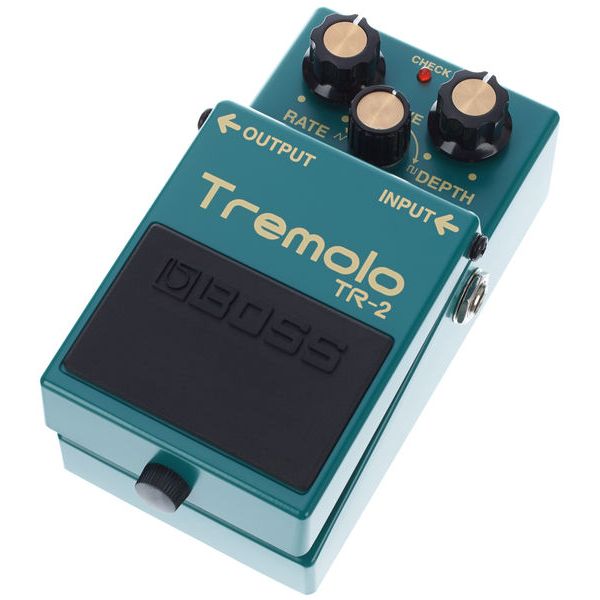
Boss has sold a version of the TR-2 for decades now, and it’s still one of the most reached-for compact tremolo pedals out there. Simple, three knobs, does exactly what it says on the tin.
I picked one up mostly out of curiosity after using a multi-effects tremolo mode for years, and it ended up staying on my board a lot longer than expected. Here’s the actual rundown.
How It Works
Tremolo is dead simple in theory, it’s just rhythmic volume modulation, your signal pulsing louder and quieter at a set rate. The TR-2 handles this with three knobs: Wave, Rate, and Depth, and that’s genuinely the whole interface.
Wave controls the shape of the pulse, sweeping from a smooth, rounded sine-wave feel to a choppier, more square-edged chop. Rate sets how fast it pulses, and Depth sets how dramatic the volume swing actually is.
Three Knobs Is A Feature, Not A Limitation
There’s something refreshing about a pedal with zero menus, zero secondary functions, and zero manual required. You plug in, turn three knobs, and you’re making decisions with your ears instead of scrolling through parameter pages.
Compared to something like a Boss MD-200, which crams a dozen modulation types behind a few shared controls, the TR-2 trades flexibility for pure immediacy. Sometimes that trade is exactly what you want on a gig.
Sound
From Subtle Pulse To Full Chop
At low depth and a moderate rate, this thing adds a gentle undulation to clean tones that’s barely noticeable until you switch it off and suddenly the sound feels flat. That’s the sign of a genuinely useful modulation effect.
Crank the depth and rate together and you get the classic choppy, stuttering tremolo associated with surf rock and vintage blues amps. It’s not subtle at that point, and it’s not meant to be.
Wave Shape Actually Matters More Than You’d Expect
The Wave knob is where this pedal earns its keep. Rounder settings feel closer to old tube amp tremolo circuits, warm and swaying. Push it toward the choppier end and you get something closer to a tremolo-arm-adjacent pulse, more percussive and rhythmic.
If you’ve spent time with tremolo modes buried inside a multi-effects unit like the UAFX Flow Vintage Tremolo, you’ll notice the TR-2 feels more immediate and tactile in comparison, even if it’s covering less ground overall.
Build Quality And Playability
Boss builds these to survive years of gig bags and pedalboard abuse, and the TR-2 is no exception, standard metal chassis, sturdy footswitch, the works. It’s the same compact footprint as most other single-knob-trio Boss pedals, so it plays nicely with a crowded board.
Power comes via 9V battery or the standard Boss adapter, sold separately, same story across basically the whole Boss compact lineup, including the Boss RE-2 Space Echo I covered separately.
Current draw is low at 20 mA, so if you’re running a battery for whatever reason, this won’t drain it nearly as fast as some of the more power-hungry digital modulation pedals on the market.
Who It’s Actually For
Surf, blues, and indie players chasing that classic pulsing tremolo tone are the obvious audience here, and honestly the pedal was built with exactly that crowd in mind from day one.
Ambient and shoegaze players get plenty of mileage too, especially stacking a subtle tremolo under a wash of reverb or delay. It adds motion without cluttering the mix, similar to how a touch of wow and flutter works on a tape echo pedal.
Session players who value predictability over deep customization will appreciate that this pedal does one job extremely well rather than several jobs adequately. If you already own something like the Boss BF-3 for flanger duties, the TR-2 rounds out a genuinely versatile small modulation section without adding menu complexity.
Honest Niggles
No tap tempo is a real omission in 2026, especially with cheaper competitors now including it as standard. You’re dialing in Rate by ear and eyeballing it against the song tempo, which works but isn’t ideal for tight rhythmic parts.
No stereo output limits it a bit for players building elaborate wet-dry-wet rigs, though that’s a fairly niche complaint for a pedal this size and price point.
The LED can be genuinely hard to see in bright stage lighting, an old Boss quirk that’s been mentioned by plenty of long-term owners over the years. Not a dealbreaker, just something to be aware of before a bright outdoor gig.
A Quick Word On Where This Sits In Boss History
The TR-2 has been part of the Boss compact lineup for a long time now, largely unchanged because the format simply hasn’t needed fixing. That’s rare in a gear market obsessed with adding features every product cycle.
It sits alongside pedals like the Boss TU-3W Waza Craft tuner, solving an entirely different problem, monitoring rather than modulating, but sharing the same philosophy: do one job, do it reliably, and don’t overcomplicate the housing or the controls.
For players building a first pedalboard, that kind of predictability actually matters more than most marketing copy gives it credit for. You learn where the sweet spots are within a few minutes, and they stay put.
Boss TR-2 Tremolo – Specs At A Glance
- Effect type: Tremolo
- Controls: Wave, Rate, Depth
- Current draw: 20 mA
- Power: 9V battery or DC adapter, sold separately
- Dimensions: 73 x 129 x 59 mm
- Weight: 400 g
Final Verdict
The TR-2 isn’t trying to reinvent tremolo, it’s just doing the classic version extremely well, in a format that’s simple enough to dial in during a soundcheck with zero fuss.
It’s not the most feature-packed modulation pedal you can buy, and the missing tap tempo is a legitimate gripe at this point in the market. But for straightforward, musical, three-knob tremolo that just works every time you step on it, this is still one of the smartest small purchases on any pedalboard.
If you’ve been relying on an amp’s built-in tremolo or a buried menu setting in a multi-effects unit, moving to a dedicated pedal like this is a genuinely noticeable upgrade. IMO it’s one of those pedals you don’t realize you’re missing until you’ve actually used one properly.