Watch It First
If you’ve ever heard „that” shimmering clean chorus tone on a record and wondered what amp made it, chances are it was a Jazz Chorus.
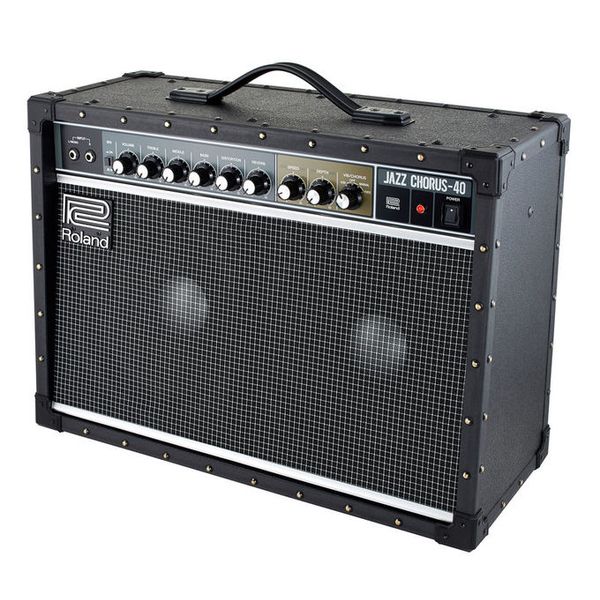
The Roland JC-40 takes the legendary JC-120’s stereo chorus circuitry and squeezes it into a smaller, lighter 40-watt combo with two 10″ speakers instead of the big brother’s twin 12s.
Is the downsized version still the real deal, or does something get lost shrinking it? Let’s talk about it.
That Clean Tone, Explained
Here’s the thing about Jazz Chorus amps: the clean channel isn’t just „clean,” it’s pristine in a way most solid-state amps simply aren’t. Headroom for days, glassy top end, and a stereo chorus effect that genuinely sounds three-dimensional through two speakers rather than one.
Turn the Speed and Depth knobs and you go from a subtle shimmer to full-on underwater warble in seconds. It’s the same circuit that’s been on countless records since the 80s, and it still sounds special.
This is exactly why it’s a shoegaze and ambient staple – if that’s your world, our 6 Best Guitars For Shoegaze & Ambient guide pairs nicely with this amp, and the built-in chorus alone could save you buying a pedal (though see our 6 Best Chorus Pedals Under $100 if you want to compare against a dedicated stompbox).
A Genuine Pedal Platform
Because the clean channel is so uncoloured, the JC-40 is a favourite among pedalboard obsessives. Whatever you put in front of it comes through honestly, without the amp fighting your dirt pedals for tonal control.
The stereo input is a genuinely rare feature at this size, letting you run true stereo effects (modulation, delay, whatever) and hear the full width of the effect rather than a mono approximation. If you’re building a pedal-driven indie rock rig, this matters more than it sounds like on paper – our 8 Best Pedals For Indie Rock list has plenty of ideas for what to run in front of it.
What About the Built-In Distortion?
Short answer: skip it. The onboard distortion is famously the JC series’ weak point, and most players treat it as a „just in case” button rather than an actual gain source.
IMO this isn’t really a flaw so much as a design choice – Roland built this amp to be the cleanest possible canvas, and asking it to also nail high-gain tones is a bit like asking a violin to also be a drum kit. If you need real dirt, run a good overdrive or distortion pedal into the clean channel instead, or check our 8 Best Amps For Distortion & Overdrive roundup for amps that actually specialise in it.
Build, Weight and Practicality
At 15.8kg it’s noticeably heavier than most bedroom combos but still very manageable for a two-speaker cabinet – one hand on the handle and you’re good for the car.
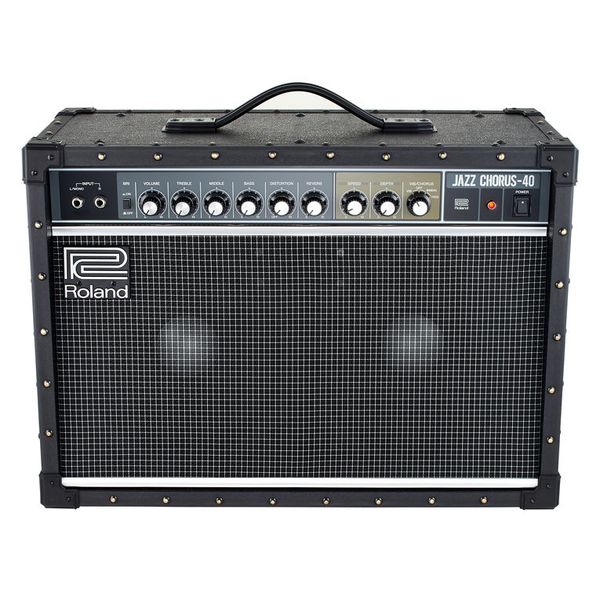
Build quality feels properly solid, the kind of „this will outlive me” confidence Roland amps are known for. Controls are simple and logically laid out: Volume, Treble, Middle, Bass, Distortion, Reverb, Speed, Depth, plus Bright and Vib/Chorus switches.
Mono and stereo effects loops plus mono and stereo line outs round out the connectivity, and there’s a headphone output for silent practice too.
Who’s This Actually For?
Jazz players, obviously – the clean headroom and articulate top end are tailor-made for chord-melody work and archtops. But don’t sleep on it for indie, shoegaze, ambient and ANY genre built around pedals rather than amp gain.
Session musicians love these too, since a JC-40 basically guarantees a good, honest clean tone at any venue without needing to bring your own rig every time.
Metalheads and classic rock players chasing amp-driven crunch should look elsewhere – this genuinely isn’t the amp for that job, and no amount of EQ tweaking changes that.
The Niggles
- Some background hiss reported at higher volumes, though it’s mostly masked once you’re actually playing.
- Built-in distortion is weak – budget for a pedal if you need gain.
- Volume knob can feel touchy at low settings, so dialling in bedroom volume takes a bit of finesse.
- Sits at the pricier end for a solid-state combo of this size – you’re paying for that Roland pedigree.
None of these outweigh what it does brilliantly, but worth knowing before you commit.
Specs at a Glance
- Power: 40 W Stereo
- Speakers: 2x 10″
- Effects: Chorus, vibrato, reverb, distortion
- Controls: Volume, Treble, Middle, Bass, Distortion, Reverb, Speed, Depth
- Switches: Bright, Vib/Chorus, Effects loop
- I/O: Stereo input, mono/stereo effects loop, mono/stereo line out, headphone out
- Footswitch connection: Yes (footswitch not included)
- Weight: 15.8 kg
JC-40 vs the Rest of the Solid-State Crowd
Solid-state amps get a bad reputation sometimes, usually from people who’ve never actually plugged into a good one. The JC-40 is basically the counter-argument.
Compare it against something like the Peavey Bandit 112 and you can see two totally different solid-state philosophies at work. The Bandit is built to be loud, cheap to fix, and pedal-friendly for rock and metal players. The JC-40 goes the opposite direction entirely – premium build, premium price, and a laser focus on doing pristine clean and chorus better than anything else in its price range.
Neither amp is trying to be all things to all players, and that’s honestly refreshing in a market full of amps that claim to do everything and end up doing nothing particularly well.
If you’re torn between the two, ask yourself what you actually play. Riffs and crunch, go Bandit. Chords, clean arpeggios and shimmer, go JC-40. It really is that simple.
The Verdict
The Roland JC-40 is one of those amps that earns its reputation the honest way: it just does one thing (pristine stereo clean tone) better than almost anything else out there, and it’s been doing it for decades.
It’s not the amp for gain-hungry players, and it’s not the cheapest solid-state combo on the shelf, but if your sound lives in clean and shimmery territory, this is about as close to a sure thing as amps get.
Downsized from the JC-120 it may be, but the legendary bit is fully intact.