Watch It First
I sat down to write about the old Boss GT-1, the little battery-powered multi-FX that lived in a thousand student backpacks. Turns out it has quietly disappeared from the shelves, and the box now doing that job in the Boss range is the GX-10.
Which is arguably a better story anyway, because the GX-10 is the cheap end of the exact same family as the GT-1000CORE. Same AIRD amp modelling philosophy, same Boss effects library, considerably less money.
So the question is not whether it sounds good. It is how much of the flagship you actually lose on the way down.
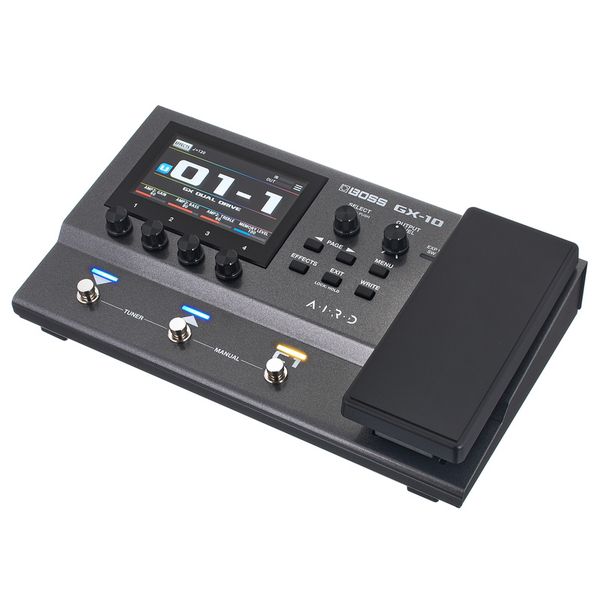
The Cheap End Of An Expensive Family
Boss have a habit of building one very good engine and then selling it at three price points. The GT-1000 is the full floorboard, the GT-1000CORE is that engine shrunk down, and the GX series is the accessible tier.
The GX-10 gives you 32 amp types and a very large pile of Boss effects, 198 memory locations, 99 factory presets, and 15 assignable blocks with flexible amp and effect routing. That is not a stripped-down feature list by any measure.
Thomann article number 598424, and it has only been available since October 2024, so this is current hardware rather than old stock.
The Touchscreen Is The Headline
A colour touchscreen on a floor unit at this money is genuinely unusual. You drag blocks around, tap to edit, and mostly avoid the four-knobs-and-a-menu ritual that every other budget multi-FX inflicts on you.
Is it as fast as editing on a computer? No. Is it dramatically faster than the GT-1000CORE with its tiny display? Absolutely, and that is a bit awkward for the more expensive box.
How It Actually Sounds
AIRD is Boss shorthand for the way they model the interaction between an amp and whatever it is plugged into. In practice it means the amp models feel like they push back when you dig in, rather than sitting there as a fixed EQ curve.
The cleans are the strong point. Fender-ish sparkle, Roland JC territory, and a Vox-flavoured edge-of-breakup that responds properly to your volume knob.
High gain is competent rather than thrilling. It is tight, it is usable, it will get you through a covers gig, but if you are chasing modern metal specifically then something like the NUX MG-30 arguably does more for less.
- 32 amp types covering the usual clean, crunch, high gain and acoustic ground
- Well over a hundred effects drawn straight from the Boss catalogue
- 15 assignable blocks with genuinely flexible routing
- Built-in looper and a proper mono and polyphonic tuner
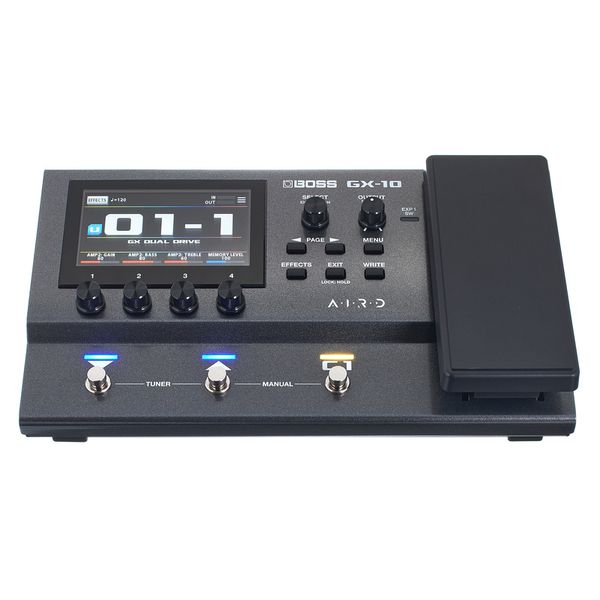
Connections And Practical Stuff
Stereo outputs, a headphone jack, a full FX send and return, and USB-C for recording straight into a DAW. There is also MIDI over that USB port if you need it.
The FX loop is the detail I would not skip past. It means you can drop a favourite dirt pedal into the chain and keep everything else digital, which is how a lot of people actually use these things.
There is an optional Bluetooth adapter, the BT-DUAL, that lets you stream audio and edit wirelessly. Optional means not included, obviously.
Three Footswitches Is The Compromise
Bank up, bank down, and one assignable control switch. That is not many for live use, and you will end up buying an external switch or an expression pedal to make it comfortable.
This is the same trade-off you make with a Pod Go, except the Pod Go has more switches and a built-in expression pedal. Worth knowing before you commit.
The Honest Niggles
No battery operation. The old GT-1 ran on AAs and you could take it anywhere; the GX-10 draws 600 mA and needs the mains adapter, which at least is included this time.
At 2.2 kg and 300 mm wide it is not exactly pocket sized either. Compared to something like the Zoom G2 FOUR, this is a proper piece of floor furniture.
And the price has crept upwards from where the GT-1 sat. Calling the GX-10 budget is fair only relative to the rest of the Boss range. It is entry-level Boss, not entry-level multi-FX.
One more thing: the touchscreen is fantastic in a bedroom and slightly less fantastic on a dark stage when you cannot see it. Set your presets at home.
Specs At A Glance
- Compact amp and effects processor for guitar and bass
- Colour touchscreen interface
- AIRD technology for valve-style amp response
- 32 amp types plus a large Boss effects library
- 198 memory slots, 99 factory presets, 15 assignable blocks
- Built-in looper and mono/polyphonic tuner
- Input, stereo outputs, headphones, FX send and return, CTL/EXP jacks
- USB-C for DAW recording, MIDI and Boss Tone Studio
- Optional BT-DUAL Bluetooth adapter
- Power draw 600 mA, 9V DC adapter included, no battery operation
- Dimensions 300 x 183 x 96 mm, weight 2200 g
- Thomann article number 598424
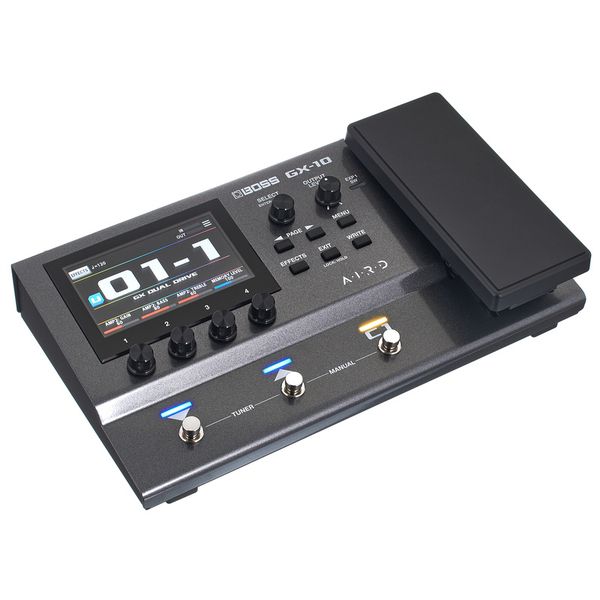
So Is It Worth It?
If you want the Boss sound and the Boss workflow without the flagship outlay, yes. The GX-10 is a genuinely good bit of kit and the touchscreen makes it the easiest Boss multi-FX to actually live with.
If your priority is maximum tone per unit of money and you do not care whose logo is on it, there are cheaper boxes doing similar work. The Valeton GP-200 is the obvious comparison and it is not far behind.
And if you already own a decent modelling amp like a Katana, think carefully about whether you need this at all.
Final Verdict
The GT-1 is gone and the GX-10 has inherited its job at a slightly higher altitude. It is the cheap end of the same family that produced the GT-1000CORE, and it shares more of that DNA than the price gap suggests.
Great cleans, solid effects, a proper FX loop and the friendliest interface Boss have put on a floor unit. Not perfect, not tiny, not cheap in absolute terms, but honest value.
FYI, if you are coming from a pedalboard rather than upgrading a multi-FX, this is a very easy way to shrink your setup without hating the result.