Watch It First
There’s a certain kind of pedal that makes people stop mid-soundcheck and ask „wait, what IS that?” The Electro-Harmonix C9 Organ Machine is one of those. Plug in a plain old guitar and out comes a Hammond, a Vox Continental, a Farfisa — nine of them, actually.
It’s not subtle. It’s not trying to be a tasteful little texture pedal you sneak into the mix. The C9 wants your guitar to sound like an actual organ, full stop, and it gets shockingly close.
I’ve had this on my board for a while now, mostly for studio sessions where hauling an actual organ (or paying a keys player) just isn’t happening. Here’s how it holds up.
How It Actually Works
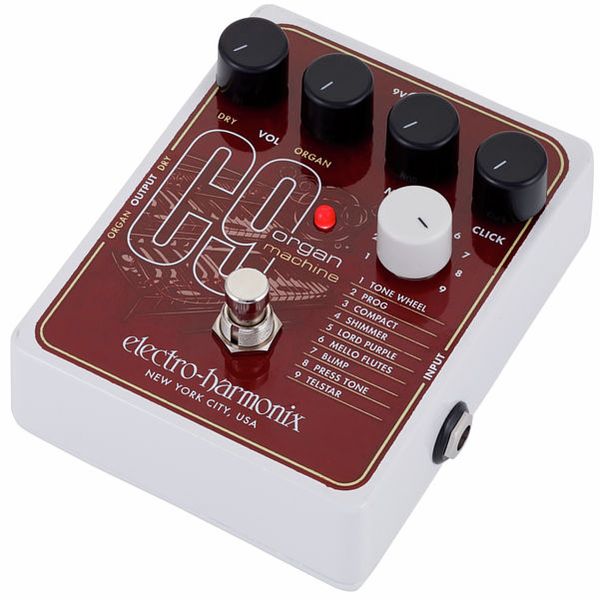
The C9 tracks your guitar’s pitch and generates a synthesized organ tone from it, blended with your dry signal via separate Dry and Organ volume knobs. It’s the same core tech EHX uses across the whole „9 Series” — the same family that gave us pedals like the B9 and the Synth9.
There are 9 presets on the selector dial: Tone Wheel, Prog, Compact, Shimmer, Lord Purple, Mello Flutes, Blimp, Press Tone, and Telstar. Each nails a distinct organ flavor rather than one generic „organ-ish” sound, which is honestly the whole reason this pedal works as well as it does.
The Sound
Tone Wheel is the classic Hammond/Leslie territory — warm, swirly, gospel-adjacent. Lord Purple leans harder into rock-organ Deep Purple vibes, and Compact nails that thin, reedy Vox Continental sound that’s all over 60s garage rock.
Tracking is genuinely impressive for a pitch-to-synth pedal. Single notes come through clean and immediate. Chords are where things get more honest — the C9 handles them, but there’s a slight synth-y smear on dense voicings that pitch-tracking pedals in this category all share to some degree.
If you’ve spent time with the Micro POG, you’ll recognize the family resemblance in how EHX approaches signal tracking — clean, fast, and built for real-time playing rather than glitchy latency.
Controls and Practical Use
Four knobs run the show: Dry, Organ, Modulation, and Click. Modulation adds a vibrato/chorus wobble to the organ voice for extra realism, and Click adds a percussive attack transient that mimics the key-click of a real tonewheel organ.
Blending matters a lot here. Running Organ at full and Dry at zero gets you the purest synth-organ tone, but I actually prefer keeping a touch of dry signal in the mix — it grounds the sound and makes it read as „guitar doing something cool” rather than „guitar replaced by a keyboard.”
Who This Is For
Worship and gospel guitarists are an obvious fit — Tone Wheel alone justifies the price for anyone who needs organ swells without an actual Hammond on stage. Session players and home recordists who want quick organ overdubs without booking keys time will get a ton of mileage too.
It’s also a genuinely fun texture pedal for anyone building ambient or psychedelic soundscapes. Stack it with something like the EHX Freeze and you’ve got sustained organ pads that just hang in the air.
If your rig already leans toward vintage-flavored gear — say a MXR Analog Chorus for shimmer and modulation — the C9 slots right in as another color on that same 60s/70s palette.
Playability & Usability
It’s genuinely plug-and-play. No app, no menu diving, no firmware updates. Pick a preset, dial in the blend, done. That simplicity is refreshing after messing with modelers that demand a laptop just to change a patch.
One thing worth practicing: your picking dynamics matter more here than on a normal pedal. Because it’s tracking pitch, sloppy muting or unintended string noise can trigger weird artifacts in the organ voice. Clean technique gets rewarded.
Honest Niggles
Polyphonic tracking isn’t perfect — big chords, especially with lots of low-string content, can sound a little synthetic compared to single-note lines. If you need rock-solid chordal organ tone 100% of the time, a real keyboard (or a well-programmed VST) will always win.
There’s also a bit of a learning curve in dialing in believable tones. Cranking Organ too high without enough dry signal underneath can sound obviously „pedal-ish” rather than like a real instrument. It takes some experimenting to find your sweet spot, and it’s easy to overdo the effect at first.
And compared to something more straightforward like a Nano Metal Muff, this is a much more specialized tool — it’s not going anywhere near your everyday rock rig unless organ textures are specifically what you’re after.
Specs at a Glance
- Effect type: instrument-to-organ pitch synthesis
- 9 presets: Tone Wheel, Prog, Compact, Shimmer, Lord Purple, Mello Flutes, Blimp, Press Tone, Telstar
- Controls: Dry, Organ, Modulation, Click
- Inputs/outputs: 1x jack in, 2x jack out (Dry signal + Organ signal)
- Power: 9V DC adapter included (EHX 9.6 DC-200)
- Dimensions: 102 x 121 x 89 mm
- Works with guitar and keyboard input; no special pickup required
Pairing It With Other Pedals
The C9 actually plays really nicely with modulation and reverb further down the chain. A splash of spring reverb after the organ signal pushes it from „guitar pedal doing an impression” into genuinely convincing church-organ territory.
I’ve also had good luck running a volume pedal after it for swells — since the organ voice doesn’t have natural pick attack the way a guitar tone does, a slow volume swell into a Tone Wheel preset gets you surprisingly close to a real Leslie cabinet spinning up.
Final Verdict
The C9 Organ Machine isn’t a pedal everyone needs, but for the players who do need it, nothing else really competes. It’s a genuinely convincing organ emulator packed into a stompbox, and it opens up textures that would otherwise mean renting a Hammond or hiring a keys player.
Compared with EQ-shaping tools like the MXR Six Band EQ or overdrive boxes like the Fender Hammertone Breakup Driver, the C9 lives in a totally different category — it’s not shaping your guitar tone, it’s replacing it with something else entirely, and doing it convincingly.
If organ textures show up anywhere in your writing, worship set, or studio sessions, this pedal pays for itself fast. Solid recommendation, IMO — just budget some patience for dialing in your blend.