Watch It First
Octave pedals have a bit of a reputation problem. A lot of them can handle a single note just fine, then fall apart the second you strum a full chord.
The EHX Nano POG doesn’t have that problem, and that’s basically the whole review in one sentence. EHX crammed the tracking engine from their bigger POG units into a box roughly the size of a deck of cards, no glitching, no weird warble, no digital stutter.
I’ve had this thing on and off my board for a good while now, so here’s the honest rundown, what it nails, where it’s limited, and whether it’s worth grabbing over the bigger POG2 or the cheaper Boss OC-5.
A Tiny Box With A Big Family Name
POG stands for Polyphonic Octave Generator. That’s a mouthful, but the idea itself is simple. It listens to everything you play, chords included, and layers octave-up and octave-down voices underneath and on top of your dry signal.
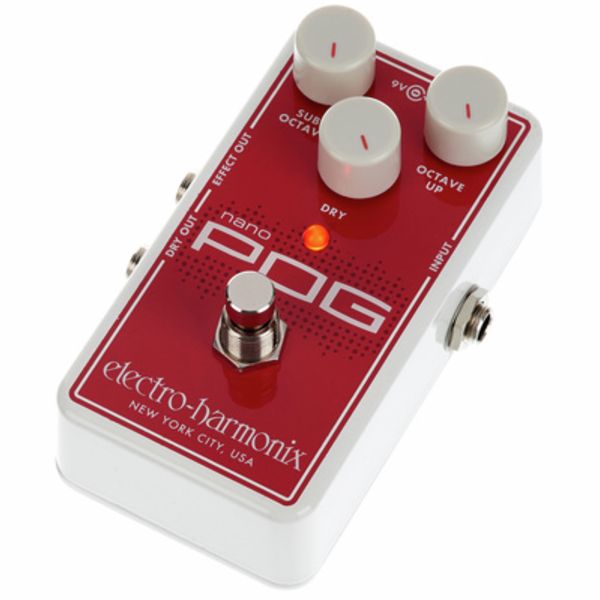
EHX has built a whole family around that one idea, the original rack-descended POG, the feature-packed POG2 with presets, the tiny Pico POG, and this one, the Nano. The Nano strips the feature list down to three knobs and nothing else.
No presets, no expression pedal input, no LCD screen. Just Sub Octave, Octave Up, and Dry, each controlling how much of that voice blends into your tone. If you’ve read my Ibanez TS9 write-up, you already know I like pedals that do one job stupidly well rather than ten jobs adequately. The Nano POG is firmly in that camp. It’s the same no-nonsense philosophy I liked in the MXR Sugar Drive Mini, one clear job, done properly, no menu diving required.
Sound
The Sub Octave Voice
This is where the Nano POG earns its keep. Dial in some sub-octave and a single-coil Strat suddenly sounds like it’s plugged into a bass rig.
It’s not some fuzzy synth-bass mess either, it tracks cleanly enough that you can play actual bass lines on a six-string and have them come out recognizable rather than mushy. That’s rarer than it should be at this price point.
Stacking The Up Octave
Add the Octave Up knob and you get that shimmery, chorus-adjacent 12-string effect a lot of players chase for arpeggios and clean chord work. Blend all three knobs together and you’re deep into synth-pad territory, more Pogotron organ swell than straightforward guitar pedal. It’s genuinely fun to just sit and noodle with on a lazy afternoon. Plug into something small like the Positive Grid Spark Mini at home and you can lose an entire evening just stacking those octave layers.
Tracking speed deserves its own mention, honestly. Even fast pentatonic runs track without stutter or glitch, and that’s the exact spot where budget octave pedals usually fall apart hardest. EHX clearly spent the R&D budget where it counts.
Build Quality
It’s built into a diecast metal housing, so it’ll survive being stepped on and tossed in a gig bag without any babying. At 65 x 110 x 57mm it’s genuinely tiny, smaller than a lot of overdrive pedals, which matters a lot once your board is already packed with delay and modulation units.
The tradeoff for that compact size is jack placement, there’s no top-mounted input here, so plan your pedal spacing accordingly before you commit to a layout. It ships with an EHX 9V power supply in the box too, a nice touch since plenty of pedals in this price range make you buy one separately, similar to what I found reviewing the Boss TU-3W Waza Craft.
Playability And Use Cases
Bass players actually get a lot out of this pedal too, not just guitarists chasing texture. Roll off the dry signal and you’ve got an instant sub-bass layer sitting under a lead line, which is a neat trick for solo or duo gigs.
For live use, the quieter footswitch EHX put on this generation is a genuine improvement over older EHX nano pedals, which had that loud mechanical clack you could hear through the PA during a quiet section. Small detail, but it matters when you’re gigging.
If you play in a two-guitar band and want to fill sonic space without hauling a keyboard player around, this thing can cover you. Organ-ish swells, thickened chords, ambient pads, the works, all from one small box.
Who It’s Actually For
If you want a set-it-and-forget-it octave tone, dialed in once and left alone, this is close to ideal. Drop it into your main chain, set the three knobs, and you’re done thinking about it.
If you’re the type who wants eight presets recalled by MIDI, or a dedicated expression input for real-time blend control mid-song, look at the POG2 instead. It costs more, but it genuinely does more.
Players wanting something even smaller and cheaper for occasional octave-up texture might be happier with the Pico POG, or checking out something like the NUX MG-30 multi-effects unit, which packs a usable octave algorithm alongside dozens of other effects in one box.
Honest Niggles
No presets is the big honest niggle here. If your sets need different octave blends from song to song, you’re tap-dancing on three knobs mid-set, and that’s not exactly fun under stage lights.
There’s also a bit of interaction between the sub and dry knobs worth knowing about. Crank the sub-octave without much dry signal underneath it and that low end can get a little woolly through a loud amp, so you’ll want to balance the blend by ear rather than trusting a fixed setting across venues.
It’s not the cheapest three-knob box on the market either. Compared to something like the Boss DS-1 price tier, this sits noticeably above it, but you’re paying for that tracking quality, and IMO it’s worth the difference.
One more thing worth flagging for anyone comparing against the Boss OC-5, that pedal focuses more on clean tracking with a dedicated range control and less on chord-based polyphonic textures. The Nano POG leans harder into the „make it sound like an organ or a 12-string” side of things, so the choice really comes down to what kind of octave sound you’re after rather than which pedal is objectively better.
Worth a mention too, this isn’t a pedal that likes being placed after heavy gain in your chain. Put it early, right after your tuner, and let your drive and modulation pedals do their thing afterward. Stick it after a fuzz and the tracking gets noticeably worse, which is just how polyphonic octave circuits behave in general, not a flaw unique to this box.
EHX Nano POG – Specs At A Glance
- Type: Polyphonic Octave Generator
- Controls: Sub Octave, Octave Up, Dry
- Connectors: Input, Dry Out, Effect Out, DC In
- Housing: Diecast metal
- Dimensions: 65 x 110 x 57 mm
- Power: 9V DC, power supply included
- Bypass: Buffered, quiet footswitch
Final Verdict
The Nano POG is proof that EHX can take a legendary circuit and shrink it down without cutting corners on the part that actually matters, tracking accuracy.
It won’t replace the POG2 for anyone chasing deep synth textures or preset recall, and if that’s genuinely your use case, don’t force it, go bigger instead.
But for guitarists and bassists who just want one excellent, always-on octave tone in the smallest footprint possible, this is genuinely one of the best options out there right now. It’s an easy pedal to recommend.