Watch It First
Almost every cheap Squier is sold on nostalgia. Look at the Classic Vibe 60s Strat – the whole pitch is “this feels like 1962, honest”.
The Sonic Mustang HH does the exact opposite. Two humbuckers, a hardtail bridge, a 24-inch scale and a finish called California Blue. There is nothing vintage about it and it isn’t pretending.
That’s why I like it, and why it’s the Squier I’d actually hand to a modern player rather than a collector.
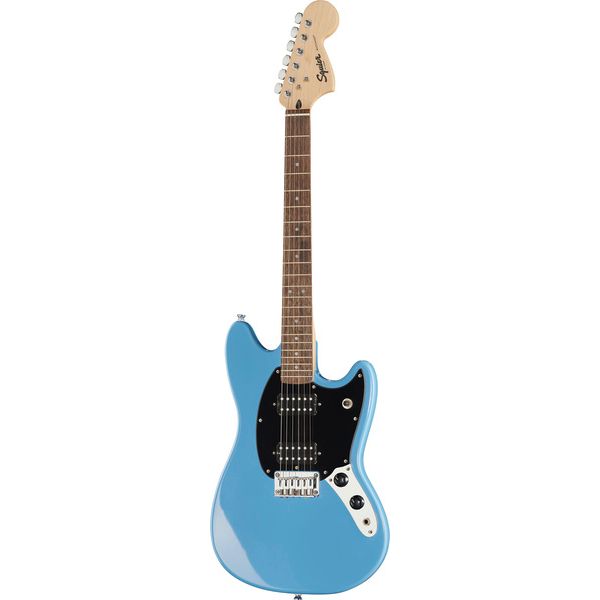
The anti-Classic-Vibe
I’ve written a fair bit about the vintage end of the Squier catalogue – including a whole 50s vs 60s vs 70s comparison that people still email me about.
Those guitars are lovely. They’re also aimed squarely at players who already know what a ’62 Strat is supposed to sound like.
The Sonic Mustang HH is for everyone else. It has no heritage story, no relic-adjacent finish, no lecture about alnico. It is a short, light, loud guitar in a bright colour, and honestly that describes about ninety percent of what people actually want from a first electric.
Two humbuckers change everything
A vintage Mustang has two skinny single coils and a switching system so eccentric it needed its own diagram. This has two ceramic humbuckers and a normal three-way toggle. Thank goodness.
Ceramic humbuckers at this price aren’t subtle. The bridge is bright and punchy with plenty of output, the neck is thicker and rounder, and both take gain far better than any budget single coil.
The bigger practical win is no hum. Sit a cheap SSS Strat next to a laptop and a cheap amp and you get a buzz you cannot dial out. This just doesn’t do that, which matters enormously if you’re recording into an interface in a bedroom.
It is not a metal guitar, though
Let me be honest about the ceiling. These pickups are hot but a bit one-dimensional – there’s not much depth or complexity there, and under really heavy gain they get a little fizzy in the top end.
For indie, punk, alt-rock, grunge and general loud fun, they’re bang on. For tight modern metal you’d want something like a Schecter Omen Extreme-6 instead. Different jobs.
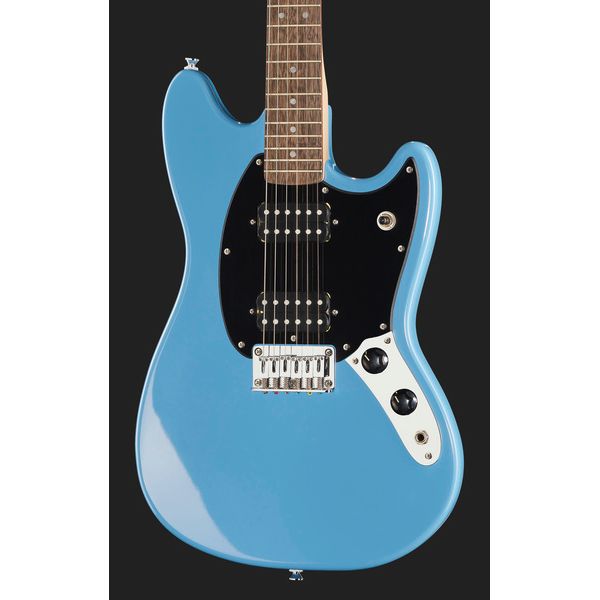
The 24-inch scale is the sleeper feature
Scale length is 610 mm – a full inch and a half shorter than a Strat.
In practice that means lower string tension, easier bends, and chord shapes that require less of a stretch. If you have smaller hands, or you’re coming off an acoustic and your fingers hurt, this is a genuinely different experience.
It also just feels quick. Everything is a bit closer together, so barre chords stop being a wrestling match. The 9.5″ radius and narrow tall frets help too – there’s enough fret height to bend properly without a shallow vintage curve fighting you.
The trade-off: 24-inch scale with standard 9s can feel slack, especially if you tune down. Bump to 10s and it firms up nicely. Same advice I give for the Squier Mini Strat, for the same reason.
Hardtail, and it matters
Six-saddle top-load hardtail bridge with block saddles. No trem, no springs, no cavity in the back.
That means three things: it stays in tune, restringing takes two minutes, and you can set the intonation properly without a floating bridge shifting on you halfway through.
For a beginner guitar that’s close to the ideal setup. Most people who buy a cheap trem never use it and spend the next two years quietly annoyed at the tuning. Removing the option is a feature, not a compromise.
The Mustang shape has a strange history
Fender launched the Mustang in 1964 as a student guitar. Cheap, short, slightly odd, and thoroughly looked down on by serious players for about twenty-five years.
Then the early 90s happened, a generation of alternative bands picked them up precisely because they were unfashionable, and suddenly the student guitar was cool. Vintage prices went silly, as they always do.
What’s funny is that the Sonic version has quietly circled back to the original brief. It’s a beginner instrument again – just one with humbuckers, a hardtail bridge and a hundred times better build consistency than a 1965 example ever had.
So you get the shape and the attitude without paying the collector tax. Which, given what a real 60s Mustang costs now, is a fairly good joke at history’s expense.
Honest niggles
- Poplar body, laurel board, basic everything. The materials are exactly what you’d expect at this money.
- Die-cast enclosed tuners are fine but stiff. They hold; they aren’t nice.
- No coil split. Two sounds plus the middle position and that’s your lot.
- The pickguard is single-ply plastic and looks it in daylight.
- Offset bodies can shift on your leg when you sit down – less than a Jazzmaster, but it’s there.
Nothing here is a dealbreaker. It is a cheap guitar built to a price, and Squier spent the money on the bits that affect how it plays rather than how it photographs.
Who it’s for
Beginners, obviously – and I’d take it over an Affinity Stratocaster for anyone whose musical taste was formed after about 1990.
Also smaller players, teenagers, and anyone who wants a light knockabout guitar that lives on a stand and gets picked up constantly.
And, quietly, experienced players. A short-scale HH hardtail in an alternate tuning is a genuinely useful thing to own, and this costs less than a decent pedal. It’s the same logic that makes oddballs like the Paranormal Troublemaker Tele so appealing.
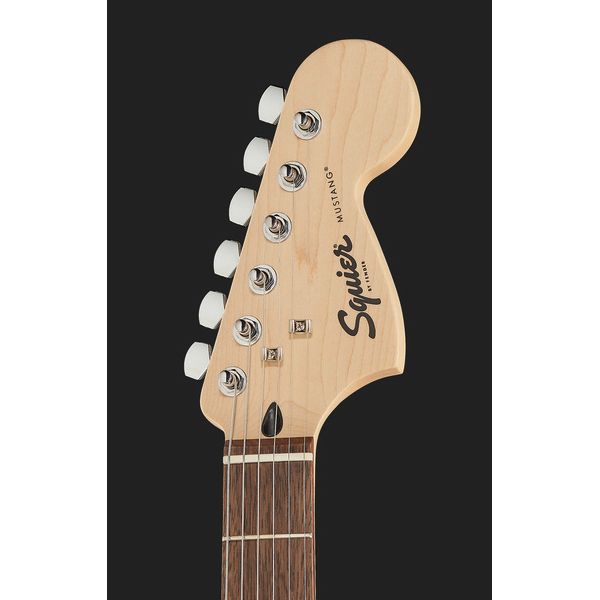
Specs
- Body: Poplar
- Neck: Bolt-on maple
- Fretboard: Laurel, pearloid dot inlays
- Frets: 21 narrow tall
- Scale: 610 mm (24″)
- Fretboard radius: 241 mm (9.5″)
- Nut width: 42 mm
- Pickups: 2 x ceramic humbuckers
- Controls: Master volume, master tone, 3-way toggle
- Bridge: 6-saddle top-load hardtail with block saddles
- Tuners: Enclosed die-cast
- Hardware: Chrome
- Pickguard: Single-ply black
- Finish: California Blue
Final Verdict
If you want a Squier that sounds like history, buy a Classic Vibe. There’s a reason people keep comparing them to proper Fenders.
If you want a Squier that just works – quiet pickups, stable tuning, a short fast neck and a colour you can spot across a room – this is the one.
It’s not refined. The pickups have a ceiling and the hardware is basic. But it’s the most fun-per-pound guitar in the Squier range right now, and the fact that it has zero interest in impressing vintage nerds is exactly why I like it.
Put 10s on it, get the action set low, and enjoy. Simple as that 😉