Watch It First
Every guitar shop has a wall of cheap dreadnoughts that all look roughly the same and all get described with the same three adjectives. The Ibanez PF15ECE has been hanging on that wall for over a decade.
That longevity is the interesting part. Ibanez has not quietly killed it off or replaced it with something shinier – it just keeps selling, year after year, to people who need a full-size cutaway electro dreadnought for very little money.
So is it actually any good, or is it just cheap and everywhere? I have opinions.
What You Are Buying
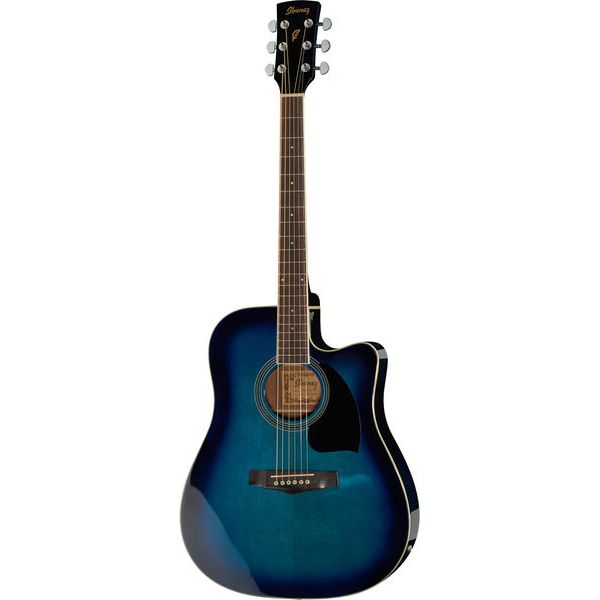
The PF15ECE is a dreadnought with a cutaway, spruce top, okoume back and sides, nyatoh neck, and laurel used for the fretboard, bridge, top binding and headstock veneer. Standard 650 mm scale, 20 frets, 42 mm nut.
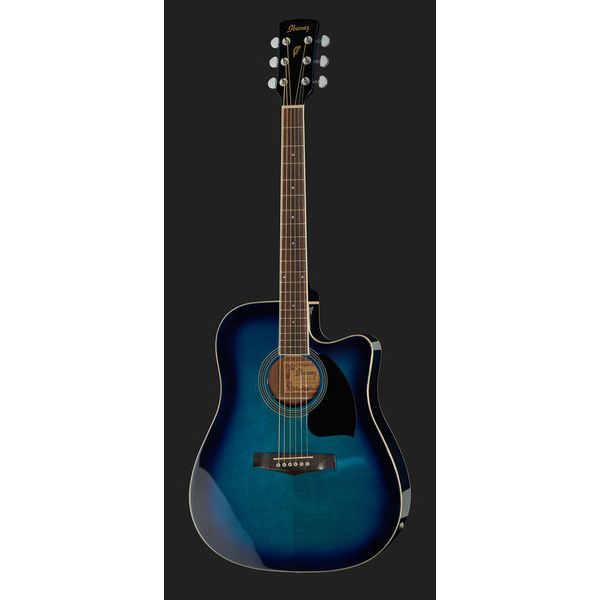
The electronics are the reason most people end up here: an Ibanez under-saddle pickup feeding an AEQ2T preamp with an onboard tuner. Volume, bass, treble, tuner. Done.
Nothing on that list is exotic. Everything on that list is functional. That is basically the whole review in two sentences, but let us do this properly.
Laminate, and Why It Is Fine Here
No solid wood anywhere. Purists will wince, and honestly they have a point about how a laminate top ages – it will not open up the way an all-solid guitar does.
But laminate has one genuine advantage that nobody mentions enough: it does not care about humidity. Drag this to a campsite, a beach, an unheated rehearsal room in February, and nothing catastrophic happens.
For a first guitar, or a guitar that leaves the house a lot, that resilience is worth more than tonal ceiling. That is the same logic behind the appeal of the Harley Benton D-120NT, only Ibanez threw in electronics.
How It Actually Sounds
Bright. Snappy. A bit scooped in the mids. It is a dreadnought so there is real low end there, but the character sits up top rather than in the chest.
Strummed, it cuts through nicely, which is exactly what you want when you are the one accompanying a room full of people singing badly. Fingerpicked, it is more ordinary – the note separation is decent but there is no complexity to the sustain.
- Strong attack, quick decay – good for rhythm, less good for atmospheric stuff
- Trebles can get glassy with the wrong strings, so try phosphor bronze
- Midrange is polite rather than rich
- Plenty of headroom before it gets flubby, which is more than you can say for many budget dreads
Change the factory strings on day one. That single move does more for the tone of a guitar in this bracket than anything else you can do, and the strings these ship with are not great.
The AEQ2T Preamp Is the Real Selling Point
Here is where the PF15ECE justifies itself against every unplugged rival at the same money. You get a working, gig-usable preamp with a tuner that is accurate enough to trust on a dark stage.
Is it a fancy system? No. There is no notch filter, no phase switch, no blend with an internal mic. The EQ is two bands and fairly blunt.
But it plugs into a PA and sounds like an acoustic guitar, which is the entire job. Compared to the more sophisticated system on something like the Ibanez AAD51CE, this is basic – but it is also considerably cheaper.
One practical warning: like every under-saddle piezo, it will feed back if you stand in front of a monitor at volume. A feedback buster in the soundhole solves that for pocket change.
Playing It
The neck is slim by acoustic standards, which is very Ibanez. If you came from electrics, this will feel familiar in a way that a chunky vintage-profile acoustic neck does not.
Action out of the box tends to be a bit high, and the nut slots are usually cut conservatively. A basic setup transforms this guitar. Budget for one, or learn to do it yourself.
The cutaway is genuinely useful, not just decorative – upper fret access on a dreadnought is normally miserable, and here it is not.
The Honest Cons
- Full laminate body means it will sound the same in ten years as it does today
- No gig bag included, which stings at this price point
- Factory setup is inconsistent – some are lovely, some need work
- Piezo quack is real if you plug straight into a mixer with no preamp help
- The Transparent Blue Sunburst finish is polarising, and the black version hides the grain entirely
- It is heavy for a budget acoustic
The gig bag omission bothers me most. A guitar aimed squarely at beginners and gigging students should ship with something to carry it in, lol.
Who Actually Wants One
First guitar buyers who already know they want to plug in. Open mic regulars who do not want to risk a nice instrument. Anyone who needs a beater that will survive being lent to a friend.
Also worth considering as a second acoustic if your main is something precious – keep the Epiphone Dove Studio at home and throw this one in the van.
Who Should Walk Past
Fingerstyle players chasing tonal nuance. Anyone recording seriously. And anyone who would be happier with a solid top – at slightly more money you get into Yamaha F310 territory unplugged, or a solid-top cutaway if you shop carefully.
Against the Competition
Versus the Fender CD-60SCE the PF15ECE is slightly brighter and slightly cheaper, and the Fender has a solid top – that is a meaningful win for Fender if unplugged tone matters most.
Versus the Guild D-240E Westerly you are comparing a budget tool to a proper instrument, and it shows. Different leagues, different budgets.
And versus a Taylor 110ce, well. Obviously. But you could buy three PF15ECEs and still have change.
Specs at a Glance
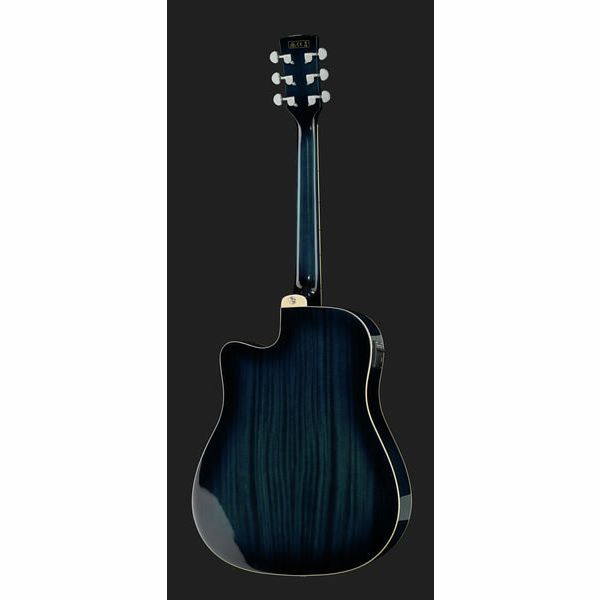
- Design: Dreadnought with cutaway
- Top: Spruce
- Back and sides: Okoume
- Neck: Nyatoh
- Fretboard, bridge, binding, headstock veneer: Laurel
- Scale: 650 mm
- Nut width: 42 mm
- Frets: 20
- Electronics: Ibanez under-saddle pickup with AEQ2T preamp and onboard tuner
- Hardware: Diecast machine heads, chrome
- Finish: Transparent Blue Sunburst
- Thomann article number: 332031
Final Verdict
The PF15ECE is not exciting and it is not trying to be. It is a competent, plug-in-ready dreadnought that costs almost nothing and does not fall apart.
Ten years of continuous production tells you something. Guitars that are genuinely bad get quietly discontinued; this one keeps shipping because it keeps doing its job for the people who buy it.
Get one set up properly, put decent strings on it, add a cheap preamp pedal if you are gigging, and you have a guitar that will happily take the abuse you would never inflict on something you actually love. That is a real category, and this fills it well.