Watch It First
Boss has been making the DD-series delay since basically forever, and the DD-8 is where it landed after the DD-7. It’s not trying to be clever – just 11 delay types, a looper, and knobs that do what they say.
I picked one up to replace a delay that had started cutting out mid-set (never buy a 15-year-old pedal off a forum, lesson learned). The DD-8 fixed that problem in about four minutes of use.
It’s not the cheapest delay on the shelf, but it’s also not trying to be a boutique analog thing. It’s a tool. A really well-built one.
What’s Actually In The Box
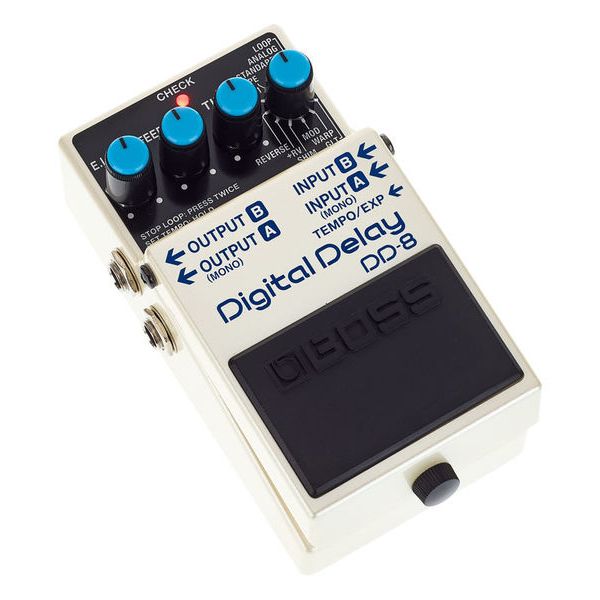
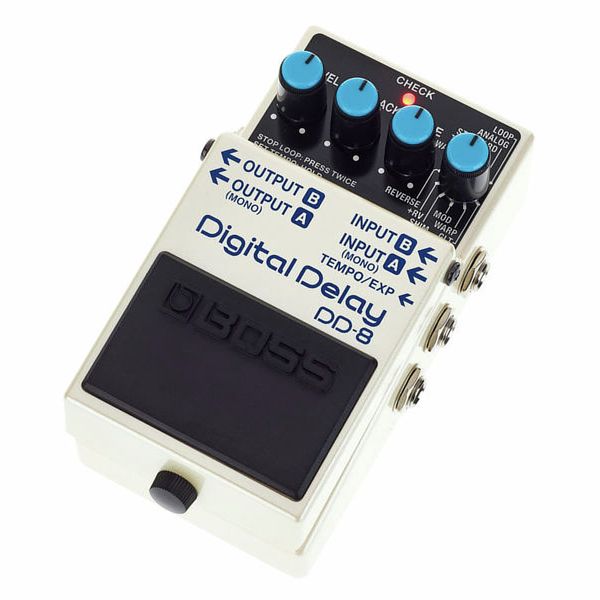
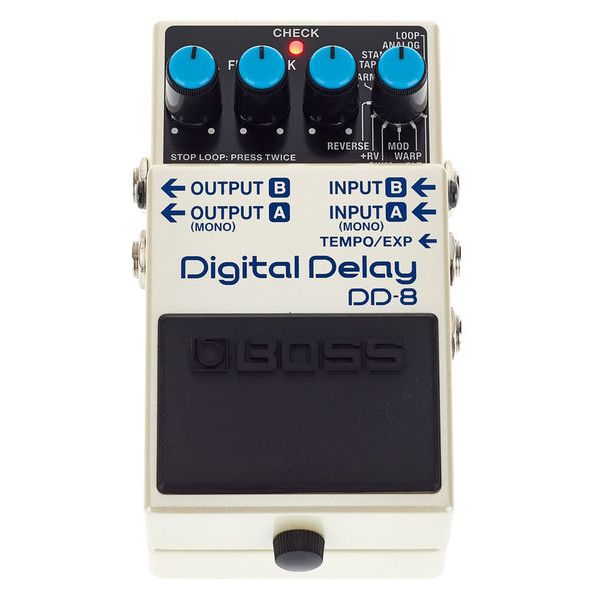
Standard BOSS compact pedal footprint. One footswitch, four knobs (Level, Feedback, Time, Mode), one small mode LED.
You get 11 delay modes: standard digital, analog-voiced, tape, reverse, modulated, dual-delay combos, and a proper looper mode with a 40-second loop. That’s a LOT for a box this size.
Stereo ins and outs too, which matters more than people think – run it into two amps or a stereo interface and the ping-pong modes actually feel wide instead of gimmicky.
Runs on a 9V battery or adapter (not included)
Power draw is 65mA, so nothing unusual there. If you’re daisy-chaining a board, budget for it like any other digital pedal – don’t try to squeeze it onto an old analog-only supply.
How It Actually Sounds
The standard digital mode is clean and transparent – repeats sit behind the dry signal without smearing your picking. That’s the mode I leave it on 90% of the time.
Analog mode rolls off the top end on repeats, which is exactly the trick pedals like the MXR Carbon Copy built a whole reputation on. The DD-8 nails a convincing version of it digitally, which honestly surprised me.
Reverse delay is genuinely fun for texture stuff, and the modulate mode adds a chorus-y wobble to repeats that works great for ambient noodling. IMO it’s the mode most people skip and shouldn’t.
The Looper Is A Bonus, Not The Main Event
40 seconds of mono looping with overdub. It’s not going to replace a dedicated unit like the Boss RC-500 if looping is your main thing, but as a „sketch an idea while I set up the next pedal” tool it’s genuinely handy.
Who Should Actually Buy This
Anyone who wants ONE delay pedal that covers digital, analog-voiced, tape, and reverse without buying four separate boxes. Gigging guitarists who need reliability over boutique mystique. Beginners who don’t yet know which delay flavor they like – this lets you find out.
If you already know you want a dedicated warm analog delay and nothing else, something like the EHX Memory Boy or the EHX Deluxe Memory Man might scratch that itch more directly. But for versatility per square inch of pedalboard, the DD-8 is hard to beat.
Honest Niggles
Four knobs means some modes need menu-diving via the mode switch to really dial in – it’s not as immediate as a one-knob delay. And if you run high feedback settings for ambient stuff, pair it with a noise gate like the Boss NS-2 – self-oscillation can get noisy fast.
Also – it’s plastic-cased like every compact BOSS pedal. Tough, road-proven plastic, but if you want the DD-200’s bigger screen and preset system, that’s a separate Boss DD-200 conversation and a different price bracket entirely.
DD-8 vs The Competition
Compared to the TC Electronic Flashback 2, the DD-8 has fewer total presets but a simpler, more immediate control layout – no app required, no menu paging for basic use. Compared to true boutique analog delays, it’s more flexible but a little more „digital” sounding in its cleanest mode, which some players prefer and some don’t.
- Type: Digital stereo delay, compact pedal format
- Delay modes: 11, including standard, analog, tape, reverse, modulate, dual-delay combos
- Looper: Yes, 40 seconds mono with overdub
- Controls: Level, Feedback, Time, Mode + footswitch
- I/O: Stereo in/out
- Power: 9V battery or DC adapter (not included), 65mA draw
Setting It Up On A Real Board
Placement matters more with a delay than almost any other pedal. Put it after your drive and fuzz pedals, not before – repeats of a distorted signal turn into mush fast if you get this backwards.
If you’re also running modulation (chorus, phaser), a common trick is delay AFTER modulation for a subtler shimmer, or delay BEFORE for a wetter, more washed-out repeat. Both are valid – just try both before deciding your chain is „wrong”.
Stereo out is where the DD-8 really shows its price point. Feed one output to your amp and the other to a DI or second amp, and suddenly ping-pong mode isn’t just a novelty – it’s genuinely a wider stage sound. Most delays at this price only fake stereo internally; the DD-8 does it properly.
Coming From An Older DD-Series Pedal?
If you’re upgrading from a DD-3 or DD-7, the jump is worth it mainly for the extra modes and the looper – the core „clean digital delay” sound hasn’t changed dramatically, which is honestly a compliment. Boss didn’t need to reinvent something that already worked.
What HAS changed is flexibility. The old DD-3 basically did one thing really well. The DD-8 does that same thing, plus ten other things, in a housing that’s barely any bigger. There’s no real downside to the extra modes if you never touch them – Mode just sits on „Standard” and you’re back to DD-3 territory whenever you want.
A Few Presets Worth Trying First
Start with Standard mode, Time around 350ms, Feedback low, and just one or two repeats – that’s your reliable „make everything sound more finished” setting for solos.
Then try Analog mode with the same settings and A/B them. You’ll hear immediately why some players insist on the warmer, darker repeats – it’s subtle but it’s real, not just marketing copy.
Final Verdict
The Boss DD-8 is the delay pedal I’d recommend to someone who wants to stop thinking about delay pedals. It covers the modes you’ll actually use, sounds clean where it should and warm where it should, and the built-in looper is a genuinely nice bonus rather than a marketing checkbox.
It won’t convert die-hard analog purists. But for everyone else? This is the one-box answer to „which delay do I buy” that keeps coming up for a reason.