Watch It First
Some pedals are tools. The Electro-Harmonix Deluxe Memory Man is more like an instrument in its own right. It’s been around since the late 70s in one form or another, and it’s shaped more iconic guitar tones than almost any other delay ever made.
David Gilmour used one. The Edge built entire textures around one. Countless shoegaze and ambient records lean on that specific warm, wobbly, slightly-unstable echo this pedal is famous for.
I’ve spent real time with this one, mostly chasing that hazy, tape-echo-adjacent sound that digital delays just can’t quite replicate. Here’s why it’s earned a permanent home on my board.
What Makes It Special
This is a true analog bucket-brigade delay with an unusually long maximum delay time for the format — 550ms, which was genuinely impressive when this circuit was designed and still holds up as a solid range today.
The real magic, though, is the built-in chorus/vibrato modulation. Dial it in subtly and your repeats get a gentle wobble that mimics the pitch instability of real tape echo units. Push it further and you’re in warped, seasick, genuinely psychedelic territory.
The Sound
Clean slapback settings sound great, but slapback isn’t really why people buy a Deluxe Memory Man. It’s the long, degrading repeats with modulation stacked on top that define this pedal — each echo gets a little softer, a little wobblier, in a way that feels alive rather than mechanically precise.
Compared to a crisp digital delay, or even the modulated delay engine buried inside something like the Walrus Audio ARP-87, the DMM’s repeats have an organic instability that’s genuinely hard to fake digitally. That’s the whole reason this circuit has survived, largely unchanged, for decades.
Stack it with a sustain tool like the EHX Freeze and you can build genuinely enormous ambient soundscapes that just hang in the air, decaying slowly.
Controls and Practical Use
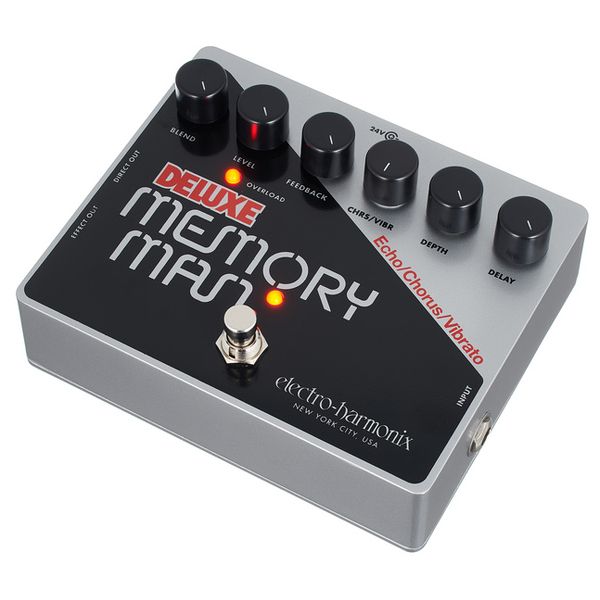
You get controls for Delay Time, Feedback (repeats), Blend, Chorus/Vibrato depth, and a rate control for the modulation, plus a footswitch to flip between Chorus and Vibrato modes. It’s more knobs than a simple delay, but nothing overwhelming once you spend a session with it.
Power comes via the included external supply — a 24V unit specific to this pedal, not a standard 9V. That’s worth flagging clearly: you can’t just grab any spare pedalboard power brick for this one.
Who This Is For
Ambient, shoegaze, and psychedelic players are the obvious core audience — if your influences include Gilmour-era Floyd or My Bloody Valentine, this pedal speaks your language natively. But it’s also just a genuinely excellent all-purpose analog delay for anyone chasing warmth over precision.
If your rig already leans vintage, pairing this with something like the MXR Analog Chorus builds a genuinely lush, retro-modulated foundation. And if you want a second, smaller analog delay for tighter slapback duties elsewhere on your board, something like the Ibanez AD Mini pairs nicely alongside it without eating your whole board.
Playability & Usability
It’s larger than a lot of modern pedals, and the external power brick adds another cable and another thing to route on your board. Neither is a dealbreaker, but it’s worth planning your pedalboard layout with this in mind before you buy.
Once it’s set up, though, it’s genuinely intuitive. All the controls do exactly what they say, there’s no menu diving, and dialing in a great tone takes minutes rather than a whole afternoon of experimentation.
Honest Niggles
The proprietary 24V power supply is the single biggest practical annoyance. Lose that adapter and you can’t just grab a generic 9V brick as a replacement — you need the right voltage, and that limits your options on a shared pedalboard power supply unless it specifically supports 24V outputs.
It’s also noisier than a modern boutique delay — some hiss and hum are just part of the deal with this circuit design. Fans of the pedal consider it part of the vintage character; purists chasing dead-silent signal chains may find it mildly annoying.
And at this size, it’s not going anywhere near a „minimalist pedalboard” build. If space is tight, something more compact like a straightforward digital delay pedal in our MXR Six Band EQ roundup territory might make more sense space-wise, even if it can’t match this tone.
Specs at a Glance
- Effect type: true analog bucket-brigade delay with chorus/vibrato
- Delay time: up to 550 ms
- Bypass: true bypass
- Controls: Delay Time, Feedback, Blend, Chorus/Vibrato Depth, Rate
- Footswitch: bypass plus Chorus/Vibrato mode select
- Power: included external 24V DC power supply (24DC-100), no battery operation
- Dimensions: 120 x 145 x 64 mm
A Quick Word on the Variants
EHX has released several versions of this circuit over the years — the standard Deluxe Memory Man, a Nano version in a smaller enclosure, and tap-tempo variants aimed at players who want more rhythmic precision without sacrificing the analog warmth.
The full-size version reviewed here is still the one most players reach for first, mostly because the larger enclosure gives you more room for the extra modulation controls without everything feeling cramped. If pedalboard space is a genuine constraint, it’s worth knowing the Nano exists as a trade-off, but you do lose some of the hands-on control in the process.
Final Verdict
The Deluxe Memory Man isn’t just another delay pedal — it’s a genuine piece of guitar history that still sounds completely relevant decades later. That warm, wobbly, slightly unstable echo is instantly recognizable and still hasn’t been perfectly replicated by anything digital.
It asks a bit more of you than a plug-and-play modern delay — bigger footprint, proprietary power supply, a few more controls to learn — but the tone you get in return is genuinely special and worth those small compromises.
If ambient, psychedelic, or just plain lush analog delay tones are what you’re after, this is about as close to the source as you can get. Easy recommendation, IMO — this is one of those pedals that earns its legendary reputation.