Watch It First
Few pedals split a room like the Boss MT-2 Metal Zone. Ask ten metal guitarists what they think and you’ll get five different opinions, most of them loud.
It’s been mocked, meme’d, and declared „the worst distortion pedal ever” by more than one YouTuber. It’s also sold by the truckload for over three decades.
Both things can be true. Let’s actually dig into why this pedal refuses to die, and whether it deserves a spot on your board.
Why the Hate? And Why It’s Kind of Unfair
The MT-2 gets a bad reputation mostly because of how people use it, not because of what it actually is. Cranked dist, cranked everything, straight into a bedroom practice amp – yeah, that sounds bad. Any pedal would.
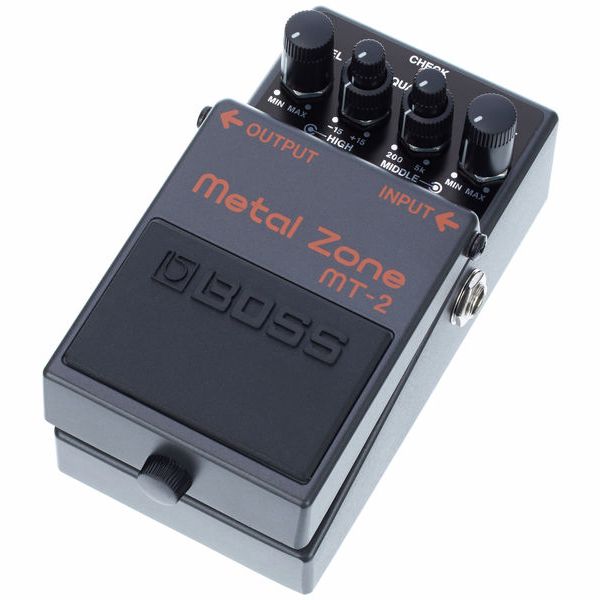
The 4-band EQ (Low, High, and a genuinely useful parametric Middle with adjustable frequency) is what makes this pedal actually good in the right hands. Most players never touch the Middle Freq knob, which is honestly where the magic happens.
Scoop that mid frequency into „shred” territory and it’s a cliche. Push the mid frequency lower and boost it slightly instead, and you get thick, aggressive rhythm tones that cut through a mix rather than disappearing into mush.
Dialing It In Properly
Rule one: never max the Dist knob. Backing it off to roughly 10-11 o’clock and compensating with Level gets you a tighter, more controlled gain structure that doesn’t collapse into fizz.
Rule two: use it as a boost in front of an already-driven amp channel rather than as your sole gain source. Many metal players run it this way – it’s the same logic covered in our Ibanez TS9 review for tightening up a loose high-gain tone.
Rule three: spend real time with the EQ. This pedal rewards patience way more than a one-knob distortion ever could.
How It Compares to Rivals
The obvious modern comparison is the Electro-Harmonix Nano Metal Muff. The EHX has a noise gate built in and a slightly more mid-scooped, modern voicing out of the box.
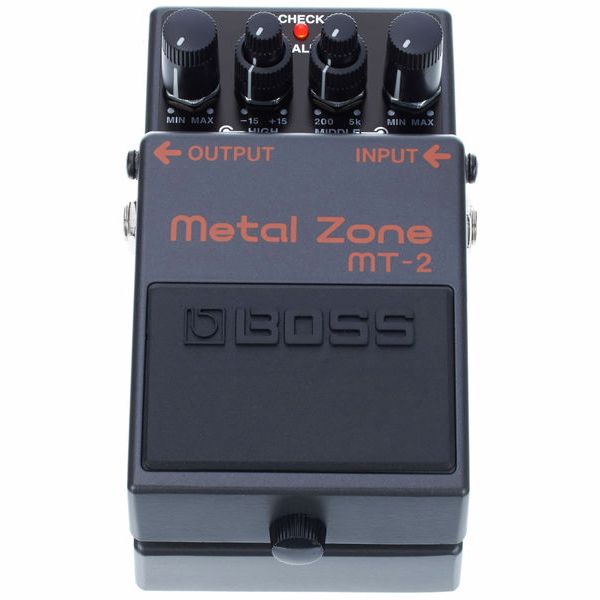
The MT-2 counters with far more EQ flexibility. If you want a pedal that can go from thrash to doom to nu-metal with knob turns alone, the Boss wins on versatility even if the EHX might win on out-of-the-box convenience.
If precise tone shaping is what you’re after generally, not just for this pedal, something like the MXR Six Band EQ paired after any distortion pedal gives you even finer control for live mix situations.
Noise and Gain Structure
Let’s address the elephant in the room: yes, it can be noisy at high gain settings, especially with single coils or a noisy amp. This isn’t unique to the MT-2, but the amount of available gain on tap makes it more noticeable.
A noise gate pedal after it in the chain solves this completely, and honestly should be considered a mandatory purchase if you’re running the Dist knob past noon regularly.
Guitars with active pickups or hotter passive humbuckers, like what you’d find on an Ibanez AZ2402, will push the front end harder and generally sound tighter than a guitar with weaker output pickups.
Build Quality
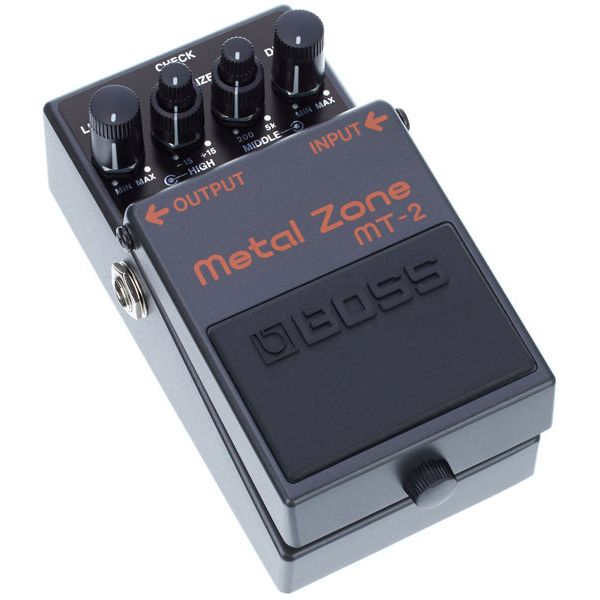
Standard Boss compact-pedal toughness – metal chassis, sturdy footswitch, battery or 9V DC operation. This thing has survived thirty-plus years of gigs, floor tom cases dropped on it, and basement rehearsal spaces. It’ll survive yours too.
Who Should Buy the MT-2
Anyone who wants serious, adjustable high-gain distortion on a budget and is willing to spend twenty minutes learning the EQ section. Great for thrash, death, doom, and nu-metal players who need real tonal flexibility rather than one fixed „metal” sound.
Skip it if you want plug-and-play simplicity with zero tweaking, or if you’re chasing a very specific boutique high-gain voicing – this pedal’s whole appeal is its adjustability, not a single signature tone.
Studio Use vs Live Use
In the studio, the MT-2 behaves differently than most players expect. Recorded through a decent mic and a real cab (or a good IR), the „harsh” reputation mostly disappears.
A lot of the fizz people complain about is actually a monitoring problem, not a pedal problem – it sounds abrasive through cheap computer speakers or headphones but tightens right up once it hits a proper cab and mic chain.
Live, it’s a different story. On a loud stage the extra gain on tap is genuinely useful, and the mid control lets you cut through a dense mix with two guitars and a bassist all fighting for the same frequency space.
My honest recommendation: track a few different Middle Freq settings before committing to a final recorded tone. The difference between „generic metal pedal” and „surprisingly usable” is often just a few degrees of that one knob.
Is It Worth Upgrading to the Waza Craft Version?
Boss also sells the MT-2W, a Waza Craft edition with a Custom mode that adds extra low-end and a different clipping structure. It’s a genuinely nicer-sounding pedal, no argument there.
But it roughly doubles the price for what amounts to a refinement, not a reinvention. If you’re on a budget, the standard MT-2 gets you 85% of the way there for a fraction of the cost – upgrade later once you know you actually want more of this specific flavor of gain.
Boss MT-2 Metal Zone Specs
- Type: Distortion pedal, metal-focused voicing
- 3-band EQ with parametric Middle Frequency control
- Controls: Level, High, Low, Middle, Middle Freq, Dist
- Extremely low self-noise circuit design (for a high-gain pedal)
- Battery or 9V DC power supply operation (adapter sold separately)
- Standard Boss compact metal enclosure
- Compact footprint: 70 x 125 x 55mm, 410g
Final Verdict
The Boss MT-2 Metal Zone isn’t a bad pedal – it’s a pedal that gets abused by people who never learn to use it properly. Once you understand the EQ section, it’s a genuinely versatile high-gain tool that’s been keeping its place on pedalboards since 1991 for a reason.
It’s not subtle, and it’s not going to fool anyone into thinking they own a boutique high-gain pedal. But for the price, the tonal range on offer here is honestly kind of absurd.
Give the EQ section the respect it deserves, pair it with a noise gate if you’re running high gain, and this budget classic will earn its spot on your board.