Watch It First
Boss dropped the RV-200 a couple of years back without much fanfare, and it quietly became one of the best reverb pedals in their entire compact lineup. No flashy launch campaign, no gimmicks. Just a genuinely studio-grade reverb crammed into a box smaller than half the pedals on your board.
I’ve had this thing running on a board for a while now, in stereo, sitting at the end of the chain where reverb belongs. It does more than most pedals twice its size try to do, and honestly the Hall algorithm alone is close to worth the asking price.
This review covers what it actually sounds like once it’s in a mix, how the controls hold up under real use, and whether it makes more sense than something like the EHX Canyon or a pricier boutique reverb unit.
What’s Actually Inside the RV-200
Boss basically took the reverb engine from their flagship RV-500 and squeezed it into a single compact pedal. That’s the whole pitch, really, and it’s a good one. You get 12 reverb types instead of the usual three or four you’d find on a cheaper unit.
The algorithms cover the obvious stuff (Room, Hall, Plate, Spring) plus more creative modes like Modulate, Dynamic, Shimmer and Ambient. Each one has its own character rather than feeling like a preset dial with different EQ curves slapped on top.
- Hall – the star of the show, lush and three-dimensional without turning to mud
- Plate – tight, studio-vocal-booth vibe, great for clean tones
- Spring – surf-y and boingy when you want it, without the physical spring noise
- Shimmer – octave-up ambient wash, good for post-rock or ambient swells
- Dynamic – reverb that ducks with your playing, handy live
Stereo I/O and MIDI
This is where the RV-200 starts to separate itself from cheaper reverb pedals. You get proper stereo in and out, a CTL/EXP jack for an expression pedal or external switch, and both MIDI in and out. That MIDI implementation means you can automate patch changes from a MIDI controller or DAW, which is not something you’d expect at this size.
If you’re already running MIDI on your board to sync something like a modulation pedal or a looper, the RV-200 slots right into that setup without needing a separate switcher.
Build and Control Layout
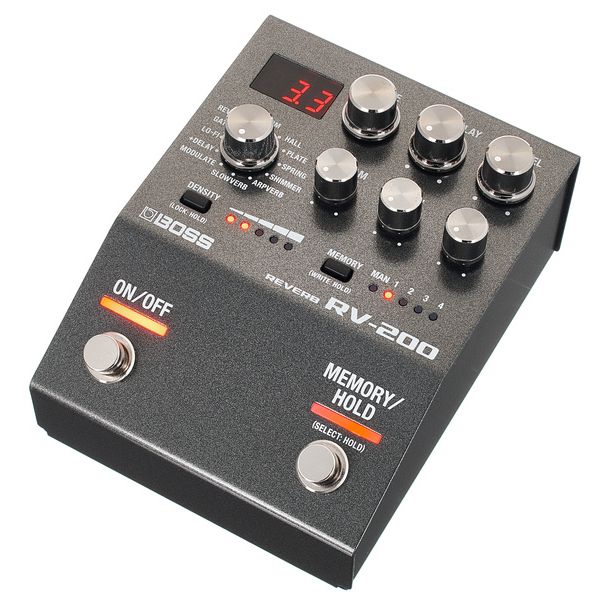
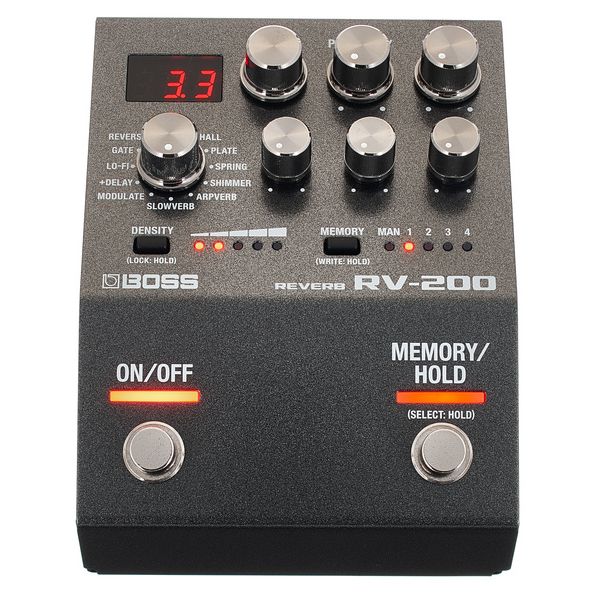
Physically it’s a compact-format Boss pedal, so it’s small. Time, Pre-Delay, E.Level and a Param knob handle the main shaping, and there’s a small display so you’re not guessing which of the 12 reverb types you’re on. Four memory slots let you store your favourite settings and recall them with the footswitch, which is genuinely useful if you switch between a subtle always-on shimmer and a huge wash for solos.
Power comes from either 3 AA batteries or a standard Boss 9V PSU (not included, sold separately). True bypass keeps your tone intact when the pedal’s off, which matters more than people think once you’ve got five or six pedals in a chain.
How It Sounds in Real Use
The Hall algorithm is what sold me. It’s dense and spacious but never gets that washed-out, swimming-in-syrup effect that cheap digital reverbs get once you push the mix past 30%. You can run it as a subtle always-on tail and barely notice it’s there, or crank it into ambient territory for slow, atmospheric parts.
Shimmer mode deserves a special mention. It’s not quite as lush as a dedicated shimmer pedal, but it’s genuinely usable, not a novelty afterthought bolted onto a menu. Pair it with something like a Micro POG ahead of it and you’ve basically got a mini ambient rig for not much outlay.
Plate and Room are both tighter and more „studio” sounding, which makes sense given Boss clearly built this with recording in mind, not just live pedalboard duty. If you record direct into an interface, this pedal genuinely competes with plugin reverbs, which is saying something.
Boss RV-200 vs the RV-6
The RV-6 is Boss’s other popular reverb pedal, and it’s the budget-friendly option in the lineup. It sounds good, it’s simpler to use, and it’ll cover most players just fine. But it’s mono, no MIDI, and fewer algorithms.
The RV-200 is the pedal for people who want stereo, MIDI recall, and studio-grade algorithms without jumping to a premium boutique unit. If you’re mostly gigging with a simple setup, the RV-6 might be all you need. If you’re recording regularly or running a MIDI-controlled board, the RV-200 punches well above its price bracket and honestly makes more sense long-term.
Worth noting too: this isn’t a pedal you „set and forget” in the way a simple boost or an overdrive pedal is. It rewards a bit of time spent in the menu, dialling in Pre-Delay and Param settings per reverb type. IMO that’s a feature, not a flaw, but it’s worth knowing going in.
Who Should Actually Buy This
Home recordists and gigging guitarists who want one reverb pedal to cover both roles are the obvious target. Worship and ambient players will get a lot out of Shimmer and Modulate. Vocalists running a Boss VE-8 style setup could even find a place for it in a vocal chain, since the stereo output and MIDI recall work just as well there.
If your board is already packed and you just want a basic „verb on/off” switch, this might be overkill. But for anyone who actually cares about reverb as an instrument rather than an afterthought, it’s hard to find a compact pedal that does more.
Specs at a Glance
- 12 reverb types derived from the Boss RV-500 algorithms, including Hall, Plate, Spring, Shimmer, Dynamic and Modulate
- True bypass switching
- Stereo inputs and outputs (6.3mm jack)
- MIDI In and MIDI Out
- CTL/EXP jack for external footswitch or expression pedal
- 4 onboard memory slots
- Controls: Time, Pre-Delay, E.Level, Reverb Type, Param, Low, High
- Powered by 3x AA batteries or 9V DC PSU (sold separately)
- Dimensions: 138 x 101 x 63 mm, weight approx. 700g
Final Verdict
The Boss RV-200 is one of those pedals that doesn’t need to shout about what it does. It just quietly does reverb better than most things in its size class, and better than plenty of pedals that cost noticeably more. Stereo I/O, MIDI, and studio-quality algorithms in a compact footprint is a genuinely rare combination.
Is it the flashiest pedal on the market? No. Is it going to be the most useful piece of real estate on your board? Probably yes. If you’ve been putting off upgrading your reverb, this is a solid, premium-feeling option that won’t leave you wanting more a year down the line.