Watch It First
Pitch-shifting pedals have a reputation problem. Half the guitarists who’ve tried one walked away thinking they’re gimmicky, glitchy, or only good for one novelty dive-bomb sound and nothing else.
The Boss PS-6 Harmonist has been quietly proving that reputation wrong for over a decade now. It’s not just a whammy pedal, it’s a genuinely flexible harmony generator that happens to do the whammy thing extremely well too.
I picked one up specifically to add harmonized lead lines to a solo project, and ended up using it for about four other things I never expected. Here’s the full breakdown.
What The PS-6 Actually Does
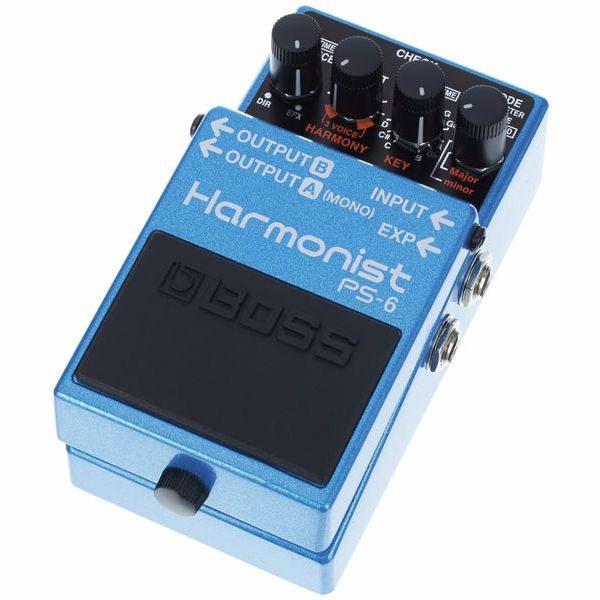
At its core, this pedal adds one or two extra pitch-shifted voices to whatever you’re playing, tracking your note in real time and generating a harmony above, below, or both. That sounds simple, but the tracking quality is what actually makes or breaks a pedal like this.
Beyond straightforward harmony generation, the PS-6 covers detune modes for a thick, chorus-adjacent shimmer, and the S-Bend and Whammy-style modes that pitch-shift dramatically with an expression pedal or the built-in pedal control.
Harmony Mode Tracks Chords, Not Just Single Notes
This is the feature that genuinely separates it from cheaper pitch-shifters. Most budget harmonizers fall apart the moment you play more than one note at a time. The PS-6 handles chords with reasonable accuracy, though single-note lead lines are still where it sounds most convincing.
You set the harmony interval, and the pedal tracks your key signature reasonably intelligently within the scale you’ve told it to use, rather than blindly shifting a fixed number of semitones regardless of what note you’re actually playing.
Sound
Harmony Mode Is Genuinely Musical
Dial in a third or a fifth above your played note, and the result sounds like a second guitarist rather than an obvious digital effect, provided you’re playing single notes and staying reasonably in the pocket of the scale you selected.
It’s not flawless, fast legato runs or wide bends can occasionally confuse the tracking, but for deliberate lead lines and harmonized melodies, it holds up remarkably well for a pedal at this price point.
Detune And S-Bend Modes Add Real Character
Detune mode is where this thing earns its keep as an everyday pedal rather than an occasional-use novelty. A subtle detune adds a chorus-like shimmer that’s genuinely lovely on clean rhythm parts, similar territory to what a pedal like the Ibanez CS Mini covers, but with its own distinct character.
S-Bend mode is the fun one, letting you set a rise and fall time for a dramatic pitch bend triggered by the footswitch. It’s genuinely reminiscent of Tom Morello’s more experimental textures, and it’s a lot of fun live even if you only reach for it occasionally.
Whammy-Style Territory
With an expression pedal connected, the PS-6 covers a lot of the ground a dedicated whammy pedal handles, octave-up and octave-down dramatic pitch sweeps included. It’s not a one-for-one replacement for a purpose-built whammy pedal, but it’s close enough that most players won’t need both.
If you’re chasing pure octave tones rather than harmony, something like the Boss OC-5 or the EHX Nano POG will get you there more directly, but the PS-6 covers a genuinely wide net of pitch-based effects in one box.
Build Quality And Playability
Standard Boss compact construction, metal chassis, solid footswitch, built to survive the usual touring and rehearsal abuse without complaint. The footprint is the familiar single-switch Boss size, so it slots easily next to other compact pedals on a crowded board.
Power comes via 9V battery or the standard Boss DC adapter, sold separately, consistent with essentially the entire Boss compact catalog, including pedals like the Boss TR-2 tremolo I covered separately.
Connecting an expression pedal genuinely transforms this box, unlocking the more dramatic pitch-bend and whammy-adjacent modes. Without one, you’re limited to the fixed-interval harmony and detune modes, which are still useful, just less dynamic in a live setting.
Who It’s Actually For
Lead players who want harmonized solo lines without hiring a second guitarist are the obvious core audience, and this genuinely delivers on that promise better than most budget alternatives on the market.
Ambient and experimental players get a lot out of the detune and S-Bend modes specifically, building textures that go well beyond straightforward pitch harmony into genuinely unique sonic territory.
Players chasing one very specific whammy sound and nothing else might be better served by a dedicated whammy pedal built purely for that job. This is a generalist pitch-shifting tool, in the same spirit as a multi-mode box like the Boss MD-200, not a specialist one, and it shows in both directions.
Honest Niggles
Tracking isn’t flawless on fast passages or wide bends, and chord tracking specifically has real limits compared to single-note lines. Manage expectations here rather than assuming studio-perfect harmony on every single note.
No expression pedal included means you’re missing the most dramatic modes out of the box unless you already own a compatible expression pedal or buy one separately.
The learning curve for dialing in the right scale and interval settings takes some patience. Get it wrong and the harmony sounds obviously off-key rather than musical, so spend real time in a quiet room getting your settings right before relying on it live.
Boss PS-6 Harmonist – Specs At A Glance
- Effect type: Harmonizer and pitch shifter
- Voices: Up to 2 additional tones, 3-voice solos possible
- Modes: Harmony, Detune, S-Bend, Whammy-style pitch shifting
- Chord tracking: Yes, single-note lines track most accurately
- Dimensions: 73 x 129 x 59 mm
- Power: 9V battery or DC adapter, sold separately
- Available since: September 2010
Final Verdict
The PS-6 earns its reputation as one of the most versatile pitch-shifting pedals still on the market, more than a decade after its release. It covers harmony, detune shimmer, and dramatic whammy-style bends in one box, without feeling like a compromise in any single mode.
It’s not a perfect replacement for a dedicated whammy pedal if that’s genuinely all you need, and the tracking has real limits on fast, complex playing. But as a generalist pitch-shifting tool that covers an enormous range of use cases, this remains one of the smarter pedal purchases in its category.
IMO once you’ve spent a proper evening dialing in scales and intervals, this becomes one of those pedals that quietly changes how you write parts, not just how you play them live.