Watch It First
Octave pedals have gone through some rough phases over the decades. Older Boss octavers, the OC-2 and OC-3 included, were beloved for their vibe but honestly a bit rough around the tracking edges once you got past single notes.
The OC-5 fixes basically all of that. Boss took everyone’s favorite vintage OC-2 voicing, kept it as a selectable mode, and then built genuinely modern polyphonic tracking on top of it. That combination is rarer than you’d think in this category.
I’ve spent real time with this pedal across electric, bass, and even acoustic setups, so let’s get into what makes it click, and where it still falls a little short.
Two Octave Philosophies, One Box
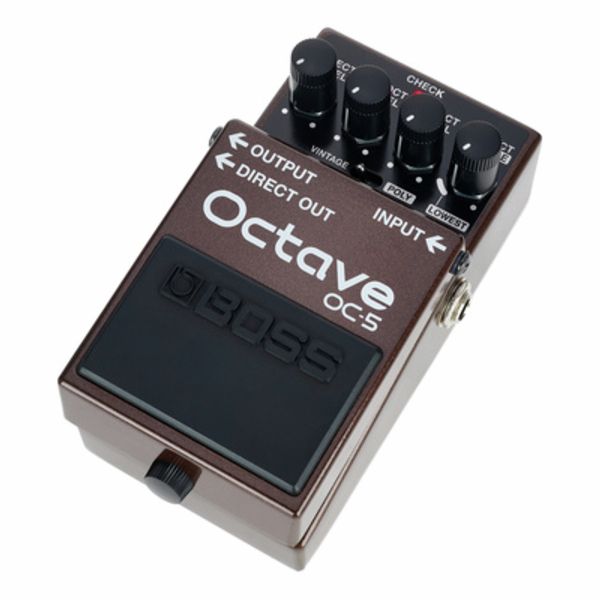
Boss didn’t reinvent the octave pedal formula here, they refined it. You get four knobs: Direct Level, Octave Up Level, Octave Down Level, and Range, plus a mode switch between Vintage and Poly.
That Vintage mode is a direct callback to the OC-2, monophonic tracking with that slightly warbly, organic low end that a whole generation of players grew up loving on recordings. Poly mode is the modern version, cleaner tracking across chords and multiple strings at once.
Having both in one box rather than forcing a choice is honestly the smartest design decision Boss made with this pedal. You’re not locked into one philosophy of what an octave pedal should sound like.
Sound
Vintage Mode
Vintage mode is where this pedal gets its character. It’s not pristine, and that’s exactly the appeal, there’s a touch of pitch-tracking looseness that makes single-note lines feel alive rather than clinical. If you grew up on records that used the OC-2, you’ll recognize this immediately.
Poly Mode
Poly mode is where the OC-5 earns its keep for modern players. Full chords track cleanly with the up-octave engaged, which opens the door to thickened rhythm parts that would have made older Boss octavers choke. It’s not flawless polyphonic tracking in the way a dedicated high-end unit might manage, but it’s genuinely usable, which is the bar that matters for most gigging musicians.
The Range knob deserves a special mention because it’s a genuinely clever addition. It lets you set a frequency threshold so the octave effect only triggers below a certain note. That means you can play a bass line down low with full octave effect while your higher chord voicings upstairs stay clean and unaffected. It took me a session or two to really understand what it was doing, but once it clicked, I found myself using it constantly. Most competing octave pedals in this price range don’t offer anything like it, they just apply the effect across your whole range regardless of what you’re actually playing, which is exactly the kind of muddiness the Range control is designed to avoid.
Build Quality
Boss builds these things like tanks, and the OC-5 is no exception. The compact pedal format, 73 x 129 x 59mm, is Boss’s standard footprint, so it’ll slot right into an existing board without needing you to rearrange anything.
Power comes from either a 9V battery or a standard Boss-style DC adapter, sold separately. If you’ve read my Boss TU-3W Waza Craft review, you know Boss pedals generally play nice with any standard daisy chain power supply, and this one is no exception.
One quirk worth flagging up front, the Direct and effect outputs are separate mono jacks rather than a single stereo out. That’s intentional, it lets bass and guitar players split their dry and effected signal to two amps or a mixer, but if you were expecting a simple single-output stompbox, budget a bit of extra cable planning.
Playability And Use Cases
This pedal genuinely shines across three very different instruments, which is unusual. Bass players get a huge amount out of the sub-octave for that classic synth-bass thickness, similar in spirit to what I found messing around with the EHX Nano POG, though the OC-5 leans more toward a straightforward, purposeful octave tool than a texture generator.
Electric guitarists get the most obvious use case, thickened riffs, faux-bass lines under a solo, or that classic „one guitarist covering bass and lead” trick in a stripped-down band setup.
Acoustic fingerstyle players might be the most pleasantly surprised group here. Adding a subtle sub-octave under a fingerstyle passage genuinely fills out the sound in a way that’s hard to achieve otherwise without an actual bass player in the room. A few of the customer reviews I came across specifically praised this use case, and after trying it myself, I get why. One reviewer even mentioned using it as a stand-in for a missing bass player during solo acoustic sets, and honestly, having tried that exact trick myself, it holds up better than you’d expect from a single stompbox.
Who It’s Actually For
If you want one octave pedal that can genuinely cover vintage warble and modern chord tracking without buying two separate boxes, this is close to the ideal solution. It’s also a smart pick if you play in more than one project with different tonal needs, since the mode switch means you’re not stuck with one octave personality.
If you specifically want deep, MIDI-programmable presets or a huge range of simultaneous voices like you’d get from something like the MXR Sugar Drive Mini’s simplicity on the overdrive side, or from EHX’s higher-end POG models on the octave side, this is more of a focused, purpose-built tool than a Swiss army knife.
Honest Niggles
Poly mode, while genuinely good, still isn’t flawless tracking on very fast, dense chord work. It handles typical rhythm playing fine, but if you’re doing rapid jazz-style chord movement, you might notice occasional artifacts.
The separate mono outputs mean this pedal wants a slightly more considered signal chain than a plug-and-play stompbox. Not a dealbreaker, just something to plan for before your first gig with it.
No onboard power supply in the box is a small annoyance given the price point, especially since Boss makes you buy their specific PSA-series adapter separately for the cleanest results, similar to what’s true of a lot of pedals in this range, including the MXR Classic 108 Fuzz Mini I covered separately.
Boss OC-5 – Specs At A Glance
- Modes: Vintage (OC-2 style) and Poly
- Controls: Direct Level, Octave Up Level, Octave Down Level, Range
- Connectors: Input, Direct Out, Effect Out (6.3mm jacks)
- Dimensions: 73 x 129 x 59 mm
- Power: 9V battery or 9V DC adapter, sold separately
- Instrument compatibility: Electric guitar, bass, acoustic guitar
- Effect type: Octaver
Final Verdict
The OC-5 takes what made the old-school Boss octavers lovable and pairs it with tracking that actually works reliably on modern gigs. That’s a harder trick to pull off than it sounds.
It’s not the pedal for players chasing deep synth-pad textures or elaborate preset systems, there are more specialized boxes for that kind of thing.
But as a genuinely versatile, road-worthy octave pedal that works across guitar, bass, and acoustic rigs without complaint, the OC-5 is one of the smartest buys in this category right now. IMO it earns its reputation as the octave pedal most gigging musicians should own.