Watch It First
Metal distortion pedals are a dime a dozen these days. Every brand has one, most sound roughly the same, and half of them disappear from catalogues within a year or two.
The MXR M116 Fullbore Metal isn’t one of those. It’s been on Thomann’s shelves since 2009 and it’s still selling well enough to sit near the top of their distortion charts.
That kind of staying power is rare in this category, so let’s see what’s actually going on inside the box.
What’s Actually Inside
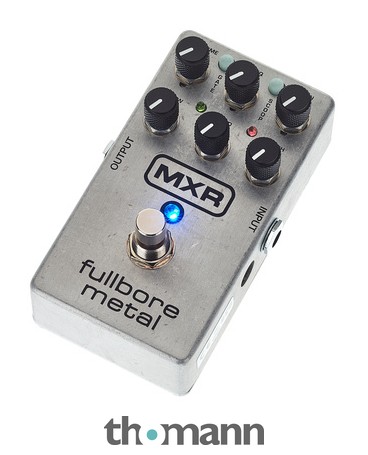
On paper it’s simple. Volume, Gain, a sweepable Mid control, Bass and Treble. That’s it.
But the sweepable mid is doing most of the heavy lifting here, and it’s the reason this pedal has lasted this long.
The Sweepable Mid, Explained
Most cheap distortion pedals give you a single fixed mid-scoop and call it a day. MXR let you actually choose which frequency gets boosted or cut.
Dial the mid-freq knob one way and you get that classic scooped, mid-90s thrash tone. Dial it the other way and you can push a nasal, aggressive honk that cuts through a dense mix like a boost pedal with attitude.
It’s a genuinely useful control, not a gimmick. IMO it’s the single biggest reason to pick this over something like a Boss MT-2.
How It Actually Sounds
This is not a subtle pedal. It’s built for people who want gain, and lots of it.
With the gain past noon you’re firmly in modern metal territory – tight low end, aggressive upper mids, and enough saturation to make single-coils sound like they belong in a different genre entirely.
Pull the gain back to 9-10 o’clock and it cleans up into something closer to a hot rock distortion, which surprised me a bit. It’s not a one-trick pony even if „one trick” is what most people buy it for.
There’s also an onboard noise gate, which matters more than people expect once you stack this in front of a high-gain amp. Silence between chugs stays silence – no hiss, no hum creeping in.
Compared to something like a wah pedal paired with a generic overdrive, this just does the job in one box, and does it with more control.
How It Stacks Up Against the Usual Suspects
The obvious comparison is the Boss MT-2 Metal Zone, which has been the default „metal pedal” punchline for decades. The Fullbore Metal is tighter and less scratchy in the top end, IMO, with a more usable mid control instead of Boss’s infamous scoop-only EQ.
Against something like the ProCo Rat 2, it’s a completely different animal – the Rat is fuzzier and more vintage-voiced, while the Fullbore Metal is scooped, tight, and clearly built for modern high-gain riffing rather than classic rock crunch.
Electro-Harmonix’s Metal Muff is probably the closest competitor in terms of intent. Both chase that same aggressive, gain-forward sound. The Fullbore Metal edges it out for me on note definition when you’re playing fast, palm-muted riffs – the Metal Muff can get a little mushy at extreme gain, whereas the MXR stays defined.
None of this means the competition is bad. It just means the Fullbore Metal earns its spot through actually being good, not just being cheap or well-marketed.
Getting the Best Tone Out of It
A few settings that work well as starting points, since the sweepable mid can be a bit confusing at first.
For scooped modern metal: gain around 2-3 o’clock, mid frequency turned low (bass-heavy sweep), mid level pulled back. For a more vintage hard-rock crunch: gain around 10-11 o’clock, mid frequency higher, mid level pushed up slightly to keep some grit in the midrange.
Running it into a clean amp platform works better than stacking it in front of an already-dirty channel – it’s voiced to be the main gain source, not a boost on top of existing distortion. Treat it like the front end of your tone chain and it rewards you.
Build Quality and Pedalboard Practicalities
Classic MXR die-cast enclosure. Brushed metal top, a bright blue LED (genuinely bright – some owners tape over it), and top-mounted jacks so it plays nice on a crowded board.
Power is 9V, either battery or a standard center-negative adaptor, sold separately. No weird proprietary power requirements here, which is always appreciated.
It’s a compact standard-size MXR box too, so it won’t eat a ton of real estate if you’re already tight on space next to your pitch pedal and delay.
Who’s This Actually For
- Guitarists who want a dedicated metal/hard-rock distortion without buying a full high-gain amp
- Anyone running a low or mid-gain amp who needs to push into proper metal territory
- Players who want EQ flexibility rather than a fixed, one-note distortion voice
- Home recording setups where reamping through a real stack isn’t practical
If you’re mostly playing blues or classic rock, skip this – it’s overkill and you’ll never use half the gain on tap. This is a specialist tool, not a do-it-all box.
The Niggles
A few things worth knowing before you buy.
- That LED really is obnoxiously bright on a dark stage
- It can sound a bit harsh/fizzy in the upper mids if you’re not careful with the EQ – takes some dialing in
- No true bypass buffer for long cable runs, so tone suck is possible in bigger setups
None of these are dealbreakers, but they’re the kind of thing you only notice after living with the pedal for a while, not after five minutes in a shop.
Full Spec Rundown
- Type: Metal distortion pedal
- Controls: Volume, Gain, Bass, Treble, sweepable Mid, Mid-Freq
- Onboard noise gate
- Power: 9V battery or 9V DC adaptor (not included)
- Enclosure: die-cast aluminium, MXR standard size
- Available since: December 2009
- Customer rating: 4.5/5 from 170+ reviews on Thomann
Final Verdict
Sixteen years on the market and it’s still one of the best-selling metal distortions Thomann carries. That’s not an accident.
The sweepable mid alone makes it more versatile than most of the competition, and the noise gate is a genuinely useful inclusion rather than a box-ticking spec.
It’s not going to replace a proper high-gain amp for serious tone chasers, but as a way to turn any amp into a metal machine for not much cash, it’s hard to beat. Recommended if that’s what you need.