Watch It First
Reverb pedals are one of those categories where the gap between „fine” and „amazing” is huge.
Most budget boxes use the same cheap Spin FV-1 chip under the hood, so they all sort of sound the same after a while.
Universal Audio decided to skip that entirely and build something closer to studio rack gear. Here’s how that plays out in practice.
Three Reverbs, One Box
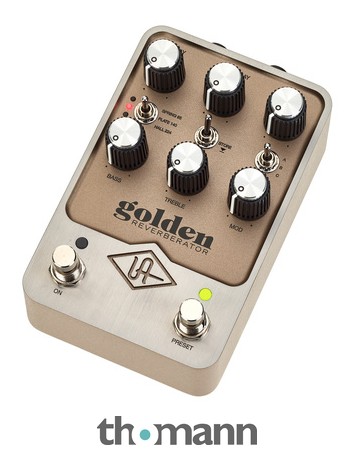
The Golden Reverberator gives you three digital reverb algorithms – Spring, Plate and Vintage – built around Universal Audio’s dual-processor UAFX engine, the same platform underneath their amp modelling pedals.
Register the pedal and you can also download extra reverb types for free, which is a nice touch most competitors don’t bother with.
Why „Studio-Grade” Actually Means Something Here
Cheap reverb pedals tend to get muddy and metallic-sounding once you push the decay past a certain point. This one doesn’t, because it’s running proper DSP horsepower instead of a bargain-bin chip.
You can hear the difference most clearly on long, ambient decays – the tail stays clean and detailed instead of turning into a wash of digital noise.
How It Sounds
The spring setting is genuinely convincing – that slightly splashy, physical „boing” you get from a real tank, without the noise or the fragility of an actual spring tank rattling around in your amp.
Plate is smooth and dense, great for ambient or shoegaze-adjacent textures, and the Vintage setting has a lovely lo-fi, tape-like quality that sits nicely behind vocals or clean arpeggios.
Stereo operation genuinely widens the sound rather than just doubling it, assuming you run it into two amps or a stereo interface. Mono players still get a great reverb, just without that extra dimension.
The One Big Catch
Here’s the honest bit: onboard, you only get one saved preset without the app. No MIDI either.
For a pedal at this price, in 2026, that’s a genuinely odd limitation, and it’s the single most common complaint in the reviews. If you need to switch between multiple reverb settings live via MIDI, look elsewhere.
For studio use or a simpler live setup where you basically dial in one great reverb sound and leave it, it’s a total non-issue. Context matters here.
Dialling In Your Own Tone
A few starting points that worked well for me across different styles.
For surf and indie clean tones, Spring mode with a moderate decay and mix around 30% gets you that classic bouncy, splashy tail without drowning the pick attack.
For ambient or post-rock swells, Plate mode with a long decay and mix pushed past 50% creates that huge, wash-like space that makes single notes feel like they’re filling a room.
For vocals or clean rhythm parts that need to sit further back, Vintage mode with a shorter decay adds warmth and depth without pulling focus, similar in spirit to what a good Jazzmaster and reverb combo would give you through a real amp tank.
In a Full Pedalboard Chain
Placement matters more with a pedal this transparent. Running it after drive and modulation, as usual, keeps things clean – reverb should generally sit last in the chain unless you’re deliberately going for a washed-out, ambient effect.
Stereo out into two amps (or a stereo interface for recording) is where this pedal really justifies its price. In mono it’s still excellent, but you’re leaving some of what you paid for on the table.
Build and Connectivity
Solid metal enclosure, true or buffered bypass switchable, two inputs and two outputs for stereo operation, and a USB-C port for updates and app connection.
Power needs a 9V DC supply rated at 400mA – not included, so factor that into your board’s power budget alongside your modulation pedals and anything else power-hungry.
Thomann backs it with their standard 30-day return window and 3-year warranty too, so if the single-preset limitation turns out to be a dealbreaker for your workflow once you’ve actually used it live, you’ve got room to send it back.
Who Should Buy This
- Studio players who want rack-quality reverb without an actual rack
- Anyone chasing convincing spring reverb without a fragile physical tank
- Ambient, shoegaze and post-rock players who lean hard on reverb tails
- Players happy with one great dialled-in tone rather than switching presets constantly live
If you’re a cover band player who needs five different reverb settings on tap mid-song via a MIDI switcher, this isn’t built for that workflow. Look at something with proper preset banks instead.
How It Stacks Up
Against the Strymon BigSky, the obvious rival in this space, the Golden Reverberator is simpler and cheaper but noticeably more limited on preset storage and modes. The BigSky is the Swiss army knife; this is a scalpel.
Against Universal Audio’s own cheaper siblings, the Evermore and Heavenly Plate, this one covers more ground since it includes spring, plate and vintage in a single box rather than splitting them across two pedals.
And against a cheap all-rounder like the tc electronic Hall of Fame 2, the difference is night and day the moment you push decay times up – the Golden Reverberator holds its clarity where the budget option starts to smear and lose definition.
Full Spec Rundown
- Type: stereo reverb pedal
- Reverb types: Spring, Plate, Vintage (plus free downloadable extras)
- Bypass: true or buffered, switchable
- Inputs/outputs: 2x 6.3mm jack in, 2x 6.3mm jack out (stereo)
- USB-C for updates and app connectivity
- Power: 9V DC, 400mA (adaptor not included)
- Available since March 2021, rated 4.8/5 from 93+ Thomann reviews
Final Verdict
The single-preset limitation is real and it’s fair to dock points for it. But the actual reverb quality here is genuinely up there with rack gear costing multiples more.
If you value tone over flexibility, and most players chasing a „wow” reverb do, this delivers. It’s a premium reverb pedal that sounds like one. And once you’ve heard the spring setting through a good amp, cheaper all-in-one reverb pedals become a much harder sell.